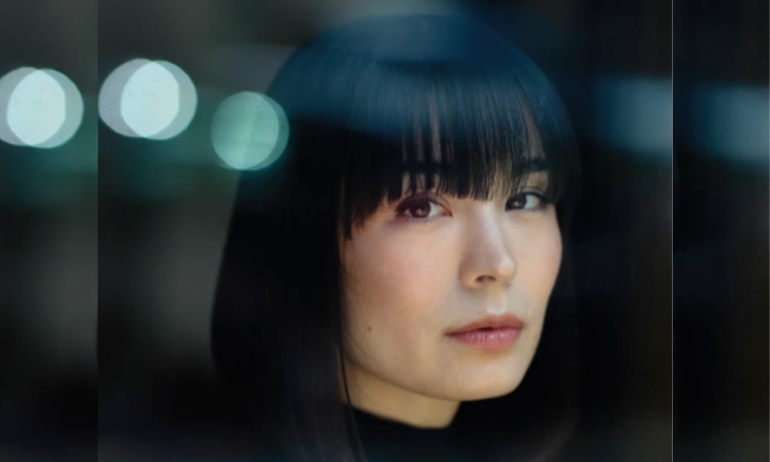

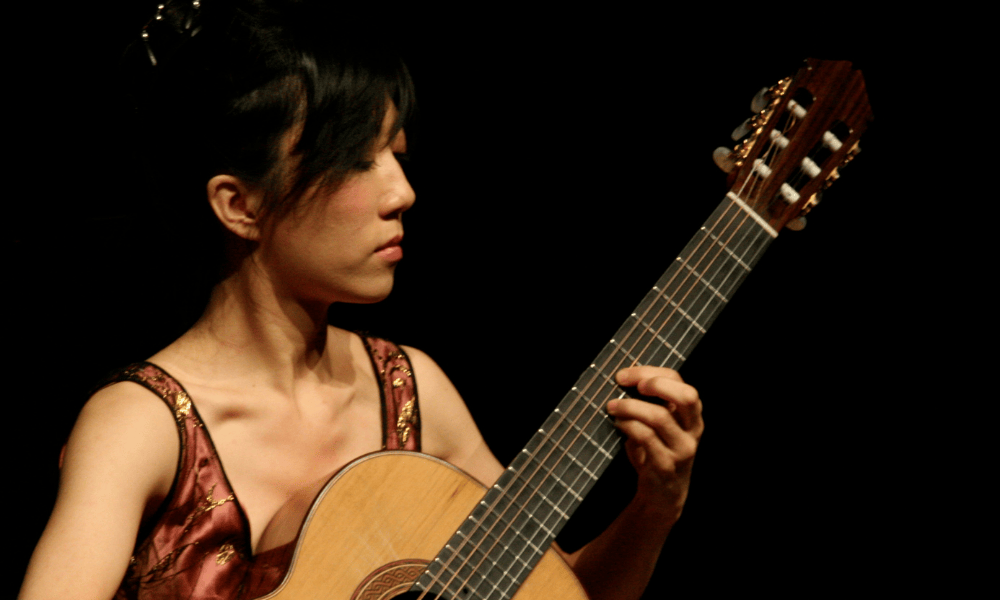
Renowned classical guitarist Xuefei Yang spoke with KGNU’s Sanford Baran ahead of her Colorado Music Festival debut on July 27, where she will perform Rodrigo’s Concerto de Aranjuez with the festival orchestra. Xuefei reflected on her deep personal connection to the piece, which she first played for the composer himself as a teenager in Madrid. She also discussed her new album, Chapeau Satie, which reimagines the works of Erik Satie for solo guitar, blending classical and cabaret influences. Xuefei spoke about bridging Eastern and Western traditions through music, her journey as a cultural ambassador, and her growing interest in composition and jazz-inspired pieces. Her upcoming performance in Boulder promises to be a moving highlight of this year’s festival.
Sanford: I’m delighted to welcome classical guitarist Xuefei Yang, who makes her Colorado Music Festival debut on July 27th, performing Rodrigo’s Concerto de Aranjuez with the Colorado Music Festival Orchestra. Xuefei’s remarkable journey as a pioneering guitarist who helped establish the classical guitar in China has made her one of classical music’s most compelling voices. She’s also just released her latest album, Chapeau Satie, featuring her innovative guitar arrangements of Eric Satie’s works. Xuefei, welcome!
Xuefei: Hello everyone! Hello Stanford! I’m really happy to speak to you.
Sanford: Well, you’re performing arguably the most famous guitar concerto ever written. What draws you to Rodrigo’s Concerto de Aranjuez?
Xuefei: Well, I remember the very first time when I heard the second movement, I was immediately drawn to this hauntingly beautiful, nostalgic, emotional music. And when I started learning the piece, it really fits, I mean, it fits so well on the guitar, but also it’s really, really difficult. So it really represents the instrument very well. I feel that Aranjuez is by far the best guitar concerto we have so far, and it’s just so satisfying playing it. Every time I play it, I perform it probably hundreds of times on the second movement, the whole concerto, I perform it at least a hundred times. Every time I play it, I have goosebumps and I have different feelings. When I play great works, I never feel bored of playing it, so I never feel bored of playing this piece.
Sanford: Well, you obviously have a beautiful relationship with the piece, and I understand a very personal connection to it as well.
Xuefei: Yeah. So when I was 14 years old, I gave my debut recital in Madrid. Rodrigo was coming to my concert. My teacher knew about it, but he didn’t want to tell me because he thought I would be nervous playing his piece in front of him. But I overheard his conversation with the interpreter, so I knew that Rodrigo was coming, and of course I was very nervous. But I got the opportunity to meet him. He was accompanied by his daughter, Cecilia, and I got the chance to shake hands with him. I had a few words. So ever since that encounter, I grew a special affinity playing his work. He was already very elderly, he was already in his nineties and rarely attends public concerts, so I was so honored to have that chance to meet him. It was really something really special for me. Also, I recorded this piece with Barcelona Symphony Orchestra, and after the recording session, I went to visit Cecilia, and I visited the Rodrigo Museum, basically that was the apartment he lived in, now it’s a museum, and I talked to Cecilia. She was saying Aranjuez is like her brother, the brother that she’s jealous of, having all the attention, you know. So all that, yes, all that personal stories really add to the emotional side when I’m playing this.
Sanford: What do you think the classical guitar offers that other instruments maybe don’t?
Xuefei: The intimacy. If you think about when you play the classical guitar, we use both arms, both legs, chest, basically the whole body to hold the guitar, and then the guitar is leaning on your heart. So it feels like you’re hugging the guitar, and the sound comes from your heart, and then you actually use your fingers, your flesh, and your nails, your body to touch the strings. So it’s really intimacy. It’s almost like the sound, right, comes from your body. Any other instruments you have to use as a bow, or mechanical media, or you have to hold it quite far away, I think guitar is the most intimate instrument, plus that it’s so portable. I mean, piano, you can play everything, but you cannot take it to the garden. I take guitar everywhere I go, even I go on holiday, I take guitar and play at the beach, or in the balcony, and you don’t need accompaniment. So the versatility, I think intimacy and versatility, for me, are the best qualities of guitar.
Sanford: Let’s talk about your new album, Chapeau Satie. What drew you to Eric Satie?
Xuefei: Well, at first, I played Satie’s famous Gymnopédies and the Nocyans, and they really actually suited to be played on guitar, because they’re short, they’re simple, they’re minimalistic, and they translate beautifully to solo guitar. But then I realized that this year marks the centenary of Satie’s death, and so I was digging into more repertoire, and I found out, actually, apart from this minimalistic style, he actually, a man of his time, he spent much of his time working and living in Montmartre, in Paris, which was the hub café culture, and he worked there as a musician, and he’s playing, and he worked with the star of the day, like singers, like Paulette Dati. So he wrote a number of popular cabaret songs as well. So they represent the other side of his style, so both the art music and the cabaret music. So I thought, oh, they actually suited to be played on the guitar. For example, the song we did, Je te veux, in English, it means I want you. It’s one of Satie’s most popular cabaret songs. It’s quite sensual, you know, even from the title, I want you. So to use the guitar, replace the piano, it just feels more tender, more sensual, and more romantic, just more feelings. And I think the sound of guitar just contributes to that kind of feeling. I’m very excited about this album. It’s like a reimagined Satie’s legacy on guitar.
Sanford: Your career has been about bridging Eastern and Western musical traditions. How do you see your role as a cultural ambassador?
Xuefei: I see that it’s very important for me, because I come from China, you know, the Chinese culture is in my blood. So playing Chinese music is almost like eating Chinese food or speaking Chinese language. It’s just so natural to me. But also, I find it’s very, I mean, I could say that I made those pieces sound natural on the guitar. But I find that the guitar is quite suited to play some of the Chinese works. Because you know, guitar ancestors are also from the Middle East, so kind of not too far from China. And also, there are a lot of Chinese plucked instruments. So I feel that I could, there are a lot of things from the Chinese plucked instruments, instrumental traditions, I could adapt, I could adapt their technique, I could adapt aesthetics of their playing and their approach. So a lot of things I could adapt. And also, I feel that having performed in more than 50 countries, sometimes I really feel the eagerness to play something from my own culture. I play music from everywhere, but I feel it’s very meaningful. And I feel partly my responsibility and partly my legacy to play something from my own culture. So I think a number of reasons made me feel like I need to do more Chinese music. So I’ve done the Sketches of China, but also I’ve done a more recent album called X-Culture, means Crossing Cultures. I feel like it’s important to embrace the other cultures other than our own culture. I feel that it’s something we really need in this time in the world. People need communication, I find that people are separated by different political views and all that stuff. But I think we need to communicate with each other about cultures, and then the culture brings people from different backgrounds together and brings people closer.
Sanford: How did you find mentors in China to develop your guitar technique?
Xuefei: Compared to the time I was studying in China, the environment got so much better now. I was the very first student to enter a music school and to study guitar, even though the Central Conservatory of Music didn’t have a guitar faculty, so I had to fight my way. But nowadays there are dozens of other major conservatories that have guitar faculty, there are many guitar students there. So the environment is very different. I guess that I’ve heard many times in China that the young students, they say to me that I have been the model, I have been the idol for them. They see me playing the guitar and I inspire them to pick up the guitar, or things like that. So I feel quite honored and touched that I am an inspiration for them. Because when I was studying guitar, I didn’t have such an idol in China. I mean, John Williams is my idol. But back then in China, there wasn’t any Chinese person, they’ve taken the path as a guitarist, so my parents really didn’t want me to take this path, they couldn’t see anybody. So I mean, I’m very happy and I’m very touched that when the younger people, they say that I’m like their idol. So I guess that maybe that’s the biggest influence I gave them.
Sanford: You have a lot on your plate, what with your new album and your American tour in August. But beyond that, what’s on the horizon for you musically?
Xuefei: Yes, I feel like I’m at my golden period. I feel that I’m not at my peak yet. I still feel that I still have more to offer. So I’m eager to see what more I can offer musically. I say that I have a wider interest of music, you know, I don’t want to put music in the pit and hole. So like this American tour coming up in August, I have a few kind of jazzy pieces in my program. I really love them. I mean, at first I thought that, oh, with the people thinking that I’m a classical trainer, can I play jazz piece? But in the end, I thought music is music, I love them. I’m not saying I’m a jazz musician, but why can’t I play them if I feel that I play them?
Sanford: And maybe even composition, composing your own works.
Xuefei: Yes, actually, that is the area I wanted to explore. I guess I’ve done one piece which I will play in my tour. But I wanted to do, that piece got a good response, so I would like to do more in the future. At first, I was a little bit hesitant because I thought that if I compose, there’s no chance I would be Beethoven. But then finally, I thought, that’s not the agenda, you know, nobody can be an ex-Beethoven, but it’s my voice. I feel that as a classical musician, we always play somebody else’s work. Of course, we play elite works filtered by time and that they’re written by the elite composers. But in a way, I kind of, I don’t need the pop musician, they play their own songs, whether they’re great or not great. But, you know, they write their own songs, which represent their own voices. So if I have something to say, why shouldn’t I write about them? So I thought that I would try more. And whether they’re going to be great or not great, I think that time will say that. Time will tell us which one will be good. Maybe some will be filtered by time, but I should try it if I do have a voice to say. So that is an area I want to try more.
Sanford: Xuefei, thank you so much for this delightful conversation. Your performance on July 27th of Rodrigo’s Concerto di Aranjuez at the Colorado Music Festival promises to be very special. And congratulations on your new album, Chapo Satie. So good to speak with you.
Xuefei: Thank you, Stanford. I really enjoyed speaking to you as well. Looking forward to my performance in Boulder.
Sanford: This is Sanford Baran for KGNU.