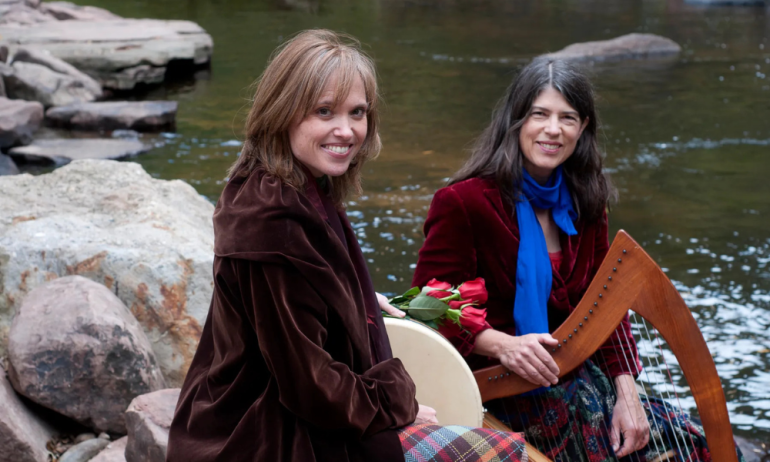

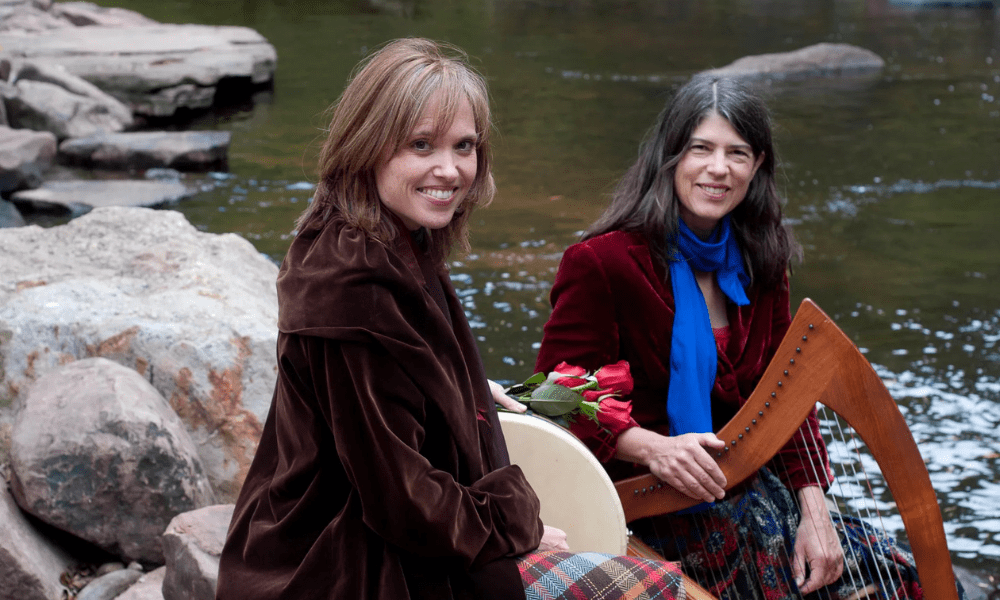
Fergus Stone welcomes musicians Beth Gadbaw and Margot Krimmel to KGNU for a conversation about Celtic music, harp traditions, and the stories behind their longtime musical partnership. The duo discusses Scottish mouth music, their inspirations, and how folk traditions connect people across cultures.
Gadbaw and Krimmel also share stories from their travels, their experiences as performers, and their upcoming show at Swallow Hill. They reflect on the joy, history, and community found through traditional music (Air Date 4/29/26).
Listen to the local gold here:
Transcript:
Fergus Stone: But first, we have in our Kabaret studio right now two entirely cherishable ladies. And not only that, but they are musicians. In fact, they’re gifted musicians, and George has them all set up and ready to go. So, ladies, can we hear a little bit of music from you? I think you’re ready now.
Fergus Stone: And there you have Beth Gadbaw and Margot Krimmel, the cherishable ladies I told you about. Tell me a little bit about the tune you just did, and then we’ll talk about what’s to come.
Beth Gadbaw and Margot Krimmel: Well, that song is called “Mouth Music,” and there’s a lot of mouth music in the Celtic tradition. That one specifically is from the Hebrides Islands off the west coast of Scotland.
A lot of Scottish mouth music was used when there wasn’t an instrument available and people wanted to dance. We learned that one from the singing of John Faulkner and Dolores Keane.
We want to pay a nice tribute to Dolores Keane, who just passed away recently. She was a very influential Irish singer and probably one of my first idols as a singer growing up enjoying Irish music. Their records as a duo are still inspiring.
Fergus Stone: Love to talk music, but first, let’s go to business. You two are performing tomorrow night, right? At Swallow Hill?
Beth Gadbaw and Margot Krimmel: Tomorrow night at Swallow Hill. The doors open at 7:00 and the show is at 8:00. We’re going to be joined by Marty Smith, who is a wonderful singer and a bouzouki player.
We’re looking forward to that show a lot. Swallow Hill is an old stomping ground of mine. I taught music there for a long time. Before that, when it was the Denver Folklore Center, I was there to see the changes and to see Swallow Hill grow out of that store. They’ve got a beautiful building and a great concert hall, and we’re really looking forward to it.
Fergus Stone: Seventy-four East Yale, I think is the address of Swallow Hill. Is that right?
Beth Gadbaw and Margot Krimmel: That sounds right.
Fergus Stone: You go down South Broadway until you get to Yale, and it’s right there on the northeast corner. There’s even parking right across the street.
I’ve enjoyed a lot of concerts in that place, and the Folklore Center was important to me over all these years as well.
Tell me this: You both have basically played music your whole lives, haven’t you? How did you meet each other and form White Birds?
Beth Gadbaw and Margot Krimmel: We met when Margot’s daughter was going to kindergarten. I had been over in Ireland and had just come back to live in Boulder, and I was teaching kindergarten music at a school. Margot’s daughter was in my class.
At the same time, I had a roommate when I was in Ireland who played Celtic harp, and I decided I was going to become a harp player. Margot teaches harp, so I started teaching her daughter, and she started teaching me.
We ended up finding that we had a lot of musical commonalities and aesthetic tendencies that went in the same direction. That was a long time ago. Three CDs later.
Fergus Stone: The harp is one of the earliest instruments, is it not? After the drum, I’m hard-put to come up with an instrument that has a longer history with the human race than the harp. Ancient Greek god Apollo played the harp or lyre, and it’s played all over the world in various versions, not just the Celtic lands.
You’ve both traveled a lot. What’s the most out-there place you’ve ever been, by which I mean the farthest from home in terms of location and culture?
Beth Gadbaw and Margot Krimmel: That’s a little bit of a tough one. With music, my performances have mostly gone into Europe and Ireland.
My daughter lives in Japan, so I’ve been there, and I’ve played my harp in Japan. The most fun I had there was connecting with a couple of Irish-Japanese musicians who played Irish music. We spent an afternoon playing with them, and it was a treat of a lifetime.
They were such great musicians, and I was so happy to be playing Irish music. Something that felt very comfortable in this really different culture. I love Japan, but it is a really different culture, and it felt so much like home to be playing Irish tunes.
I’m not Irish, neither are they, but the tunes are.
Fergus Stone: What about you, Beth?
Beth Gadbaw and Margot Krimmel: For me playing, it’s been Ireland and England. But having had the opportunity recently to go to Italy and hear music there, I always manage to find the Irish pub wherever we are.
Getting to go and sing in those pubs and listen to Irish music is magical. I love listening to the Italian mandolin player on the side of the street, too.
I was also moved recently when we went to Hawaii and heard an amazing ukulele player and singer. This world of folk music is so magical, tear-jerking, awe-inspiring, and such a bringer of joy.
It’s wonderful to share it, so thanks for having us and letting us do that.
Fergus Stone: In Ireland, of course, you can take the kids into the pub to hear the music.
Beth Gadbaw and Margot Krimmel: Oh, yeah.
Fergus Stone: How old are your kids?
Beth Gadbaw and Margot Krimmel: They’re in high school now. We have lots of fond memories as mothers, taking our kids to pubs and concerts and gigs and parties.
I still remember your daughter, that little body sitting behind that big harp, and my daughter sitting there too.
Fergus Stone: Last time I tried to take my kids into an Irish pub, we all turned around two steps inside the door because you couldn’t see the back wall for all the tobacco smoke.
Beth Gadbaw and Margot Krimmel: Oh, yeah.
Fergus Stone: They’ve changed now. Pubs are smoke-free.
Beth Gadbaw and Margot Krimmel: Everybody’s happy about that.
Fergus Stone: I watched the fiddler going in with the case under his arm and thought, “Okay, this is the place we want to go.”
Well, you guys have earned a lot of awards over the years. It’s not ordinary to play music and have people recognize you with awards. You’ve stuck with being musicians through all the vicissitudes of a music career, and I want to hear another tune from you.
Beth Gadbaw and Margot Krimmel: Sounds good.
Fergus Stone: Ladies and gentlemen, it’s Beth Gadbaw and Margot Krimmel, and they’re playing tomorrow night at Swallow Hill at 8:00. What’s this tune going to be?
Beth Gadbaw and Margot Krimmel: This tune is called “St. Bridget’s Choricle.” Margot recorded it on her solo record as a harp solo, and when I heard her playing it, I thought, “You know, that song needs some words.”
Not because the playing wasn’t perfect as it was, but it was so inspiring. I thought, “There’s a story in there.” Sure enough, this is another song from the Hebrides.
There’s a collection of Hebridean songs from the early part of the last century where both this song and “Mouth Music” came from. This story uses words I took from that book and made them fit with Margot’s perfect arrangement.
Fergus Stone: My wife is a big fan of Bridget. I’m sure she’ll be hanging on the radio at home.
Once again, Beth Gadbaw and Margot Krimmel here on KGNU.
Fergus Stone: Beautiful. Beth Gadbaw and Margot Krimmel appearing tomorrow night at Swallow Hill. We’ve got some announcements to make, but thank you, ladies. Thank you so much. We have to do this again sometime soon.