
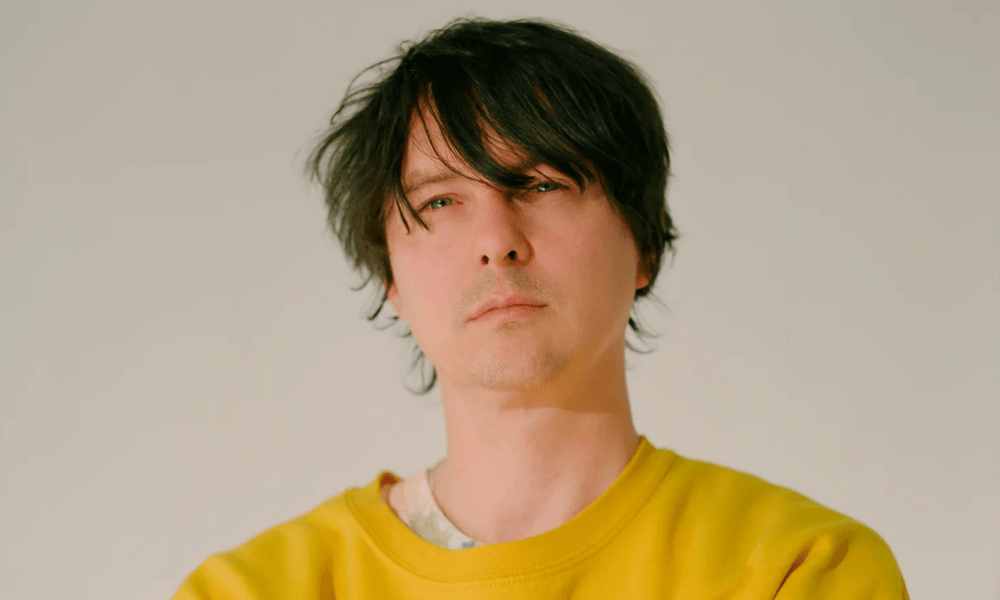
Smith talks with Noah Lennox this week, better known as Panda Bear, about his new album Sinister Grift, his first solo release in five years. Lennox reflects on his lifelong creative process, the joy of making music, and the collaborative role of his Animal Collective bandmates and his daughter on the record. He also discusses how life in Lisbon has shaped his work, the energy of touring with a full band, and the evolving nature of songs in live performance. Looking ahead to his Boulder Theater show on September 30, he promises a fresh set list each night that blends Sinister Grift tracks with reimagined favorites from his catalog.
Smith: You are listening to 88.5 KGNU. I’m B. Smith, and today we’re bringing you a conversation with one of the most influential voices in experimental pop. For over two decades, Noah Lennox—better known as Panda Bear—has shaped modern music both as a founding member of Animal Collective and through his acclaimed solo work.
From albums like Person Pitch and Panda Bear Meets the Grim Reaper to collaborations with Daft Punk, Solange, and Sonic Boom, his music has inspired generations of artists. This year, Panda Bear released Sinister Grift, his first solo album in five years—an inviting, deeply collaborative record featuring all of his Animal Collective bandmates alongside Cindy Lee and Rivka Ravi of Spirit of the Beehive.
I had the chance to talk with him about the making of the album, the collaborators who helped bring it to life, and what fans can expect from his live show in preparation for his performance at the Boulder Theater on September 30, presented by KGNU, Westword, and Paradise Found.
Here’s my interview with Panda Bear.
All right, Noah, welcome. Thank you so much for being here. I’m stoked to have you. You’ve been making music for over 20 years now, both with Animal Collective and as a solo artist. When you look back, what feels most consistent about your creative vision after all this time?
Noah Lennox: Oh, yeah. Thanks for having me, Brian. I’d say the thing that’s really stayed the same—which I think is why I keep coming back to it—is this routine part of my life. At this point, I’m not sure I’ll ever stop making stuff. I’m not sure I’ll release it forever, but I’m pretty sure I’ll be making it.
It’s this very specific sense of satisfaction I don’t experience in any other part of my life. That feeling when you’re working on something and the pieces kind of come together—or sometimes you have a moment where the song comes to life a little bit. There’s a really specific, pure sense of joy that comes from that.
Josh and I talked about it a lot while making this record. We kept noticing that feeling really hadn’t changed. It felt the same making Sinister Grift as it did when we were fooling around with the Tascam eight-track my family had—doing weird voices and just getting into recording. Appreciating how you made something from nothing. That specific joy really hasn’t changed in the hundred thousand years we’ve been doing this.
Smith: So was that something you had sitting around and then you and Josh said, “Hey, let’s play with this and see where it goes”? Or did you already have a sound in your head that led to using that as a tool for recording?
Noah Lennox: My parents actually had this really cool approach. Anytime they saw us getting into something, they would try to support it if they could. The eight-track Tascam was bought by my father, who noticed my brother, sister, and I were getting into music.
We had a Korg 01 in the house that I used to make little sequences and songs on. Once we had the recorder, I dove right into it. I was lucky to have both the means and parents who were supportive.
Smith: Shout out to all the cool parents who see the spark in their kids and encourage them. I know on Sinister Grift you had your daughter, Nadja, reciting a poem on one of the tracks. Was that reflective of your own upbringing?
Noah Lennox: Although she has no interest in making music or being a musician—she still hasn’t listened to the track—I wanted a spoken word part in the song, which had these big vocal refrains on either side.
There was a Louvin Brothers track I was inspired by for that song, but my first idea was Nadja. Before I asked her, I thought maybe Dean Blunt could do something, so I sent him the track. Ultimately, he wasn’t coming up with something he liked, so I went back to my original idea.
Despite it not being her thing, she approached it really professionally. I asked her to write three or four different pieces, and we chose the one that suited both the meter of the song and thematically fit with what I was singing. I was really proud of how she handled it.
Smith: That’s awesome. Let’s talk about Lisbon. You’ve lived there for nearly 20 years. How do you feel about the city, and how has it shaped your music?
Noah Lennox: It’s been just over 20 years. I still really love it here, despite the fact that it’s massively changed—people like me coming from the outside included. I admit I’m part of the problem.
When I first moved here, I had one American friend, Randy—also from Baltimore—and he was the only American I knew or talked to for 15 years. Now I can’t walk down the street without running into fellow expats. Places change all the time, everything’s in flux, but I still love it, even though the vibe is really different now.
Smith: Has that reflected in your music?
Noah Lennox: I’m sure it has, in ways that are hard to pin down. For example, it’s accurate to say Lisbon is a really sunny place, but I wouldn’t call Tomboy particularly sunny, and I made it here. The experiences I have, people I talk to, and places I visit all find their way into the music sooner or later—though often transformed in ways that are hard to trace.
Smith: Yeah. You’re in between tours now. You just wrapped up with Tour iis—we saw you at the Fillmore in May—and you’re embarking on another U.S. and Europe tour this fall. How’s it felt being back on the road with the full band?
Noah Lennox: Really good. It’s a very different beast than doing things solo. I’ve enjoyed it a lot. Everyone puts themselves into the songs, and they’ve taken on a character they didn’t have before. Beyond the communal aspect—just being around people I really like—the music has benefited a lot. I’ll be sorry to see it go, but everything has its time and place.
Smith: Yeah. Let’s talk about Sinister Grift. The album almost functions like a rock ensemble record, with guitars and drums at the forefront. How does the live band and the album come together in a live environment?
Noah Lennox: Halfway through recording, I knew I wanted to do it with a band. The record itself inspired that idea. I started with my arrangements and let everyone put themselves into it. Over time, the songs have grown and taken on slightly different characters. I really like the idea that a song is never finished—it just grows into another form.
Smith: I agree. Since art has a point where you have to stop and release it, live performance offers a way to revisit and evolve it. Do you ever find moments of inspiration while playing live?
Noah Lennox: Yeah, for sure. Maybe not a whole new angle, but definitely little changes. When someone does something different, it’s really exciting on stage.
Smith: Exciting for the audience too. Always fun to hear a little change from the album.
Noah Lennox: I hope so.
Smith: This album features all the members of Animal Collective across different tracks. How did you incorporate their voices?
Noah Lennox: Each in different ways. Josh was the most involved—he produced, engineered, and mixed it. His sensibility really informed the sound. Brian created sound packs for me—folders of basses, voices, noises—and his character shines through the sound design.
Once those two were on board, I wanted to find a place for Dave. On Ends Meet, I asked him for a noise solo, and he certainly delivered.
Smith: When it came to sequencing, some tracks felt like they ran together like a suite. Was that part of your vision or Josh’s production?
Noah Lennox: My favorite albums always feel like the sum is greater than the parts. I like when songs support each other or tell a bigger story. With this one, I wanted the sequence to have a story arc or narrative.
Smith: The sound has been a summer soundtrack for me. There are comparisons out there to Brian Wilson or Van Dyke Parks. How do you feel about that?
Noah Lennox: I’m definitely a big fan of both. Their vocal arrangements, along with influences like the Louvin Brothers, classic rock, reggae rhythms—all of that inspires me.
Smith: I agree. When I gave the album its first listen, every track felt fresh. That’s what keeps fans coming back. Your work has influenced so many younger bands. Do you notice that generational ripple? What newer bands have caught your ear?
Noah Lennox: I really like the Cameron Winter record this year. The Nourished by Time record too—we toured with Toro y Moi around March and I loved those songs. There’s a London band called Good Sad Happy Bad, formerly Micachu and the Shapes, that I’m a big fan of.
I like to keep an eye on contemporary stuff. I don’t know if it’s warranted, but I like to think I’m in conversation with it.
Smith: What’s the music scene like in Lisbon?
Noah Lennox: There are a lot of different things happening. Maria and Tomé, who play in my band, are part of a circle called Kafe that’s been around since I moved here. There’s also the Príncipe label doing electronic stuff—they’ve gotten a lot of attention internationally.
Smith: Well, Noah, I really appreciate your time. You’re playing the Boulder Theater on September 30, and we’re excited. What can the Boulder crowd expect?
Noah Lennox: We do a new set list every night—rotating who writes it—so it’s hard to say exactly. We’ve got about three sets worth of material, and we’ve added some new old ones we hadn’t played before. I’d wager it’ll be a mix—maybe not 50/50 Sinister Grift and older stuff, but close. It depends on who writes the set list that night.
Smith: That’s so cool. New set list every night—September 30 at the Boulder Theater, Noah and his band, aka Panda Bear, will be stopping by. Noah, thank you so much for calling in today.
Noah Lennox: Thanks, Brian. I really appreciate your time. We’re all really looking forward to the show.
B. Smith: Great. Thank you.