
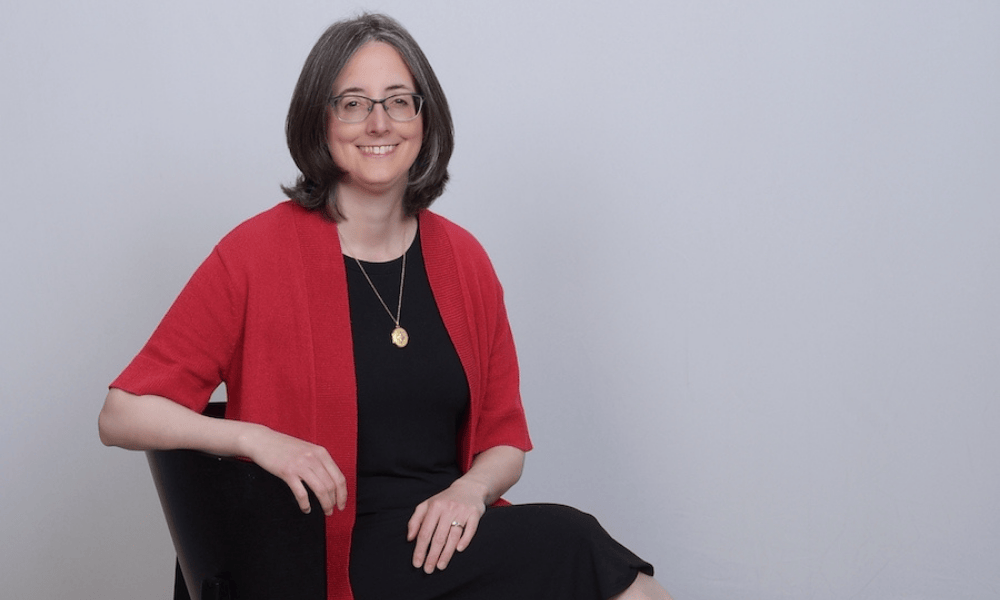
On September 1’s edition of A Classic Monday, Iris Berkeley speaks with Denver composer Loretta Notareschi, who is among the composers highlighted at a chamber music concert titled “Within Reach: New Music from Denver and Beyond” September 15 at Regis University.
Iris Berkeley: So happy to have Denver-based composer Loretta Notareschi in advance of a performance featuring one of her works, taking place Monday, September 15th at Regis University’s Peter Claver Recital Hall. The concert is entitled Within Reach: New Music from Denver and Beyond. She has a work on the program entitled Scourge Songs. She’s also sharing the program with two other local composers, Bob Bassett and retired physician Michael Frank, as well as new music from Andrea Ziyi. Performers include the Wild Beautiful Orchestra and Chad Reagan of the Central City Opera Touring and Teaching Artists. We have a lot to talk about. Welcome, Loretta.
Loretta Notareschi: Thank you so much for having me.
Iris Berkeley: Thank you. And thank you for joining us on a holiday to talk about this upcoming performance. There’s so much on this program—new works from four composers, referencing some really beautiful and profound poetic texts, and 11 instrumentalists. It’s a lot for a really diverse chamber music setting. How did this program come together?
Loretta Notareschi: Yeah, it is quite a program. I’ve been putting together the program document and organizing all the pieces, which has been quite a task. The program came together because Michael Frank and Bob Bassett are former students of mine and fellow composers. Andrea Ziyi is a composer that Michael knew. A couple of years ago we put on a concert with the Wild Beautiful Orchestra, and earlier this year we got in touch and said, “Let’s do it again.”
Iris Berkeley: That’s fantastic to have those connections to draw on. It sounds like you’re in familiar territory, but there are also some profound topics being held up to the light in these works. Your own piece on this program, Scourge Songs, draws on poetry about the pandemic. I think I’ve got this right—you collaborated with poet Elise Nora, who’s also on the Regis University faculty with you?
Loretta Notareschi: That’s right. Elise is a colleague of mine at Regis and we’ve done several projects together. This was one of the first few, based on poetry about the pandemic. Elise creates powerful imagery in her words that really bring to light the different aspects of that time.
Iris Berkeley: And now, fall of 2025 and everything that comes with it—how does it feel to present a work about the pandemic from today’s standpoint?
Loretta Notareschi: It feels really poignant and meaningful. I just had a conversation with Chad Reagan, the baritone soloist for this performance. We were remembering difficult conversations with people about the controversy around vaccines and thinking about the people we knew who died during the pandemic. Even though it feels “over,” it’s still very much with us.
Iris Berkeley: Right. And you’re also recasting this with a different voice, correct? It was originally written for solo soprano?
Loretta Notareschi: Yes, originally for mezzo-soprano. When I published it, I thought it would also work well with baritone. I didn’t have an opportunity in the first couple of years to perform it that way, but when this concert came up, I said, “Let’s do it with baritone.” So this will be the premiere of that version.
Iris Berkeley: That’s fantastic. We’re going to hear a recording of it in a few minutes. Who’s the soloist on that recording?
Loretta Notareschi: That’s Sarah Perske with the Nebula Ensemble, a Denver-based new music group. We recorded it last summer and released it in February of last year. It was wonderful to work with those musicians. We also made a video, which is available on YouTube, with the lyrics as subtitles so that Elise’s beautiful words can be seen.
Iris Berkeley: That’s wonderful. How did that workflow come about—working with a poet you already knew and had collaborated with in the past?
Loretta Notareschi: Elise and I like to sit together and brainstorm first before anything goes on the page. In this case, Nebula Ensemble said, “We’re going to do a concert on the pandemic, why don’t you write a piece for it?” I said, “I’d like to work with Elise.” She likes to write a lot, so she wrote about eight poems, of which I selected five. She always says, “I like to give you more than you can use.” Musical time is slower than poetic time—you can’t always use every word a poet writes. So she and I worked closely to refine the text as it went into the music.
Iris Berkeley: “Musical time is slower than poetic time.” I love that. That’s a wonderful way of looking at it. Let’s back up a little bit on your background, because you’ve written for some really diverse ensembles—everything from full orchestra to string quartet to classical ukulele. Through all of that is a desire to connect with audiences. How does your choice of instrumentation help foster that emotional connection?
Loretta Notareschi: I think the first and most important audience is the performer. I always try to craft my music for the performer first. I like to work with performers from many different backgrounds—sometimes amateurs, sometimes professionals. I want to connect with that player, what they like to do on their instrument, what feels graceful and natural. If you connect with the performer, you’ll connect with the audience too.
Iris Berkeley: Absolutely. You mentioned earlier that some of the other composers on the program were your students.
Loretta Notareschi: Yes. For example, Dr. Michael Frank and I met at our church. He said he wanted to learn a little about music—he’d been a longtime songwriter. I said, “Let’s sit down and learn a little.” Then he wanted to learn more, so I suggested he take classes at Regis. He ended up pursuing a second bachelor’s degree in music composition in his sixties. That was a great model for younger undergraduates, showing lifelong learning. He’s launched into composing his own works, and he’ll have two on this program.
Iris Berkeley: Anything we should know about those?
Loretta Notareschi: One is Do Not Go Gentle into That Good Night, a choral and small ensemble setting of Dylan Thomas’s poem. It’s about not going gently into death. Continuing with the theme of depth in this program, we’ll have pieces about death, memorial, hope, Martin Luther King Jr., and the pandemic. It will be a wide-ranging set.
Iris Berkeley: It sounds like the right time for that diversity, especially with the connections you’ve made. The Front Range classical scene can be a small world. I saw you referencing clarinetist Brian Ebert, who I remember seeing perform years ago. What is it like coming together in that sort of fellowship, especially with so much deep meaning in these compositions?
Loretta Notareschi: A lot of the composers on the program are connected with poet Frank Clark, who is also a physician. He’s a psychiatrist and a poet, and several pieces include his poetry through his connection with Michael Frank. Two of his poems deal with school shootings, which we’re all unfortunately thinking about again after the recent Minnesota tragedy. Frank responds deeply to current events as well as autobiographical parts of his life, so we’re very lucky his poetry will be part of the program. He’ll also be with us that evening.
Iris Berkeley: You bring up an interesting point about biography informing art. For my curiosity—your biography reads like I’d need a couple of passports to follow along. Were you originally a violinist?
Loretta Notareschi: I started out singing as a child in a group called the Sunshine Singers, then moved to piano and violin. For a while I was quite serious about violin and thought I’d major in it. But at a summer camp I took composition as an elective and discovered that was my true passion.
Iris Berkeley: You grew up in Ohio and Oklahoma, then studied at Berkeley, the Kodály Institute in Hungary, and were a Fulbright scholar. How has seeing such a broad slice of the world informed your work?
Loretta Notareschi: I’ve been lucky to hear fantastic music around the world. In Hungary I studied with wonderful choral conductors who emphasized both theory and beautiful singing. At UC Berkeley I heard cutting-edge new music. Every summer I teach at the Walden School in New Hampshire, where I hear the latest work from young and established composers. Traveling and listening keeps my ears open.
Iris Berkeley: And there will be a lot of folks in residence at this performance on the 15th, plus a pre-concert talk?
Loretta Notareschi: Yes, we’ll speak about the music and poetry at 6:30 p.m., before the concert.
Iris Berkeley: Before we hear your piece, one more question: is there anything you’d like listeners to know as they arrive at Regis?
Loretta Notareschi: I’d say come with open ears. These are all either brand-new pieces or, like mine, presented in a new form. We composers and poets hope audiences bring open minds and let us know how the music sounds. Nobody’s heard this music before.
Iris Berkeley: What’s that like for you?
Loretta Notareschi: It’s always exciting. I feel mostly gratitude for the performers, who are putting in so much work. I’m also eager to hear the other pieces once we begin rehearsals.
Iris Berkeley: Wonderful. Before I let you go, can you tell us a little about the work we’re about to hear?
Loretta Notareschi: Yes, Scourge Songs is in five movements. Each poem reflects a different perspective on the pandemic. The first is the patient, who begins by doubting the virus is real and ends up in the hospital. The second is from the daughter of a dying patient. The third is from the planet itself, about the environmental restoration that occurred during lockdowns. Then comes the doctor, and finally, the friend. The piece ends with a meditation that reflects the fact that even though the pandemic feels past, COVID is still with us—and the music fades away rather than stopping abruptly.
Iris Berkeley: Thank you so much. We’ll hear all five movements of Scourge Songs by Loretta Notareschi, performed by the Nebula Ensemble. You can also hear it live Monday, September 15th at Regis University in a program called Within Reach: New Music from Denver and Beyond. Loretta, thank you for your time today, especially on the holiday.
Loretta Notareschi: Thank you. I really appreciate it. Have a great night.
Iris Berkeley: You too.