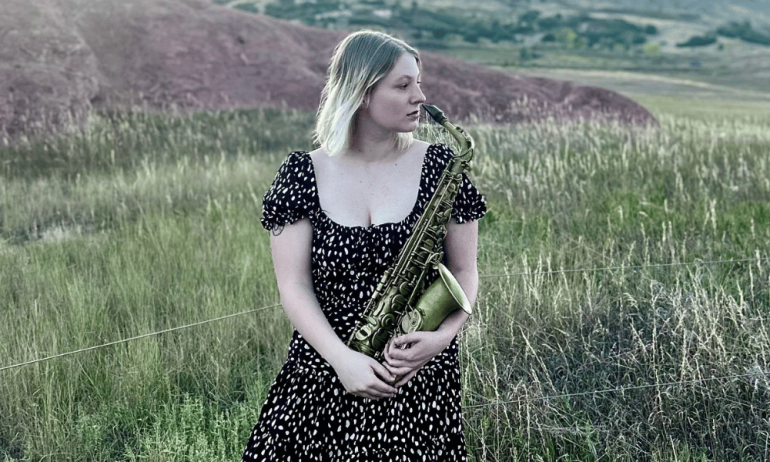

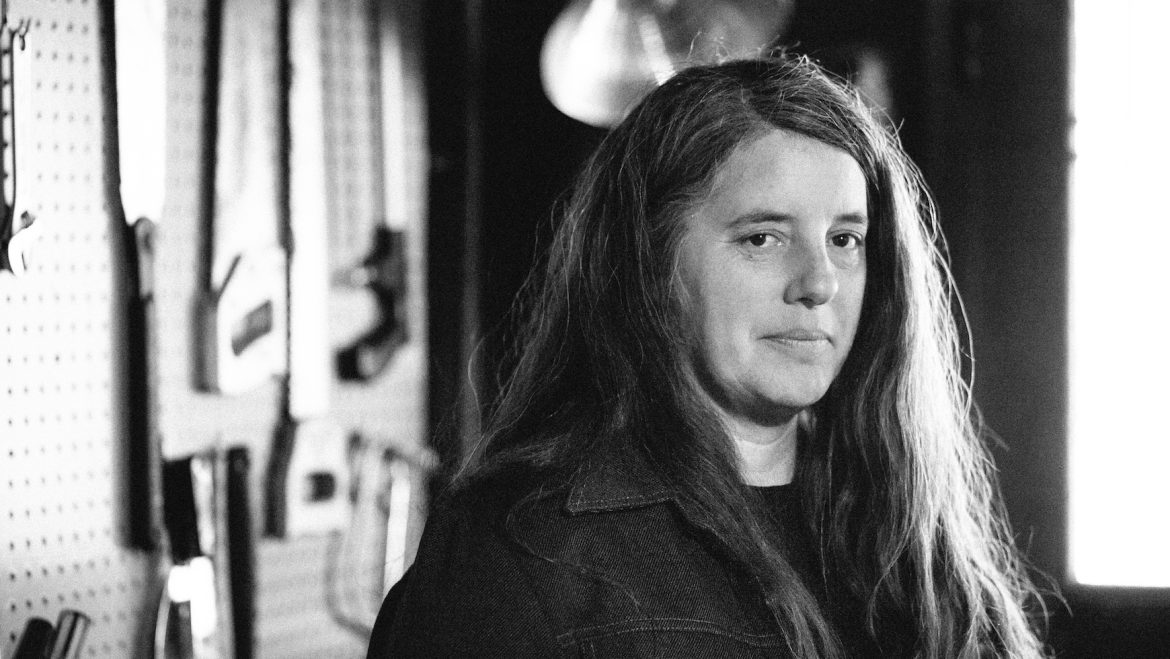
KGNU’s Indra Raj speaks with Portland-based guitarist and composer Marisa Anderson, known for her striking blend of American roots traditions and experimental textures. In this conversation, Anderson reflects on her evolving relationship with the guitar, the influences that have shaped her sound, and her upcoming solo performance at The Savoy in Denver on Thursday, October 23, part of the MAS Presents fall lineup.
Indra Raj: This is KGNU Community Radio, and my name is Indra Raj. My guest is guitarist and composer Marisa Anderson, a singular force in contemporary instrumental music based in Portland, Oregon. She blends American roots traditions—blues, folk, gospel, and country—with experimental textures and cinematic scope.
Her acclaimed albums showcase her unmistakable guitar voice, and her collaborations with artists like Jim White, Luke Schneider, and William Tyler have expanded her sound even further, earning her praise as one of the most distinctive guitarists of her generation. Marisa Anderson will perform at The Savoy in Denver on Thursday, October 23, as part of the MAS Presents fall lineup.
Welcome to KGNU, Marisa.
Marisa Anderson: Thanks. Thanks for having me.
Indra: It’s great to have you here. For folks who may not be familiar with you or your music, how did your journey in music begin—especially as a guitarist?
Marisa: I like to think that I’ve learned to play guitar three different times in my life. I started when I was about ten, taking classical guitar lessons. I grew up in a small town—there was a guitar teacher, and that’s what he taught. So for eight or nine years, that’s all I knew how to do: read notes off the page, play etudes and arpeggios, Scarlatti pieces… I learned a lot that way.
Then I went to college for a year, and everyone there was playing folk songs—Neil Young, Bob Marley, Bob Dylan—and I thought, how do you do that? I’d been playing for years but didn’t know that world at all. I dropped out, started traveling, and ended up taking lessons with Nina Gerber, a guitarist from the Bay Area. She taught me how to improvise within songs—folk and country, not jazz. That was the second time I learned guitar, because it was a completely different mindset.
The third time was when I left standard tuning about fifteen years ago. I’ve been playing in my own tuning since around 2010. That meant relearning the neck completely. My classical training gave me technique and body awareness—good habits to know how to break. Improvising taught me how to have a dialogue with my sound. My solo work is a hybrid of both—I have songs with beginnings and endings, but in the middle, they can take the path they need to take.
Indra: I love that. Can you recall what you were listening to during those three stages of learning?
Marisa: When I was young, my mom only listened to classical music—mostly Baroque, lots of Bach. My dad listened to country music, and I went to church, so hymns really found their way into my soul. Later I realized country comes from gospel, so it makes sense those were connected for me.
When I started learning folk and roots styles, Reverend Gary Davis was a huge influence—his combination of melody and rhythm is like Bach to me. I got into him through Jorma Kaukonen, then discovered Pop Staples—his tone and clarity are incredible. My dad had some Staple Singers records, and I eventually realized just how brilliant that guitar sound was.
I also have to mention Ali Farka Touré and Joseph Spence. Hearing Ali Farka Touré on a cassette when I was 19 transported me—it was holy music. And finding a Joseph Spence record years later through Eric Isaacson from Mississippi Records actually started a lifelong friendship.
Indra: That’s such a beautiful connection between your influences. You mentioned your tuning—do you always use the same one?
Marisa: My standard tuning is DADF#AD, open D. I’ll move it a step in either direction for certain songs, but that’s home for me. It works well as a solo player because it allows notes to sustain as my hands move. That sustain is also why I play electric guitar. I like notes to ring in the air.
Indra: Do you ever return to standard tuning?
Marisa: Only if I have to—like when playing with others who need to follow my hands or read charts. But for solo work, I’m almost never in standard tuning anymore.
Indra: As KGNU’s music director, I’ve noticed more instrumental, ambient, and experimental music emerging—especially in independent and underground spaces. You’ve been in this world a long time. What have you noticed about how that scene has evolved?
Marisa: That’s a great question. It’s interesting—you’re in Colorado, and a lot of the roots of that scene branch out from here. One of the first instrumental folk recordings I heard involved players like Sam Bush. Colorado has long been a hub for musicians experimenting with acoustic instruments and traditional forms—whether it’s bluegrass, country, or jam bands.
If you go back to the Grateful Dead, they were blending traditional music with improvisation. I saw them in the ’80s, and it was my first exposure to improvised music—it blew my mind. In the ’90s, artists like Mazzy Star and Gillian Welch carried that slower, softer, more introspective style forward. Then you have the influence of Brian Eno and ambient music. By the internet era, those worlds naturally started blending.
Indra: You also do a lot of collaborations. How does that shape your creative process?
Marisa: It depends on the collaboration. With Jim White, our sets are completely improvised. We don’t rehearse—we just talk about life before the show, then play for an hour. It’s a musical conversation. I also do a four-hour improvised show every year in Portland, and I recently did a two-hour solo version of that in Norway. It’s about activating a space, letting people come and go, and breathing with the sound.
I also play with Tara Jane O’Neil—our work is more song-based but still improvisational. I love what I call “decorating songs,” finding little spaces to add shine. I did a couple shows with Charlie Parr recently in that same spirit.
Indra: That’s such a great phrase—“decorating songs.” You’ll be performing solo at The Savoy, right?
Marisa: Yes, it’ll be a solo set. I have a set list, but the songs can meander. I’ve also been working on a new project based on an archive I’ve been studying for the past two and a half years—music from countries the U.S. has been in conflict with during my lifetime. I’ve been studying music from Southeast Asia, the former USSR, and the Islamic and Arabic worlds. I’ll perform four pieces from that project.
Indra: That sounds fascinating. Thank you so much, Marisa Anderson. Again, Marisa will perform at The Savoy in Denver on Thursday, October 23, as part of the MAS Presents fall lineup. Thanks for joining us on KGNU.
Marisa: Thanks for having me.