
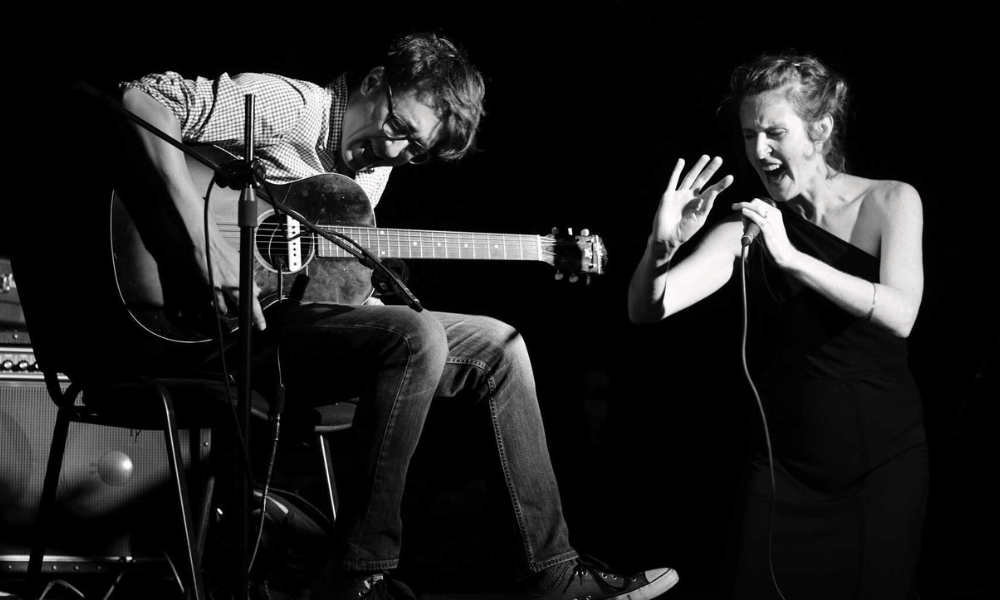
At the Big Ears Music Festival, KGNU’s Monte Dube spoke with Dalava co-creators Julia Úlehla and Aram Bajakian about their deeply personal, genre-blurring project rooted in Czech and Armenian heritage, ancestral song traditions, and experimental improvisation. They also discussed their latest album Understories, shaped by pandemic-era reflection, mythology, and a shared belief in music as a living, evolving practice of memory, descent, and renewal. (March 2026)
Monte Dube: This is Monte Dube coming to you from beautiful Knoxville, Tennessee, where we are on the fourth morning of the four-day Big Ears Music Festival. I am so pleased this morning to be joined by Julia Úlehla and Aram Bajakian, co-creators of the musical ensemble Dalava. They released their third album last year, Understories, and we’ll definitely talk about that—but there’s also so much to explore in each of your individual origin stories and your work together.
Spoiler alert: Julia and Aram are husband and wife, co-creators, and parents of two daughters. So let’s get into it.
We’ll start with Julia, then go to Aram, and then come back together. Julia, why don’t you talk about your origin story?
Julia Úlehla: My origin story and my creative origin story are deeply entangled. My father came as a refugee from Communist Czechoslovakia to Windsor, Ontario in 1968, right after the Russian invasion. He worked at Kmart, scrubbed toilets, arrived with $7, and eventually had friends in Houston who helped him get into a physics program at university.
He made his way to the U.S. and met my mother in a French class—she was from Dallas. I was actually born in Knoxville.
Monte Dube: How did that happen?
Julia Úlehla: My father went to MIT for his PhD, and his first job was in Knoxville. By total chance, Big Ears is here in Knoxville too, so this has felt like a layered homecoming in many ways.
When I was expecting our first daughter, I came across a book called Giva Sen, written by my great-grandfather. In it, he transcribed folk songs from his childhood village in what is now Czechia. He wrote them down in Western musical notation when he was 18 and continued for four years.
He was a plant physiologist and ecologist, but he believed songs were living beings. As a child, he would hear people singing across fields while working, and that experience shaped his sense that songs emanated from the land itself.
The book was suppressed during the Communist era and later reprinted in 2008. My grandmother sent me a copy, and it contains over 300 melodies—songs I can still trace to my ancestors. When Aram and I were expecting our baby in New York, we started Dalava.
We wanted to be at home with our child while still creating, so we began asking: what is a living song? How do you know if a song is alive? Can it remain alive after cultural rupture?
Monte Dube: Were you multilingual growing up? Did you speak Czech?
Julia Úlehla: I’m still embarrassed by how bad my Czech is. I’m not fluent. I mostly heard it when my father spoke with family. My mother isn’t Czech, and often the language you grow up with most is the one your mother speaks.
We started visiting Czechia in 1983, so I have the sound of it and some sense of it in my body, but I’m not fluent.
Aram Bajakian: Julia is very humble, but she speaks German and Italian as well.
Julia Úlehla: I really don’t, not nearly as well as he says.
Monte Dube: You studied classically?
Julia Úlehla: Yes, at Eastman. I went to Stanford not knowing what I would study, and then discovered I had a large operatic voice. I became an opera singer professionally after Eastman.
Then I saw a laboratory theater company in Italy and was so struck by their work that I auditioned, joined, and worked as an actress in Italy until I got pregnant.
Monte Dube: So you met in Italy?
Julia Úlehla: No, we met when we were 15.
Monte Dube: Aram, you’re also a child of immigrants?
Aram Bajakian: Yes. My family is Armenian. I grew up in Massachusetts, hearing Armenian spoken but never formally learning it. I’m only now taking lessons in Western Armenian.
I started guitar at age 10 and was also drawn to Armenian oud music, which I now practice more than guitar.
In college at UMass Amherst, I studied with Yusef Lateef. I noticed a strong Armenian presence in experimental music, which became part of my PhD research—experimentalism in the Armenian diaspora.
Monte Dube: What an experience studying with Yusef Lateef.
Aram Bajakian: Yes. I did a project called Diy Formations, inspired by Lateef’s work on scales and melodic patterns. I used those pitch sets to create long-form meditative pieces, but I didn’t want it to sound like traditional jazz.
Monte Dube: Your first album was Kef.
Aram Bajakian: Yes, on Tzadik Records. Kef music is Armenian American dance music with complex rhythms like 10/8 and 7/8. I wanted to reinterpret it in a more punk-influenced way.
Monte Dube: And John Zorn is here at Big Ears.
Aram Bajakian: Yes, performing multiple shows.
Monte Dube: On Kef, did Julia’s sister do the artwork?
Aram Bajakian: Yes, she did.
Monte Dube: And Lou Reed was a major influence for you.
Aram Bajakian: Yes. I actually played guitar with him later in life. I didn’t grow up deeply familiar with his music, which I think allowed me to approach it fresh and not be starstruck.
Monte Dube: You’ve said you like to “mess up” music.
Aram Bajakian: I’ve always been drawn to making unusual sounds. As a kid, I would put a guitar in front of a fan and listen to the overtones. I was just experimenting without knowing anyone else was doing similar things.
Musicians are like magicians—we work with sound that appears and disappears. That’s part of what I love.
Monte Dube: Julia, would you say Aram is a punk?
Julia Úlehla: Yes, he pushes things constantly.
Aram Bajakian: Even last night on tour I changed instruments mid-set just to see what would happen.
Monte Dube: One last question before we get to Dalava: your album There Were Flowers Also in Hell—where does that title come from?
Aram Bajakian: It comes from a William Carlos Williams poem. It’s about a life lived through difficulty, but still containing beauty. That idea stayed with me for years.
Monte Dube: And “asphodel” is associated with the underworld, right?
Julia Úlehla: Yes.
Monte Dube: Which feels like it foreshadows Understories.
Julia Úlehla: Yes, I never made that connection before.
Monte Dube: There are songs about motherhood, including “Medicaid Lullaby.”
Aram Bajakian: Yes. That song came from our experience with the U.S. healthcare system during Julia’s pregnancy. It’s a political piece, but also very tender.
Julia Úlehla: We recently visited the hospital where we gave birth while on Medicaid, and it was very emotional—painful and beautiful at the same time.
Aram Bajakian: And Lou Tone is also a tribute to Lou Reed’s sound world and his use of pedals.
Monte Dube: Julia, what does Dalava mean?
Julia Úlehla: It’s a Czech word describing a blurred horizon where sky and land meet and you can’t distinguish between them. It felt like a perfect metaphor for this project—something fluid, distant, and unresolved.
Monte Dube: There’s a sense in your work of ancestry and excavation.
Julia Úlehla: We all carry lineage. We’re just exploring it more directly in our work.
These songs are everything—joy, pain, longing, love. They teach us how to be in relationship with the world, including the more-than-human world.
Monte Dube: It feels almost alchemical.
Julia Úlehla: Yes, it is.
Monte Dube: The new album feels mythic—almost like a descent and return.
Julia Úlehla: Yes. We recorded it during COVID, during a time of grief, isolation, and reflection. At first I thought it was too dark to release, but later I realized it’s not darkness—it’s descent.
And descent is part of renewal. In myth—Persephone, Orpheus—you go down, and something new is found there.
Monte Dube: It’s a resurrection.
Julia Úlehla: Yes. It comes back up transformed.
Monte Dube: What’s next for Dalava?
Aram Bajakian: We’re realizing we could just keep working with these songs indefinitely. They keep changing.
Julia Úlehla: Each performance is different. We improvise more and more, and the songs become seeds that grow into ecosystems of sound.
Aram Bajakian: It’s deeply improvisational now—different every night.
Monte Dube: Julia, it feels like you’re channeling your great-grandfather’s spirit.
Julia Úlehla: Yes, it feels like a devotional practice. I often feel like the music is coming through me rather than from me.
Monte Dube: Thank you both so much. It’s been a joy discovering your work.
Julia Úlehla: Thank you. These were very thoughtful questions.
Monte Dube: Thank you.