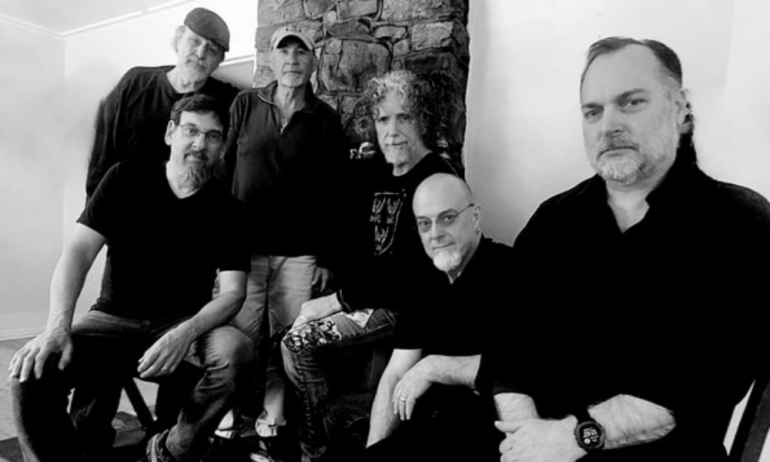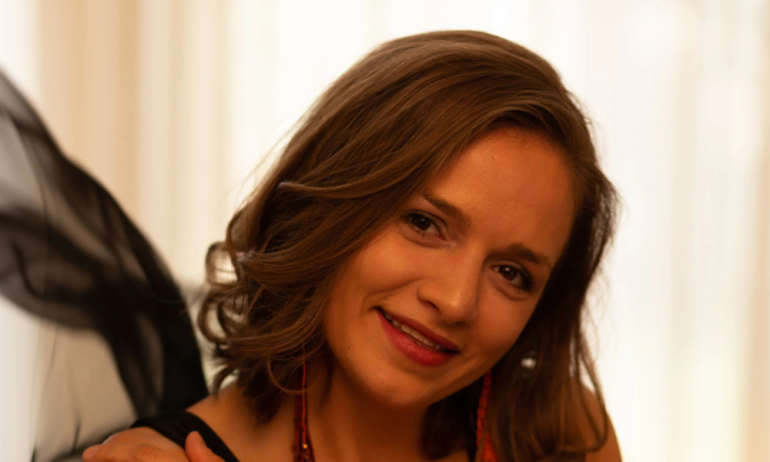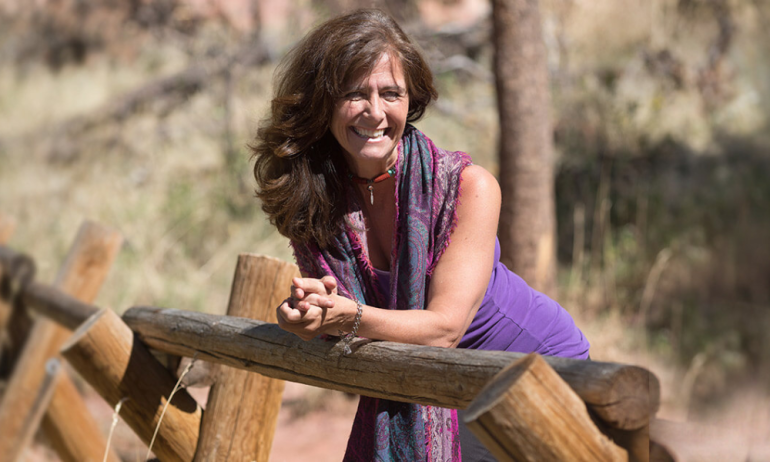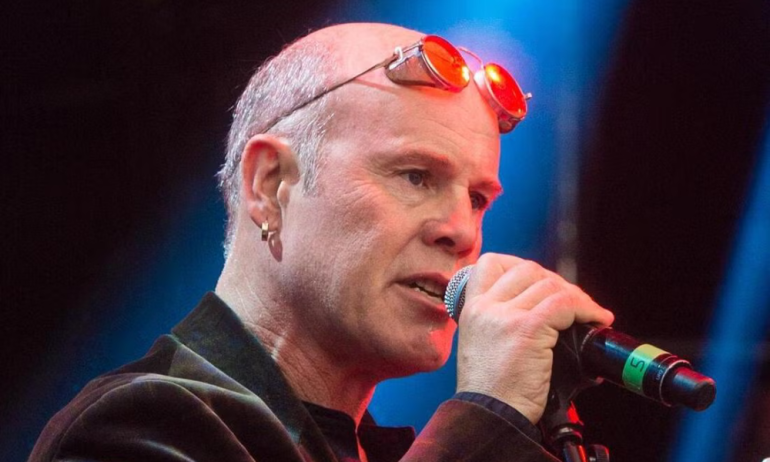

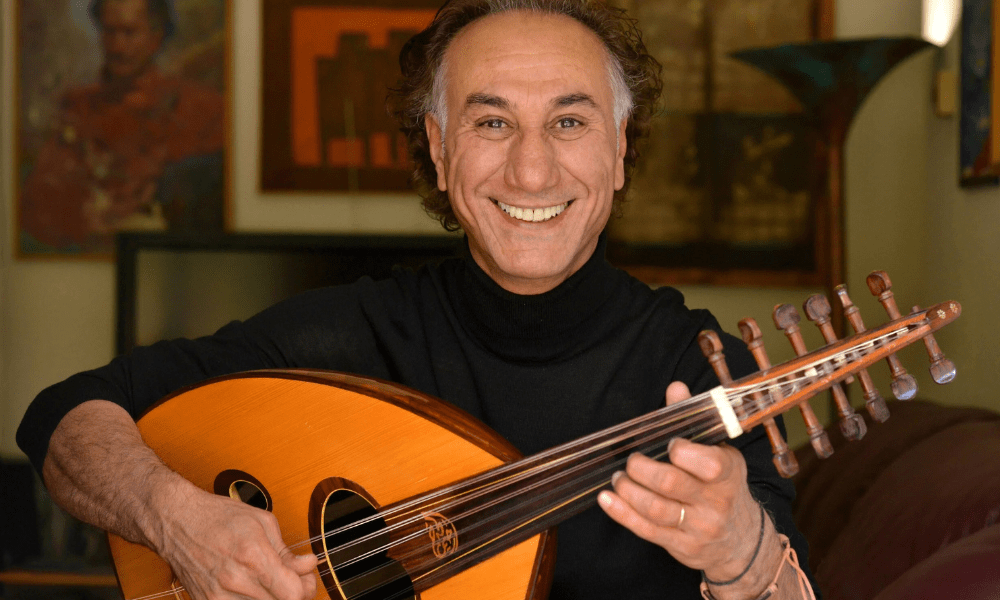
Master oud player Rahim AlHaj joins EC Erb to discuss his lifelong journey of using music as a bridge across cultures and conflicts. From his Grammy-nominated collaboration Ancient Sounds with Amjad Ali Khan to his latest album One Sky with Sourena Sefati, AlHaj reflects on how music expresses shared humanity, connects people beyond borders, and keeps stories of compassion and resilience alive. He performs November 13 at the Savoy in Denver, presented by MAS. (Air date: 11/12/2025)
Rahim AlHaj Interview – November 9, 2025
EC Erb: It’s my pleasure to welcome back to the KGNU Airwaves Master Oud Player Rahim al-Haj.
Rahim al-Haj: It’s been a while, so thank you for having me. I really appreciate it. It is really great.
EC Erb: And our paths have crossed through the years. We’ve got so many mutual connections.
Rahim al-Haj: You know, that’s one of the great things about music, really. It just connects people from around the world. And actually, I would say it all the time that music has the most channels to connect people. It’s an incredible way of connecting people. I mean, you’re talking about cinema maybe, but music is always available in our life, in our home, in our car, in our ear—you’re always there.
EC Erb: Tell me a bit about meeting Amjad Ali Khan and recording the Grammy-nominated album Ancient Sounds.
Rahim al-Haj: Twenty-six years ago, when I arrived in the United States, in New Mexico, Amjad Ali Khan, the famous Sarod player, was told, “There’s an Iraqi musician who just arrived two or three months ago, but he doesn’t speak English.” And he said, “Wow, can I meet him? Can I see him?” Then they called me and I came in. I didn’t speak English. We recorded the record—that was in 2000—and when I heard it, I said, whoa, that’s such beautiful music.
EC Erb: Your last recording is One Sky with Sourena Sefati, and this is who you’ll be performing with in Denver. How did this collaboration come about?
Rahim al-Haj: You remember when Bush said there is an “axis of evil”? I said to myself, hmm, that’s interesting. How about bringing musicians from North Korea, from Iraq, and from Iran, and composing music to show our humanity? We are human beings—we are not the axis of evil. No, we are like anybody else on this planet. And I called the group Axis of Evil, the band. We recorded the record, and Smithsonian took it. They said, “Hey Rahim, Axis of Evil is a difficult title. Would it be possible to change the name?” I said, “No, it’s perfect.” Eventually, I agreed, and we did the record.
It’s about recognizing our humanity and how music has the power and capacity to unite us, not divide us. That’s such a beautiful feeling. In fact, I remember composing a piece when I was sixteen, during the Iraq–Iran War. I specifically chose an Iranian maqam called dasht to protest the war. It was like saying, no—they are not our enemy. They’re human beings like us. Politicians do whatever they want. And after all these years—forty years later—an Iranian musician is playing that same piece. Isn’t that wonderful? That piece, by the way, got me in trouble with the Iraqi government because we were at war with Iran, and they said, “How dare you compose music in an Iranian mode, not an Iraqi one?”
EC Erb: As we’ve been talking about music and how it forms those connections, one thing that always feels strong for me is that I love sitting and listening to music in the comfort of my home, but there’s something else that just happens when you’re there to experience it live. I feel like we, as the audience, really become part of it, and something can grow inside of us with live performance.
Rahim al-Haj: I always say it’s a new birth because you are not the same person for that one hour. When you are on stage, you are a new person, new notes. You have to express them in the way that you feel in the moment. Even if it’s written and you’ve played it zillions of times, every performance is about that moment of presence. You can express yourself in that moment to the live audience. You can see them, you can hear them, you can feel their reaction and connect with them—and that’s what lifts the musician up. You feel alive. There’s nothing like it.
EC Erb: Another recording of yours I wanted to touch on was Little Earth. You reached out and collaborated with a wonderful array of musicians, and one that really caught my ear was the piece The Searching. You recorded it with the late great accordion player Guy Klucevsek, who’s been such a favorite of ours at KGNU. I got the impression that he’d never played a maqam before, and yet he fell into the music—even finding that unlikely quarter tone on the accordion.
Rahim al-Haj: Yeah, it’s really incredible. Guy did a phenomenal job on this piece, and I think he’s the only accordion player who managed to play the quarter tone on the accordion. Literally, there’s no one else in the world who could do that—it’s almost impossible.
We were recording in Santa Fe, and he put me in tears. I remember thinking, how did he capture what I wanted to say? How did he know exactly what I needed in this piece? That’s The Searching. It’s about when you fall in love and sometimes go separate ways for whatever reason. You have that curiosity about your lost love—where did they go? Did they marry? Have kids? One day, at the airport, he sees a woman with her son, and she recognizes him. It’s too late, but that’s her, his love. He had been searching for her, and that’s what the piece is about.
EC Erb: Your last album is entitled One Sky, and it wraps up with that piece Dancing Planet. I just love the beautiful music and the imagery. This piece makes me wonder—is the planet itself dancing, or are you inviting all the inhabitants to the dance?
Rahim al-Haj: Thank you very much. That’s exactly it. I remember my mom used to sing in this rhythm, an Irish rhythm, and I always wondered—how did Irish rhythms come to Iraq? We’d been occupied by Britain at that time, in my mom’s era. She used this rhythm to make up songs and keep us quiet. So I took that rhythm and used it to honor the planet—when people live in harmony, peace, love, and compassion. It’s an invitation for everyone to come and celebrate the earth through dance.
EC Erb: You moved to the United States after leaving Iraq. What did you learn from that experience that you might share with us?
Rahim al-Haj: I’ve been here twenty-six years, and I learned that there’s nothing bigger than a big heart for humanity. I learned that it doesn’t matter who you are, what color you carry, or what language you speak—there’s something inside you that you can’t get rid of: you are a human being.
I remember vividly my first concert when I was about to collect my ticket to go back to Syria. I thought, I can’t live here—no one knows the oud, no one knows Rahim AlHaj. Then a little boy and his father came to the green room. The boy was in tears. I said, in bad English, “You don’t like my music, do you?” And he said, “No, I loved it, but I need your signature.”
At that moment I thought, if this little boy understood what I was trying to express—the struggles of children and women in times of war—then maybe I could make a difference here. And I did. Here I am, still working, and I will never stop until I expire.
I’ve learned that yes, it takes time, but the reward is the love and appreciation from people. We don’t need more than that, really. Especially in these times, which are so difficult and divided, we need our voices to be heard, to tell our stories and our humanity. Everyone has a story to tell—small or big, happy or sad—and not everyone gets to share it. So how about we share our stories and learn from them? That’s my understanding of music and art in general.
EC Erb: I just wanted to remind the listeners that Rahim AlHaj will be performing with Sourena Sefati at the Savoy in Denver on November 13 at a MAS Presents show. We’re looking forward to this. Thank you so much for your time today, Rahim. It’s been a delight speaking with you.
Rahim al-Haj: Thank you very much. Likewise.
Interview by EC Erb
Produced and edited by EC Erb and Michael DeLalla