
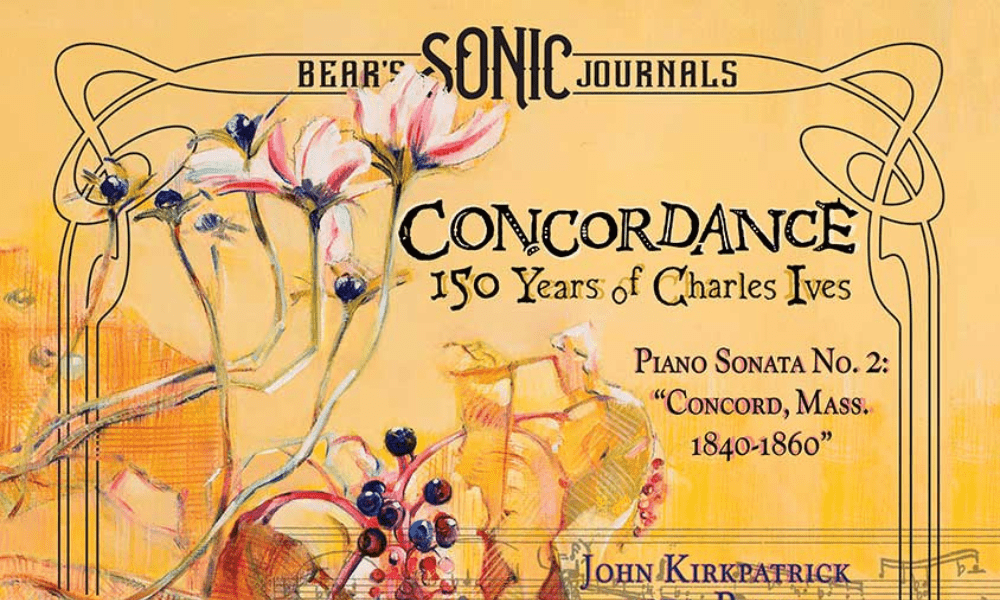
KGNU’s Iris Berkeley speaks with Hawk Semins of the Owsley Stanley Foundation about Concordance: 150 Years of Charles Ives, a new release in the Bear’s Sonic Journals series. The collection features a 1974 recording of Charles Ives’ Piano Sonata No. 2 (“Concord, Mass., 1840–1860”) performed by pianist John Kirkpatrick and recorded by Owsley “Bear” Stanley, the legendary Grateful Dead sound engineer. The tape was rediscovered during the Foundation’s ongoing effort to preserve Stanley’s extensive archive of live recordings.
Semins discusses the history of the recording, Phil Lesh’s longtime interest in Charles Ives, and the connections between Ives’ music and the Grateful Dead. The release also includes a new 2025 recording of the Concord Sonata by pianist Donald Berman and world-premiere recordings of four contemporary works inspired by women transcendentalists, including Emily Dickinson, Harriet Tubman, Louisa May Alcott, and Margaret Fuller (Air Date 6/1/26).
Listen to the interview here:
Transcript:
Iris Berkeley: And we’ve just heard the first movement entitled Emerson of Charles Ives’ Piano Sonata No. 2 tonight on a Classic Monday, in a live recording by John Kirkpatrick from 1974, engineered by none other than Owsley “Bear” Stanley, the legendary engineer for the Grateful Dead. It’s part of a series of Bear’s Sonic Journals released by the Owsley Stanley Foundation.
And here to talk about its release and its frankly amazing origin story is the foundation’s own Hawk Semins. Hawk, are you on the line?
Hawk Semins: I am.
Iris Berkeley: Hello. It’s such a pleasure to have you here tonight. I don’t even know where to start. This story is so much. Perhaps you can begin by telling our listeners a little bit about the foundation and what it was formed to do.
Hawk Semins: Sure. As you mentioned, Owsley was the Grateful Dead’s first sound man. He essentially built their sound systems and designed some of the highest-fidelity sound systems the rock-and-roll world had ever seen at that point, including the Grateful Dead’s Wall of Sound in 1974.
One of the tools in his toolbox was that he taped every concert by every artist who played on a stage he had built. He called them his Sonic Journals. They were like a notebook that he would listen to and use to evaluate how he had done from venue to venue and improve as he went along.
The recordings were nearing the end of their shelf life. Before he died, he told his family that he wanted the tapes preserved for their historical significance. There was never any intention that they would be commercially exploited, and certainly no releases without artist approval.
We formed the foundation as a nonprofit. We’ve had a budget of about $500,000 to preserve more than 1,300 reels of deteriorating reel-to-reel recordings.
Iris Berkeley: Wow.
Hawk Semins: We are in the last lap of the preservation effort, and every year we do one release from the archive. That tends to fund the preservation effort.
This year’s release was Concordance, celebrating 150 years of Charles Ives, and in particular his influence on the Grateful Dead.
Iris Berkeley: It is an absolutely beautiful release. You all were kind enough to send us a copy. It has what feels like a hundred pages of program notes and photographs. The story is incredible.
Right after Bear died in 2011—and then Phil Lesh, the bass player, came to the foundation and said you needed to find two things you weren’t necessarily expecting: Miles Davis and Charles Ives.
Hawk Semins: That’s right. Phil was very close with Owsley. After Bear passed away, Phil was one of the first people we talked to. Starfinder, Owsley’s son, went to Phil and asked if he had any advice.
The first thing Phil said was, “Find the Ives.”
That left us completely befuddled. What did he mean? What recording was he talking about?
It turns out that on March 7, 1974, John Kirkpatrick came to Marin County, just a couple of blocks from where Phil and Bear lived, and performed for the Charles Ives Centennial.
Kirkpatrick, of course, was the pianist who really put Ives on the map. As you mentioned in your introduction, Ives had languished in relative obscurity until Kirkpatrick performed the Concord Sonata live in New York to critical acclaim in 1939. The first score was written in 1920, so it took nineteen years before it was really recognized by the public.
Phil heard that this performance was happening, grabbed Bear, and said, “Bring your tape deck. Let’s go record this.”
They went to the venue. Phil later told me how he lugged the equipment upstairs with Bear and Ned Lagin of Seastones fame. They convinced John Kirkpatrick to let them record. Bear set everything up, with the familiar delay while he got the sound just right.
After Phil set us on this mission more than ten years ago, it took us ten years to find the tapes.
Iris Berkeley: Wow.
Hawk Semins: In classic Owsley Stanley Foundation fashion, the tape was recorded over a Grateful Dead performance at Winterland from February 23, 1974. It was reel number three. We didn’t get to it until we preserved that entire run of shows.
Iris Berkeley: And then you’re like, “Here it is.”
Hawk Semins: Exactly. Unfortunately, Phil passed away around the same time that we found it. This project became what we like to call our Viking funeral for Phil.
Phil would tell you that Charles Ives and John Coltrane were the two most influential musicians on his musical career and the way he thought about music.
This was a very important project for him. One thing we did was introduce him to the Charles Ives Society in 2024 and ask him to participate in a panel called Improvisation in Ives.
On that panel he was joined by Bill Frisell, composer David Sanford—who appears on this release—and other notable musicians and composers. Phil was so excited. You could see him radiating joy while talking about Charles Ives, his musical love.
One thing he mentioned was this concert he had attended. He didn’t mention that he and Bear had recorded it. What fascinated him was that Kirkpatrick departed from the score. He wanted to hear more variations.
As part of this farewell project to Phil, disc one is the mastered version of the tape he recorded with Owsley in 1974 for the Ives centennial. For disc two, we engaged Donald Berman, the last student of John Kirkpatrick and current president of the Charles Ives Society, to perform his own version of the Concord Sonata so that Phil could have more variations. We put more variations out into the world.
It was recorded using Owsley Stanley–informed techniques. We’ll never know exactly what Bear would have done, but it was recorded before a live audience in Concord, Massachusetts—no overdubs. It’s truly the Concord Concord.
Iris Berkeley: Wow. The second disc was recorded live on February 8, 2025, and I want to get to that.
But first, I didn’t know about the Charles Ives connection. Now that I think about it, it makes perfect sense. There’s a great quote from Bear in the program book that I’d love to share.
He says:
“Shortly after I met the Grateful Dead, we all took a dose of acid up at my place in Berkeley and went for a drive, each in their own car, up into the Oakland-Berkeley Hills. As we drove, somebody found a station playing Charles Ives’ Fourth Symphony, a very psychedelic tune. We all tuned in, and the cars seemed to become very strange and agile as we drove around stoned to the teeth while this truly fantastic music played.”
Later the booklet explains that Bear and Phil became convinced that Ives must have been on some kind of psychedelics himself, which probably wasn’t the case. But his music was so far outside the box.
Hearing that these guys bonded over their love of this neglected American composer is fantastic.
Hawk Semins: It’s a great story. With the help of Jesse Jarnow, who does the Good Ol’ Grateful Deadcast, we determined the exact night of that drive: February 4, 1966.
At exactly 9:00 p.m., KPFA played the second movement of Charles Ives’ Fourth Symphony, the “Comedy” movement. Phil wrote about it separately. The next day they went to Los Angeles, and more adventures ensued as they all lived together there.
Phil wrote that the drive welded Charles Ives into his DNA. That was his phrase.
It’s interesting that both Phil and Bear discovered Ives independently. Bear discovered him while studying ballet in Los Angeles.
Both were fascinated by the appearance of the scores themselves. Phil had a great quote on the Ives panel: it almost didn’t matter what the music sounded like—the score looked so cool on the page.
He saw the notes long before he heard the music. When he finally heard it, his suspicions were confirmed. It truly was mind-blowing.
Iris Berkeley: That’s the thing about Ives. He kept revising and revising over the years.
Am I right that the modern recording on disc two isn’t the same version Kirkpatrick performed?
Hawk Semins: It’s very different.
One of Berman’s jobs when he studied with Kirkpatrick was transcribing fragments. He became deeply familiar with the first transcription of the Concord Sonata, which isn’t often performed. He incorporates material from that early version into his performance of Emerson.
Ives never stopped revising the work. There were really two published scores, one in 1920 and another in 1947. Kirkpatrick recorded it twice, once in 1949 and again, I believe, in 1968.
What’s especially cool is that the recording the Grateful Dead heard in 1966 was Leopold Stokowski conducting the Fourth Symphony. It was a brand-new recording at the time, having been released in 1965.
If you fast-forward to 1967, the Grateful Dead are in New York. Stokowski is conducting the Fourth Symphony with two additional conductors at Carnegie Hall. Phil brings the entire band to hear it. Then Phil and Mickey Hart return the next night to hear it again.
Phil describes Mickey’s reaction in his autobiography. Mickey thought it was mind-blowing, holographic, life-transforming. He said they had to find a way to put it into their own music.
At the time they were working on Anthem of the Sun. Inspired by Ivesian techniques, they experimented with overlapping musical layers, much like Ives did with marching bands converging and diverging.
On “That’s It for the Other One,” they took four live versions of the song “The Other One,” offset them slightly in time so the effect was disorienting, and then slammed them back together.
People talk about polyharmony, polytonality, and polyrhythm. Here we have poly-Deadness.
Iris Berkeley: I’m going to have to listen to that album again through that lens.
I could keep you on the phone forever, but let’s talk about the rest of disc two. Concord Legacy: Other Transcendentalists showcases four women transcendentalists. What’s the origin story there?
Hawk Semins: It’s very cool.
These are four original compositions written between 2018 and 2023. Donald Berman commissioned four different composers to create works in the Ivesian tradition honoring four women transcendentalists.
The original Concord Sonata focuses on Emerson, Hawthorne, the Alcotts, and Thoreau.
The Concord Legacy pieces focus on Emily Dickinson, Harriet Tubman, Louisa May Alcott, and Margaret Fuller.
This is a world-premiere recording. The works had been performed live before, but this is their first recording and release.
We hope people enjoy them. It’s a wonderful way to bring Ives into the twenty-first century through new voices telling another important part of the transcendentalist story.
Iris Berkeley: I had a hard time choosing which one to play. I think we’re going with the Margaret Fuller piece.
How does it feel to finally have this record in the world after spending so many years wondering what it was and where it might be? How do you hope it bridges the worlds of the Grateful Dead and Charles Ives?
Hawk Semins: Making it was its own reward.
One of the advantages of being a nonprofit is that we can invest in projects like this for the public good.
A lot of our work involves helping Deadheads understand the origins and influences behind the Grateful Dead. Owsley was so closely associated with the band, but everyone in that era was listening to everyone else.
The Bay Area was an incredibly fertile musical environment. The airwaves were full of different kinds of music. Every release we produce demonstrates the diversity of voices that existed in the 1960s. It wasn’t all psychedelic rock.
We’ve released Ali Akbar Khan, the Chieftains, Johnny Cash at the Carousel Ballroom, the Allman Brothers Band, Tim Buckley, and many others.
Everyone was listening and learning from one another. Ives was an important part of that mix.
We had heard Phil talk about Ives for more than a decade. One of the greatest rewards of this project is that we weren’t Ives scholars when we started.
Iris Berkeley: You clearly are now.
Hawk Semins: We certainly learned a lot. We wanted to make something Phil would have been proud of.
It saddens us that he isn’t here to enjoy it. I know he would have loved it.
I think all that love shows up on every page of the booklet and in the care we took to make this project as perfect as possible.
Iris Berkeley: In addition to being a wonderful recording, the physical package itself is extraordinary.
Where can people learn more and get a copy?
Hawk Semins: Visit the Owsley Stanley Foundation website at OwsleyStanleyFoundation.org.
Each release has its own landing page, and this one is featured right on the front banner. For more day-to-day updates, visit our Facebook page, where we regularly post photos of reels being preserved and discuss what we’re finding.
We also have a store on our website.
And of course, you can find our releases wherever good music is sold. They’re available through Amazon and many other outlets.
Iris Berkeley: Hopefully we’ll have this interview posted on KGNU.org in a few days, and maybe you can share it on your Facebook page for anyone who missed the conversation.
This has been an absolute pleasure. Is there anything else you’d like our listeners to know?
Hawk Semins: Just that we’re an all-volunteer nonprofit. We do all this for the love of it.
This is our twelfth release, and we hope to have another one out on Record Store Day this fall, fingers crossed.
Iris Berkeley: Amazing. The Black Friday Record Store Day release?
Hawk Semins: Yes.
Iris Berkeley: Wonderful. Thank you so much.