
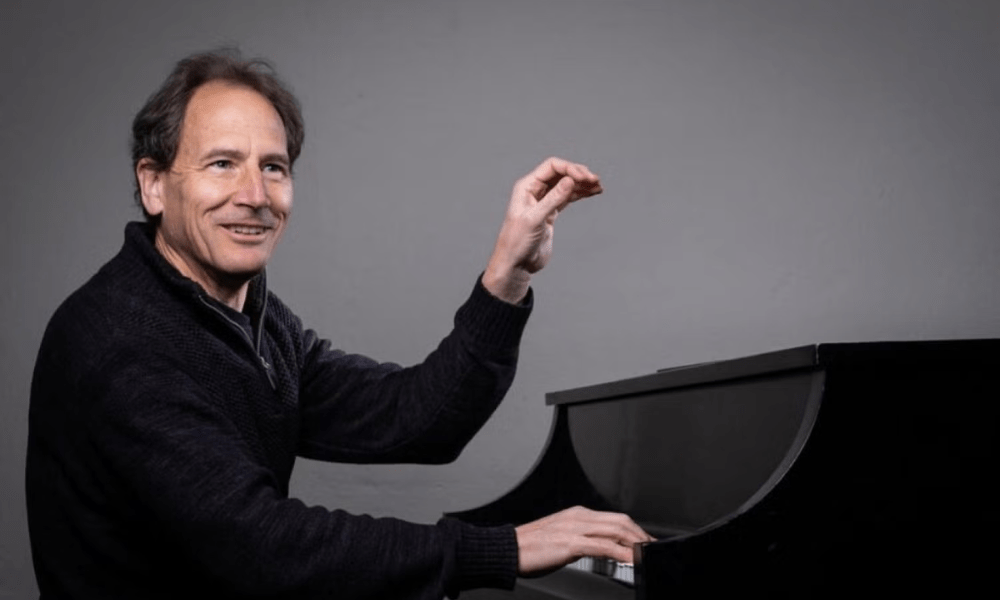
Pianist David Korevaar joined Chris Mohr for KGNU’s A Classic Monday to discuss his ambitious new recording project: the complete 32 Beethoven piano sonatas. In conversation with Chris Mohr, Korevaar reflected on his lifelong relationship with Beethoven’s music, the challenges of recording nearly 12 hours of repertoire in under a year, and the evolution of Beethoven’s compositional style across the sonatas. The interview also touched on upcoming performances with the Colorado Ballet, Boulder Symphony collaborators, and chamber music programs in Boulder. Throughout the program, listeners heard selections from the Appassionata, Opus 101, and the monumental Hammerklavier Sonata. (Air Date 2/23/2026)
Listen to the interview here:
Transcript:
Chris Mohr: We’ll be talking more about the Colorado Ballet with our guest tonight, our guest artist, you might say. David Korevaar, our pianist, is here in the KGNU studios. Thank you so much for coming and spending part of your evening with us today.
David Korevaar: It’s great to be here, Chris. Thanks so much for having me in.
Chris Mohr: You have a lot of recordings out, and I keep seeing one after another come out. But I really wasn’t expecting the complete 32 Beethoven piano sonatas to come from your fingers. That’s a lot of notes. Is this a years-long project? How long does it take to get to the point where you can perform that many works?
David Korevaar: My association with Beethoven sonatas goes through my whole life, as it would for any pianist. It’s something you start doing when you’re a kid.
I had never thought of doing all 32. My longtime colleague at CU, the choral director Joan Catoni Conlon, who retired some years ago, once told me after I played Beethoven on a faculty recital, “You should record them all.” I never forgot her saying that, though at the time I kind of brushed it off.
During the COVID lockdowns in 2020, which was of course a Beethoven anniversary year, my response was to learn the few sonatas I didn’t already know and put out some homemade videos. I was recording them at home on an out-of-tune piano because that’s what we were all doing at the time. That inspired me to think this was music I felt very close to — music many of these pieces had been with me for 20 to 40 years.
A couple years ago, I decided to really do the project properly and record the full cycle. I’m very excited that it’s all out and available online. There’s also a physical two-CD set, which represents about one-sixth of the whole project.
Chris Mohr: Which we’ll be playing excerpts from today. I have to tell you, when I was in college, one day I had some extra money and bought the complete Beethoven sonatas with Claudio Arrau. I thought, “Let’s see which of these I like.” I loved the first one, was blown away by the second, stunned by the third, and it just went on and on. There’s not a weak moment in there.
This collection of music says so much, and it often feels like Beethoven was ahead of his time. It seems the piano sonatas were a little ahead of the symphonies in terms of how he was developing as a composer. Can you say something about that journey through the complete 32?
David Korevaar: I think what you say is absolutely right. People have talked about how you’d see things in the sonatas first, and then later they’d show up in the symphonies or string quartets.
At the end of Beethoven’s career we talk about “late Beethoven,” but in the piano sonatas that late style already shows up in the Opus 90 Sonata, even though chronologically most people wouldn’t classify it that way. Then we begin seeing it in the last pair of cello sonatas, Opus 102, and in the Opus 101 piano sonata. Something really changes in the way he looks at musical structures and textures. There’s much more counterpoint and adventure in the sounds he’s creating.
That said, he was always exploring new sounds. From the beginning, when there weren’t enough notes on the piano, he found clever workarounds. Then when manufacturers expanded the keyboard range, he was thrilled. In the Waldstein Sonata he suddenly had another octave on top to use.
In the later sonatas he finally got more bass notes, so by the final sonata, Opus 111, we get down to a low C. For years the lowest note had been F. Beethoven loved those new low notes and wanted everyone to hear them.
Chris Mohr: I’ve heard that he used to have a repairman standing by his piano because he’d break strings during concerts.
David Korevaar: It still happens. I’ve had a string break once in my life during a concert. Things definitely happen.
Chris Mohr: When you’re approaching such a huge body of work and trying to record it, how do you keep the uniqueness and freshness of each piece? The sheer volume of music would seem daunting.
David Korevaar: I think what you said earlier about listening to Arrau’s recordings is important. Every sonata opens your eyes in new ways. Anytime I play a piece, whether it’s new to me or not, it’s new to me in that moment. Every time I play the “Moonlight Sonata,” it’s the first time. I want the audience to feel that way too. That’s the secret for me.
The recordings were done between October 2023 and July 2024. I planned out which repertoire I would have ready when and made sure I had time to practice everything. I wanted to record them within a relatively short period so the whole project would feel like a snapshot of one moment in my artistic life.
Chris Mohr: You suggested we start with Sonata No. 23, the Appassionata. People who know Beethoven sonatas recognize it immediately, but not everyone listening may know it. Why did you choose it?
David Korevaar: It’s a perfect example of Beethoven exploring new sounds. The piece begins very softly in the bottom register of the piano, and then very quickly he opens up one of the most incredible fortissimos ever written for the instrument. He’s trying to make the piano produce more sound than anyone thought possible.
The Appassionata also represents a moment where Beethoven was writing on a much larger scale for solo piano than anyone before him. It’s monumental in scope, with tremendous expressive variety and pianistic invention. It’s really groundbreaking in many ways.
Chris Mohr: David Korevaar performing the first movement of Beethoven’s Sonata No. 23 in F minor, the Appassionata. You’ve performed almost all 32 sonatas live over the years and now recorded all of them. We were talking a bit about editing. This recording has such a strong dramatic arc that it sounds almost unedited.
David Korevaar: That’s the goal. Editing is an art in itself. Because the conception of the piece is fairly consistent across multiple takes, you can preserve that flow.
I know from talking to producers and engineers that I’m fairly easy to record because I can produce clean takes without too much patching. The challenge with recorded music is that audiences hear every wrong note, so in the modern world you can’t really leave them in. But the idea is still to make it sound like a live performance.
Chris Mohr: Speaking of live performance, tell us about what’s coming up for you this spring.
David Korevaar: This Friday I’ll be performing at the Academy in Boulder as part of a regular series there. We’re presenting a program of little-known Romantic chamber music. We’ll perform a piano quartet by Louisa Lebeau, who studied with Josef Rheinberger, a trio by Filip Šrvenka, and miniatures by the Russian composer Paul Juon.
Then on April 13, in collaboration with the Boulder Symphony and Evan Patrick Hughes, I’ll perform two Beethoven works that serve as a kind of prelude to the Ninth Symphony, which the symphony will perform later in April. I’ll be joined by Maida Weiss and Andreas Seeger for the Archduke Trio, and I’ll also play the Hammerklavier Sonata.
At the same time, for two weekends in April, I’ll perform Rachmaninoff’s Second Piano Concerto with the Colorado Ballet as part of their new works program.
Chris Mohr: With live orchestra and dancers.
David Korevaar: Yes. This is actually my third collaboration with the ballet. A few years ago I performed for The Lady of the Camellias, which used concert works by Chopin, including much of the First Piano Concerto and several other major pieces. More recently I performed Stravinsky’s Capriccio for Balanchine’s Rubies. I’ve had a wonderful association with the ballet.
Chris Mohr: We’re going to hear part of the Sonata No. 28 in A major, Opus 101.
David Korevaar: We’ll hear the second half of it, which consists of a slow introduction and then the finale.
Chris Mohr: David Korevaar playing Beethoven’s Sonata No. 28 in A major, Opus 101. David has just recorded all 32 Beethoven piano sonatas, representing decades of experience performing these works in concert. Congratulations. This must be your biggest recording project ever.
David Korevaar: It’s hard to imagine anything bigger than this. It’s close to 12 hours of music.
Chris Mohr: I know from your social media that you spend a lot of time hiking in Utah and the Colorado mountains. Does nature influence your music-making?
David Korevaar: I think everything we do informs everything else we do. Teaching, performing, hiking — it’s all connected. I always have music in my head when I hike. Sometimes it’s not even complete music, just little fragments of notes cycling through my mind.
Chris Mohr: We could go on for nights with this music, but I want to hear a little from what many people consider one of the greatest sonatas ever written: the Hammerklavier, Opus 106. Tell us why it’s such a towering masterpiece.
David Korevaar: First of all, it’s long — the longest of Beethoven’s piano sonatas, and unprecedented in scale. It’s incredibly dense and very close to impossible to play, which is part of its attraction for pianists. But it’s also simply a great piece of music.
The fugue at the end is famously complex and takes multiple listenings to fully grasp. Performers often struggle with Beethoven’s metronome markings because the tempos are almost insane. By then he was deaf, and I think the way we perceive music internally differs from how we hear it in the world. I try to choose tempos that let the music remain intelligible.
Despite its size and complexity, it’s an extraordinarily coherent piece. The slow movement is one of the most sublime things Beethoven ever wrote. And astonishingly, he never actually heard the piece himself.
Chris Mohr: Between his early sonatas around 1795 and the Hammerklavier, the piano evolved tremendously. Beethoven always seems to push the instrument beyond its limits.
David Korevaar: More than the maximum. He goes to 11 all the time.
Chris Mohr: David Korevaar, our pianist for the last hour. Thank you so much for coming in tonight and sharing your new recording with us here at KGNU. Congratulations again. This feels like the Mount Everest of piano projects.
David Korevaar: It’s a big one, for sure.
Chris Mohr: Are you planning to perform these sonatas live as part of promoting the recordings?
David Korevaar: I already have been performing them in various places. Next week I’ll be at the Beethoven Center in San Jose, California, and there will definitely be more performances. Of course, 2027 is another major Beethoven anniversary year, so there’s bound to be even more happening then.
Chris Mohr: Thank you again, David. It’s been a few years since we last talked, so hopefully next time won’t take quite so long.
David Korevaar: Sounds good. It’s been wonderful to be here, Chris. Thanks so much.