
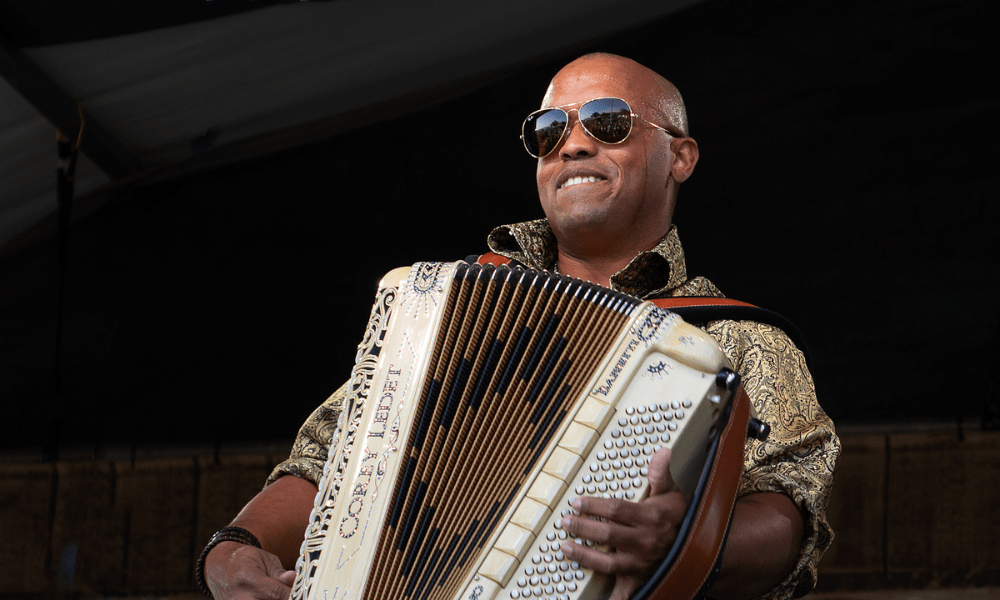
KGNU’s Dan Willging spoke with acclaimed Louisiana zydeco musician Corey Ledet about his powerful new live album, Corey Ledet & Black Magic Live in Alaska. Ledet shared the story behind recording the project at the Anchorage Folk Festival, where enthusiastic audiences embraced his high-energy blend of zydeco, funk, blues, and Creole music.
The conversation explored Ledet’s musical roots, the influence of legends like Clifton Chenier and Buckwheat Zydeco, and his belief in expanding zydeco beyond traditional boundaries. Ledet also discussed his dedication to preserving and learning Kouri-Vini, the Louisiana Creole language spoken in his family for generations. Along the way, he reflected on improvisation, cultural identity, and the advice from Buckwheat Zydeco that convinced him to keep pursuing music when times were tough. (Air Date 2/26/26)
Listen to the interview here:
Transcript:
Dan Willging: All right, Corey, do I have you on the line?
Corey Ledet: Yes, sir. How are you doing?
Dan Willging: Good. Thanks for taking the time to talk with us here on KGNU in Boulder, Colorado.
Corey Ledet: Thanks for having me. I really appreciate it.
Dan Willging: Corey Ledet is a zydeco artist from Southwest Louisiana. How long have you been a professional, Corey? Since you were 10?
Corey Ledet: I started playing really young. Altogether, I’ve been playing 33 years, and professionally in Louisiana for 23 years.
Dan Willging: That’s great. I’m really impressed with your latest album, Corey Ledet & Black Magic Live in Alaska. What can you tell us about it?
Corey Ledet: It’s my first live project. We play Jazz Fest all the time, and Jazz Fest records artists, but those are Jazz Fest projects. This is my first live album for myself, and I’d always wanted to do one.
Doing a live album, you never know what you’re going to get. I’d tried recording live before, but it never came out right. Then I got invited to the Anchorage Folk Festival and suggested recording there. They were completely on board, made sure they had the proper equipment and engineer, and when we got home and listened to it, it sounded amazing. I knew we had something we could work with.
Dan Willging: Had they ever recorded a live album at the Anchorage Folk Festival before?
Corey Ledet: I’m not sure. I don’t know if they’d done anything like that before.
Dan Willging: Had they ever had zydeco there before?
Corey Ledet: I think they’d had Creole music, but I’m not sure about zydeco specifically.
Dan Willging: I can’t imagine what those Alaskan audiences thought when they saw your show. What was the reaction?
Corey Ledet: They were on their feet the whole time, demanding more. When it was time for us to leave, they almost didn’t let us go. They wanted us to stay and were willing to find more gigs for us in the area. It was great.
Dan Willging: Maybe next time you’ll take over the whole state.
Corey Ledet: It’s never too late for that. Maybe next time we’ll stay a month.
Dan Willging: I liked what you said in the press notes — that you weren’t afraid to record outside Louisiana because Clifton Chenier did so many out-of-state live recordings.
Corey Ledet: Exactly. I’d tried recording live in Louisiana before, but there were always technical problems or something didn’t work out. Then I started thinking about Clifton. Most of the live albums I know from him were recorded outside Louisiana — Montreal, California, Paris, all over.
The only live recordings I know that were actually recorded in Louisiana were Live at Grant Street, which came out after Clifton passed away, and another one Tibetana’s released recently that was recorded around 1980 or ’81. Everything else was outside the state. I thought, if Clifton was bold enough to release live recordings from outside Louisiana, I could do it too.
Dan Willging: Especially for audiences that aren’t deeply familiar with zydeco. They did a great job.
Corey Ledet: They really did. I was very pleased with it.
Dan Willging: I’ve seen your show many times, but this version feels different. You hit people hard right away with the energy. Is the track list in the same order as the concert?
Corey Ledet: No. We played three days and recorded all three performances. I chopped everything up and combined it into one sequence because I wanted listeners to feel like they were actually there at the show.
Dan Willging: That makes sense. You open strong with songs like “This Is All I Want,” then “Boudin Man,” then “Alaskan Funk,” and after that settle into the deeper Creole zydeco tradition. I thought the structure worked really well.
Corey Ledet: What I’ve found is that when I play outside Louisiana, I have more freedom to stretch out musically. Around Acadiana, people often want the music done a certain way — either nouveau zydeco or old-school zydeco — and they can be set in their ways.
But once you get outside that area, you can branch out. I’m really not doing anything different from what Clifton Chenier did. He played R&B, funk, country, blues, rock, and old Creole tunes, all in his own way for his era. I’m just following that recipe for today.
Buckwheat Zydeco once told me that when you get outside the area, you have to spread your wings and play all kinds of music. That’s what he did, and I’m following that path.
Dan Willging: Advice from Buckwheat Zydeco is gold. I also heard he once convinced you not to quit music altogether.
Corey Ledet: Yes, that was the same conversation. Things had gotten difficult. The phone stopped ringing, I’d play locally and nobody would show up, and I had merchandise nobody was buying. It got frustrating.
Little Buck talked to Buckwheat for me, and Buckwheat invited me over to his house. We talked for hours, and he told me, “If you quit, I’m going to have a problem with you.”
Dan Willging: For listeners, “Little Buck” is Paul “Little Buck” Sinegal, the legendary Louisiana guitarist who played with Clifton Chenier, Buckwheat Zydeco, and many others.
Another thing listeners should know about you is your work with the Kouri-Vini language. We don’t really call it Creole French anymore.
Corey Ledet: No, it is what it is — Kouri-Vini. A lot of people call it Louisiana Creole, but it’s its own language. Depending on where you’re from in Louisiana, the dialect changes a little.
The version my family speaks comes from the St. Martin Parish area — around Breaux Bridge, Parks, and St. Martinsville. Once you go north toward Eunice or Ville Platte, it changes. Every region has its own style or dialect.
When I was in Paris last year, I explained how French differs in Louisiana, and somebody there told me it’s the same in France — people in northern France speak differently than people in southern France.
Dan Willging: Have you learned new words just by hearing different regional dialects around Acadiana?
Corey Ledet: Definitely. People can usually understand the general meaning even if they don’t catch every word. My ear is just tuned to the Kouri-Vini my family speaks because that’s what I grew up hearing from my dad’s side of the family.
Dan Willging: There’s also now a written form of Kouri-Vini.
Corey Ledet: Yes. There’s a book called Tiliv Kreyol available on Amazon. It includes spellings and audio resources. My cousin Herbert Wilt is also teaching me how to read and write it.
Dan Willging: I think I met him at the Zydeco Festival in Opelousas.
Corey Ledet: Probably so. My family covers a lot of ground.
Dan Willging: When did the written system for Kouri-Vini really begin?
Corey Ledet: I think it’s fairly recent, maybe within the last 10 years. When my dad was growing up, none of it was written down. People just learned it by listening.
Dan Willging: Well, Corey, thanks for joining us today. It’s been a while since we talked, and I’ve missed our conversations.
Corey Ledet: Of course. Will you be coming down for Festival International?
Dan Willging: Yes, sir. In May.
Corey Ledet: All right. I’m closing out one of the stages on Sunday.
Dan Willging: That’s fantastic. Will it be more like your Alaska-style show?
Corey Ledet: Yes. That’s the direction I’m pushing right now.
Dan Willging: I love it. I played “Alaskan Funk” on my blues show, and the DJ after me — who calls himself “The Funktologist” — loved it.
Corey Ledet: That song was actually completely improvised. We finished another song, and suddenly I blanked on what to play next. I told the drummer to give me a funky beat, and everybody just jumped in. The whole thing was spontaneous.
Dan Willging: It’s a fantastic track. After we wrap up, I’m going to play “Je Parti Dans La Campagne.”
Corey Ledet: That’s right.
Dan Willging: I got close on the pronunciation.
Corey Ledet: You’re in the ballpark.
Dan Willging: Maybe just in another part of the parish.
Corey Ledet: But you’re in there.
Dan Willging: All right, Corey. Have a great day, and we’ll see you in a few months.
Corey Ledet: Thank you very much.
Dan Willging: This is Corey Ledet.