
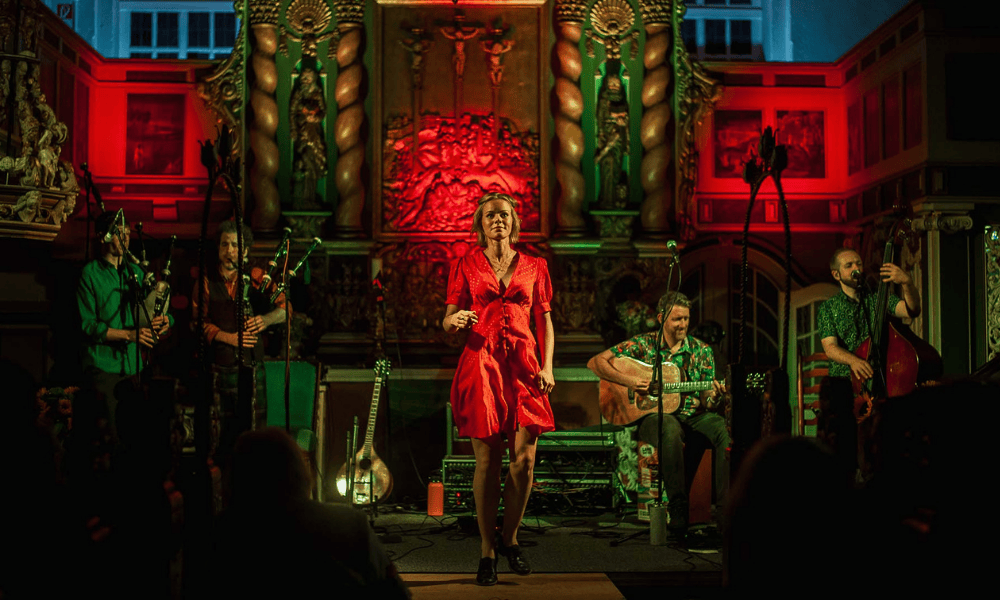
Scottish folk powerhouse Breabach celebrated 20 years together with a vibrant set at RockyGrass 2025. Fiddler and vocalist Megan Henderson discussed the band’s Glasgow roots, their mix of contemporary and traditional Scottish sounds, and the Celtic influences that connect deeply with American bluegrass. Currently touring the U.S., Breabach reflected on the privilege of making music full-time, the joy of cross-cultural tune exchanges, and the thrill of bringing Scottish step dancing to a RockyGrass audience.
Fergus Stone: We’re backstage at RockyGrass 2025. I’m speaking with Megan Henderson of the amazing band Breabach. They gave a riveting performance Saturday afternoon here at the festival. Megan is the fiddle player, and she also has a beautiful voice. Welcome to RockyGrass, Megan.
Breabach: Thank you for having us.
Fergus Stone: Tell me a little bit about Breabach. How long has the band been together?
Breabach: The band is actually celebrating its 20th anniversary this year. I joined in 2011. The original members were Ewen and Calum, who are still with us. I like to call them the veterans of the band. There was also a fantastic fiddle player, Patsy Reid, and Donal Brown. Over the years, it has evolved into what it is now.
The band all met in Glasgow, which is such a fantastic city—a real melting pot of music, genres, and cultures. It’s been a very special place for us to grow with our music. But we’re also always in the Highlands of Scotland—that’s where our music, language, and culture come from, and where our passion lies. What we play is contemporary Scottish folk music, but we also like to evolve it while staying true to our roots.
Fergus Stone: Many bluegrass fans know that one of the deepest roots of bluegrass music comes from Celtic traditions—particularly Scottish and Irish fiddle tunes. In fact, the father of bluegrass, Bill Monroe, often spoke of the “ancient tones,” referring to the very sorts of things you play. I even found a sign at the Culloden Battlefield that said “Monroe, 37th Foot.” Bluegrass people are aware of that Celtic connection, but many others might not be. Do you play primarily Celtic music, or are there other styles you draw from?
Breabach: Absolutely. My background was in folk and traditional music, a lot of Gaelic music, but I was also classically trained and have a degree in classical music. James Lindsay, our bass player, is a fantastic jazz musician—unbelievable, really. He also enjoys rock and heavy metal. Calum is quite into funk as well. So everyone in the band dips their toes into other genres of music.
Fergus Stone: Do you play any bluegrass tunes?
Breabach: You know, I do, though I’m not the best with remembering names of tunes. Over the years, I’ve had the honor of playing backstage at different festivals with amazing bluegrass musicians—just exchanging tunes, picking things up by ear. That’s where it all stems from. I’m hoping to get a few tunes in while we’re here on our last day at RockyGrass.
Fergus Stone: One of my favorite Celtic tunes is MacPherson’s Rant.
Breabach: Oh yes, not in our set list today, but we know it well. It’s a great song.
Fergus Stone: Did you come to America just for RockyGrass, or are you on tour?
Breabach: We’ve been out for a couple of weeks and managed to build a tour around RockyGrass. We’re so honored to be here. We started at the Hiawatha Festival in Marquette, Michigan, then played Chicago, and tomorrow we head to Oregon before making our way home.
Fergus Stone: Oregon is a big traditional music state. You’ll find a lot of fans there.
Breabach: Yes, this is our second or third time in America in the last few years. We’re just starting to find our feet here, and it’s lovely to revisit places and audiences.
Fergus Stone: Are you able to do this full time, or do you need to supplement with other jobs?
Breabach: We’re very fortunate that this is our main work. I do some music teaching and youth projects at home, and several of us also do freelance recording with other musicians. But yes, it’s full-time music, which we know is a real privilege. The travel and airports can be exhausting, but we’re grateful to do what we love.
Fergus Stone: And you’re based in Glasgow?
Breabach: We were based in Glasgow, but now Ewen and I live in the Highlands, in an area called Beauly, where I grew up. James lives near the Isle of Skye. Calum and Conal are still in Glasgow, so we use Glasgow as our base for making music.
Fergus Stone: Americans might know Glasgow for the saying, “The moose is loose in the hoose.”
Breabach: Yes, absolutely. We actually wrote a piece for our last album called Fàs, which in Gaelic means “to grow” and “regeneration.” Glasgow’s affectionate nickname is “The Dear Green Place,” because despite its rough-and-ready reputation, it’s full of beautiful parks and green spaces.
Fergus Stone: I was told that in Scotland, summer rain is “water over.”
Breabach: Yep, that’s right.
Fergus Stone: You did some clogging in your performance yesterday, and the crowd loved it. Do traditional bluegrass audiences recognize it right away?
Breabach: Yes. I was a little nervous doing what we call Scottish step dancing, especially since the Appalachian style of clogging is so incredible. I’ve been heavily influenced by other step-dance traditions too, like the foot-tapping styles in Quebec. It’s lovely to bring that back home and add our own touches. The Appalachian style is amazing—just incredible.
Fergus Stone: I must say, I really enjoyed your performance yesterday. Thank you for coming all this way, and we hope to see you again.
Breabach: We’d love to be back. It’s been an incredible time here. Thank you.
Fergus Stone: Thanks so much for taking time with us.
Breabach: Not at all.