
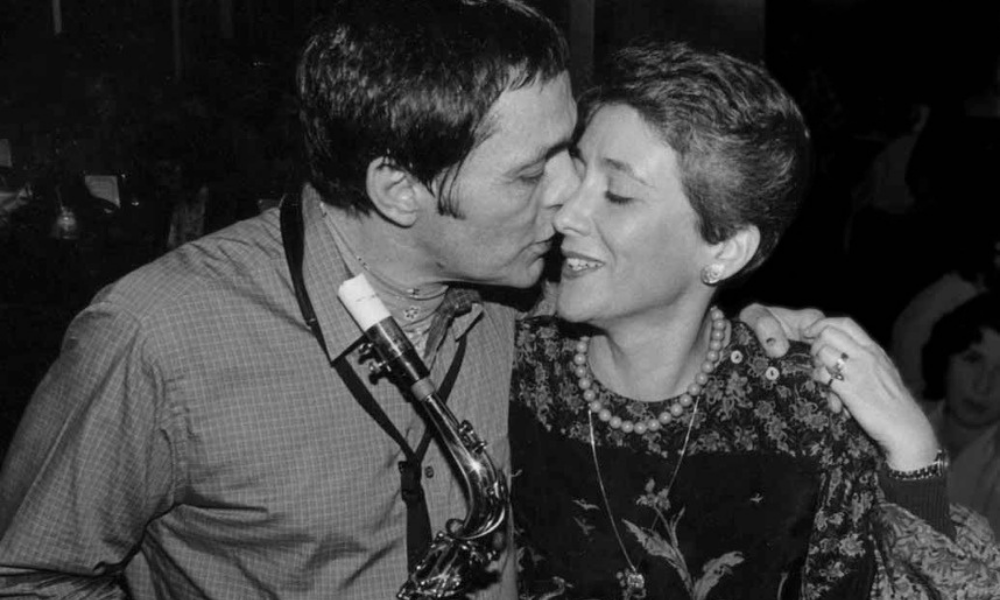
In the first half of this multi-airing interview, Laurie Pepper recalls her artistic upbringing in Los Angeles, her early love of jazz, and how struggles with addiction led her to Synanon, where she met saxophonist Art Pepper. She describes their relationship, the seven-year process of creating his autobiography Straight Life, and Art’s constant reinvention as a musician. Laurie also reflects on how their partnership transformed her, giving her responsibility, confidence, and a deep mutual respect with Art. (Interview: 8/28/25)
Rodger Hara: Good evening. I’ve got Laurie Pepper on the line. Laurie, welcome to KGNU and Jazz Lives. How are you today?
Laurie Pepper: I’m good. Hi, Rodger.
Rodger Hara: Where are you today—Southern California?
Laurie Pepper: I’m in Los Angeles, in an area called Silver Lake. It’s supposed to get to 98 degrees today. I’ve got an air conditioner on, but it’s struggling. So I’m probably going to start sweating during this.
Rodger Hara: It’s wonderful to see you and meet you online. I am very interested in hearing about you—your life with Art, your influence on Art, music, the impact of Art on your life. Tell me about yourself. Where were you born, where are you from, and what led you to your intersection with Art’s Life at Synanon?
Laurie Pepper: I was born in L.A. We lived in New York for a while when I was a child, but we came back here when I was eight or nine. My family was all here. My mother’s family was very artistic, semi-bohemian.
My uncle was a musician and a musicologist, a friend of Igor Stravinsky’s. My mother had been a dancer with Martha Graham. So it was natural for me to get interested in music at an early age. I’m pretty old—I just turned 85—so when I was in my teens, that was a time of lots of jazz in the world, starting in the mid-1950s into the sixties.
So I was going to jazz clubs, and I even went to a place that’s sort of legendary now, that Charlie Haden and Bill Holman went to, called Westlake College of Music. I was studying there—I wanted to be a singer. It’s lucky for all of us that I didn’t become a singer, but it was a great experience going to that school, hanging out with jazz musicians, and listening to jazz constantly in clubs.
I never met Art at that time, but Charlie Haden was actually playing with Art. At the time I was hanging out at Westlake, Charlie was underage—I think I was 15, and I don’t think he was 18. At any rate, I was already very interested in jazz.
I never listened to Art Pepper because we were all a bunch of snobs at Westlake and thought West Coast Jazz wasn’t any good—except that I loved the Chico Hamilton Quintet. My family befriended them because Fred Katz, the cellist, was a friend of my uncle. So we went to see the Chico Hamilton Quintet and I got to know them a little bit. I loved them. But this was not something I dared say around the people at Westlake, because Chico was West Coast. Secretly, I loved West Coast Jazz.
Later on in life, when the sixties came along, I got caught up like a lot of other people—I was using drugs and hanging out with rock and rollers. It finally got to the point where I was suicidal. And so I thought, well, if I don’t die, maybe I can go to Synanon, which people had told me about.
So I went to Synanon. After I had been there about three months, maybe longer, Art Pepper came in, and he was on the “kicking couch” at Synanon. Everybody said, “Oh, let’s go see Art Pepper,” you know, because he was a celebrity. And I said, “Nah, no.” And then later on, he hit on me at a Saturday night party we had in this giant club down by the beach, where Synanon was located in L.A. He hit on me, and he was very persistent. And of course, I fell in love.
Rodger Hara: Can you talk about the book that you and Art did—Straight Life—and how long it took you to do all of the recordings and transcribing? It’s just a fascinating book that talks about so much of your life with him, his life, his jazz, the people in his life. It’s the most interesting, 360-degree view of an artist. I know it has been used a great deal by people interested in the history of West Coast Jazz.
Laurie Pepper: I can’t take full credit for it. When we were in Synanon and had become lovers, Art started telling me stories of his life. I was completely transfixed by them. I had always loved people’s life stories. I love oral history in general—just the way it’s spoken by people who can really talk. And Art could really talk.
After Art left Synanon, because he couldn’t stand it anymore, he wrote to me and asked me to join him, which I was afraid to do. I kept thinking, if I left Synanon, I could take all these stories and write a book. And so it was ambition, along with love, that brought me to his side.
In April we started recording. He was working at a friend’s bakery at that time. He moved in with me eventually, but we began recording there. After the first afternoon of recording, I was so dazzled. The thing you have to know about Art Pepper is he was great at rising to an occasion. He wasn’t just sitting there idly talking—he was really telling a story. He was talking about his feelings, his imaginings, and his fears. It was overwhelming.
I knew at that moment nothing would stop me from doing that book. And that’s how it started.
Rodger Hara: And how did you get all of the other people whose voices are heard in the book to open up and share?
Laurie Pepper: It’s amazing how people will do that if you really want to know what’s going on with them and they know you’re sincere. Most people, anyway.
In Synanon, we had this thing late at night after Synanon games. We’d sit in a circle and somebody would be told to “run their dirty rotten story,” as it was called. They would tell their life story and their connection with drugs and alcohol. I was one of the few people who stayed awake through all of those stories, because I loved them.
Art responded to my enthusiasm. Although I had to bribe him with candy later on when he didn’t want to do it anymore, I realized it was because it took a lot out of him. He was giving a performance every time I recorded him, and I wasn’t aware how much energy that took.
Anyway, I went to the other people he had talked about. I loved oral history, and one of the best books I ever read was The Children of Sánchez by sociologist Oscar Lewis. It’s about a poor family in Mexico City, and he got the life story of the family from all the family members. So when I started doing Straight Life, I knew I wanted other voices—partly because I figured that was the way to do it, and partly because Art was so extreme and told such incredible tales that if they were true, I felt we needed witnesses. And we got them.
Rodger Hara: And did you do the recordings on a cassette recorder?
Laurie Pepper: Yeah. I just dragged a cassette recorder around at that time. I did one long-distance recording—there was a guy, Alan Dean, who had been a singer in London when Art was there during the war. I contacted him. He was living in Australia. I sent him some tapes and asked him to record his memories of Art, and he sent them back to me. But otherwise, I just went to see people wherever they were.
Rodger Hara: And how long did it take altogether?
Laurie Pepper: It took seven years.
Rodger Hara: Seven years to record, transcribe, and write.
Laurie Pepper: And rewrite. And rewrite. And rewrite.
Rodger Hara: Did Art participate in all of that with you?
Laurie Pepper: No. He would tell me the stories, and if I wanted to know more about something, I’d grab him and make him tell me. I edited heavily—he would interrupt himself, and part of a story would be here and the other part there, so I had to put them together.
When I read it back to him, I’d ask, “Does this sound like you? Does this feel right?” He would say yes or no, or he’d want to change something. So he participated in that sense. But as far as the interviews with others, he had nothing to do with those.
Rodger Hara: After leaving Synanon—after the bakery—did he return to music? I mean, it seemed like he burned down and rose phoenix-like from the ashes many times.
Laurie Pepper: That’s what he did.
Rodger Hara: And it seemed like every time he did that, it influenced his playing. Is that true?
Laurie Pepper: He was an artist. What does an artist do? An artist grows and changes. That’s inevitable—that’s what they do. And of course, he was influenced by his experiences and by what he heard other people doing. But he didn’t want to be too influenced by others. He got carried away with Coltrane briefly—that was before Synanon—but he later incorporated that influence into his own playing.
Rodger Hara: He reinvented himself often.
Laurie Pepper: Often.
Rodger Hara: And we’re the beneficiaries of how his style changes and the other influences entered into his music.
Laurie Pepper: If you listen to his first recordings with Kenton—on Art Pepper with Stan Kenton, the Shorty Rogers arrangements—he’s unearthly. He swings like crazy. His tone is so beautiful. He never stopped swinging.
As he got older—look, as a friend of mine says, “When I was young, I had a voice like a 10-year-old boy, and now I have a voice like an 85-year-old woman.” That’s what happens. Art knew that. He knew things changed, and attitudes changed. All of that came through his music, because he was an artist.
Rodger Hara: Can you talk about the relationship—how you changed Art, and how Art changed you?
Laurie Pepper: I was pretty immature going into that relationship. I learned a lot about being in a relationship from being with him, because he was very demanding. He relied on me very heavily, and that had never happened to me before. I had to learn how to deal with that.
That was so good for me. When I went into Synanon, I had never grown up, and suddenly I was the responsible one. I became that because Art required it. So when he died, I was able to live my life and deal with record companies and publishing companies, and do all those things, because I had learned to do them since Art needed me to.
I managed the band, I managed the tours, I paid the musicians, I hired and fired people. All of those things would have been unimaginable to me before I met Art. Not only did he need me to do it, but he absolutely trusted that I could. He had faith in me. It was incredible.
I don’t know—I tried to make him think I was together, but I wasn’t. He believed in me completely. When we did the book, he believed I was a great writer. When I ventured an opinion about his music, he listened. He had so much respect for me.
When you give your life over for a while to somebody else’s career, if they don’t appreciate it, why are you doing it? Art’s appreciation was vast, and it was real. He wasn’t putting it on. He always told other people all that I did. When we did interviews about the book, Art would say, “Laurie did it. Laurie did it all.” How can you not love a guy like that?
Rodger Hara: Laurie, that is a great way to end this segment of the interview. It’s a nice segue for the second half.