
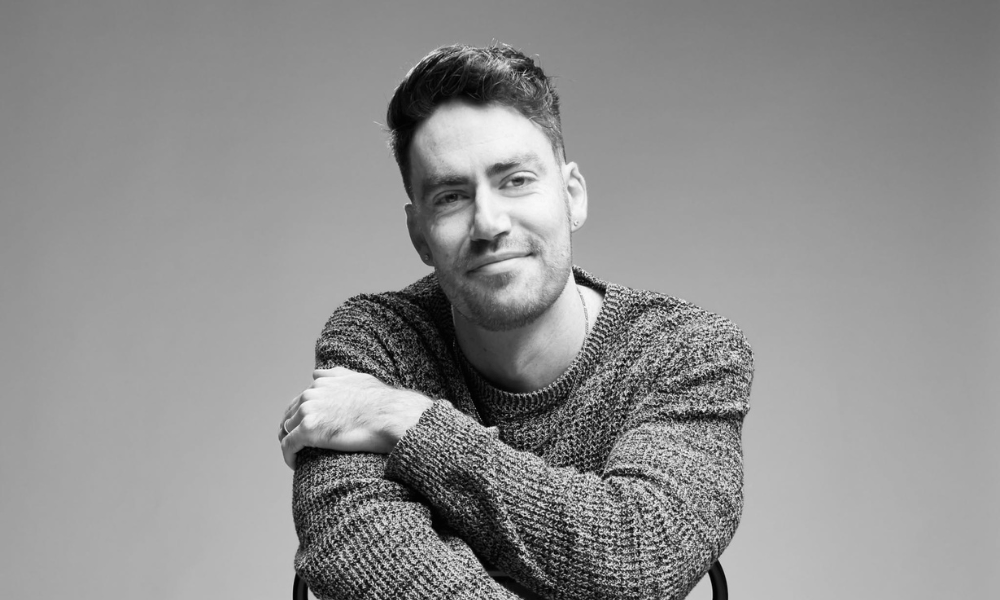
KGNU’s Rodger Hara speaks with Boulder native and composer Daniel Weidlein about his wide-ranging career as a jazz musician, film composer, orchestrator, vocalist, and recording artist. A Fairview High School graduate who went on to study at USC’s Thornton School of Music, Weidlein discusses his work in film scoring, chamber jazz, and international performance, as well as the creative influences that have shaped his music.
The conversation also explores From the Ashes, Weidlein’s ambitious new project inspired by fire ecology, climate resilience, and the life cycle of forests. Combining original music, dance, and environmental storytelling, the work reflects on both the devastation and regeneration that follow wildfire. Weidlein also shares details about upcoming performances, recordings, and collaborations with choreographer Gwendolyn Gusman. (Air Date 6/11/26).
Listen to the interview here:
Transcript:
Rodger Hara: Hey, good afternoon. I’ve got Daniel Weidlein on the KGNU airwaves. Welcome, Daniel. How are you today?
Daniel Weidlein: I’m good. Thanks, Roger. Thanks for having me. Great to be here.
Rodger Hara: You’re welcome. Where are you?
Daniel Weidlein: I am here in my recording studio in Los Angeles.
Rodger Hara: And you are a Boulder native, is that correct?
Daniel Weidlein: I am. Born and raised. I grew up in Gunbarrel, just outside the city limits. I went to Boulder Public Schools and then moved to Los Angeles to go to college and never left. But I find myself back in Colorado quite often, especially for artistic collaborations.
Rodger Hara: What high school did you go to?
Daniel Weidlein: I went to Fairview and graduated in 2008. I really cut my teeth as a musician there in a lot of ways. I studied with Steve Christopher, Ron Ravier, and Janice Vlachos, who I believe are all in the Colorado Music Educators Hall of Fame.
Rodger Hara: And what about university?
Daniel Weidlein: Then I moved here to Los Angeles to attend the University of Southern California’s Thornton School of Music, where I studied with Bob Mintzer, Russ Ferrante, and some other incredible people in the jazz world.
Rodger Hara: It sounds like the teachers you had at Fairview and the people you’ve worked with at USC have led you to the professional career you’ve had. Talk about what you’ve done professionally since you graduated.
Daniel Weidlein: I’ve had a very varied career as a musician. I’ve been working full-time as a musician since I graduated college, and even while I was still in college. That has led me in a lot of different directions.
I still think of myself primarily as a jazz musician. I have my own projects and have worked as a sideman for others. One of the reasons I came to Los Angeles was that I wanted to be involved in commercial music. I started working in recording studios while I was still in college and eventually built my way up to owning the studio I now run, BioSoul Music.
I’ve performed and toured around the world in a variety of contexts as a saxophone player, keyboard player, and singer. I sing with a vocal jazz group called M-Pact, which got its start 30 years ago at UNC in Greeley and has since become well known internationally. I took over the bass chair in that group from Trist Curless when he left to join The Manhattan Transfer.
On top of all that, I do a lot of composing, writing, and orchestrating across a wide range of genres, including pop music, musical theater, film scoring, and orchestration.
Rodger Hara: How about the film composing?
Daniel Weidlein: I’ve always loved film music. I was enamored with it from a very young age. One of the first scores that made a strong impression on me was Randy Newman’s score for A Bug’s Life, and it’s still one of my favorite film scores of all time.
From there, I started collecting soundtrack CDs, including scores from films my parents wouldn’t necessarily let me see. I distinctly remember listening to Thomas Newman’s scores for Meet Joe Black and Snow Falling on Cedars, as well as Gladiator. Of course, anything by John Williams had a huge impact on me, especially Star Wars and Jurassic Park.
I love the rich history of film music in the 20th century. In many ways, I think film music became the logical continuation of the classical music tradition.
Rodger Hara: Talk about any films you’ve orchestrated music for.
Daniel Weidlein: I’ve written music for a number of independent films. The score I’m most proud of, and my most recent full score under my own name, was for a film called Sleepwalk.
That project was especially interesting because the filmmakers ran out of money for licensed music. The film takes place in the early 1960s, and they wanted both the score and all of the source music to draw from exotica and Brazilian music from the late 1950s and early 1960s.
Because they couldn’t afford to license artists like Yma Sumac, they asked me to write all of the source music as well. I ended up creating an entire album of Brazilian-influenced exotica music. I worked with some amazing singers in Los Angeles and recreated the musical world of that era.
The final release included both the film score and a full album of original exotica and Brazilian-inspired music written to sound period-authentic.
Rodger Hara: Where did that come from? A kid from Boulder going to USC and ending up writing exotica with a Brazilian flair?
Daniel Weidlein: I just love listening and learning. I’m a student of music, and I’m fascinated by the places where different traditions and genres intersect. I don’t claim to be an expert in all of them, but I love learning about them and incorporating those influences into my work.
I also collect world flutes. Whenever I travel to a new country, I try to bring home an indigenous flute from that region. That curiosity naturally feeds into my music.
Exotica itself is a genre mashup. It draws from Brazilian music, early electronic music, jazz, and classical influences. It creates this fascinating hybrid sound.
I actually wasn’t very familiar with the music of Les Baxter, who was central to the exotica movement, until the director asked if I could write in that style. I went and did my homework, listened to a tremendous amount of his work, and incorporated those influences into the project.
Rodger Hara: Where all have you been around the world?
Daniel Weidlein: I travel quite a bit. My wife’s family is in Germany and India, so we often combine those destinations into a single trip. I have several bansuri flutes from India.
I performed in China last year and brought back a couple of flutes from there. I’ve traveled extensively throughout Central and South America and have toured quite a bit in Scandinavia. I’d love to explore more of East Asia because I really enjoyed my time performing in China.
Rodger Hara: Talk about the albums you’ve recorded in addition to the soundtrack for Sleepwalk.
Daniel Weidlein: Before we move on, another project I’m very proud of was Glitter & Doom. I didn’t write the music, but I orchestrated the film. It uses the music of the Indigo Girls to tell a beautiful LGBTQ love story through a musical format.
I orchestrated the entire film, including a brand-new song the Indigo Girls wrote for the end credits. That gave me an opportunity to exercise my symphonic orchestration skills in a really meaningful way.
As for my own albums, I released my first two solo albums in 2018 and 2019. I actually recorded both at the same time with a group of my favorite jazz musicians from the East Coast. We recorded at Audible Images in Pittsburgh and completed enough material for two albums.
Those projects represented my first real exploration of my voice as a composer. I describe my style as chamber jazz. It takes the language and improvisation of jazz and combines it with compositional techniques and textures from classical music.
My first album, Fire in the Sky, heavily features a string quartet, particularly on the title track. The second album, A Winter’s Lullaby, incorporates woodwind quintet writing and other chamber music influences.
I’m always interested in finding the place where different genres meet. Ultimately, I want to create music that belongs in a concert hall regardless of genre. I love music that gets people dancing, but my own compositional voice tends toward a seated listening experience.
Rodger Hara: Of the music you’ve recorded so far, what tracks would you like me to play now to give people an example of your work?
Daniel Weidlein: I would start with “Fire in the Sky,” the title track from that album. I’d also recommend “Wednesday Morning” from the same record.
Then from A Winter’s Lullaby, I’d suggest the first movement of “A Red Line Suite.” The vinyl release combines material from both albums under the title A Red Line Suite.
That piece came from a trip to Boston. I was riding the T, and the train conductor’s station announcements sounded so musical that I pulled out my phone and recorded them. I later transcribed the entire announcement and used it as the melodic foundation of the suite.
The track begins with the original voice memo, then the piano plays the melody, and finally the full band enters.
Rodger Hara: Very cool. Stay tuned. I’ll cue those up, play them, and then move into part two of my interview with Daniel Weidlein.
[Station underwriting announcements]
Daniel Weidlein: Support comes from Paradise Found Records, where the music never stops, located at 1646 Pearl Street in downtown Boulder. Open daily from 11 to 7. Boulder’s source for vinyl and CDs, from used classics to new releases, turntables, Bluetooth speakers, and house calls for collections. More information can be found at paradisefoundrecordsmusic.com.
Support comes from Holland & Hart, located at 1800 Broadway in Boulder, assisting clients in business litigation, intellectual property, employment and labor, and more. A full list of the firm’s capabilities can be found at hollandandhart.com.
Rodger Hara: Hey Daniel, part two. What’s next for you? Talk about the new album you’re working on, what it contains, what inspired you to write it, and what the theme will be. I also understand there’s going to be a dance component accompanying it next year.
Daniel Weidlein: Absolutely. My next album is part of a much larger project called From the Ashes.
From the Ashes is a suite of music written with the intention of becoming a full dance production. We’re first recording the music as a standalone work. The recording will be made at PS Audio’s studio, and their boutique label, Octave Records, will release it.
We’re bringing together an incredible group of musicians from Los Angeles, Montana, and Colorado, including pianist Peter Stoltzman, one of my favorite musicians. After recording the core ensemble, we’ll return to Los Angeles and overdub a string quartet throughout the album.
The project is about fire ecology and the life cycle of a forest. The inspiration came during a writing retreat at Shaver Lake in California shortly after the Creek Fire. The community had been protected, but the surrounding landscape had burned as far as the eye could see.
What struck me wasn’t only the devastation but also the incredible regeneration already underway. New saplings were emerging everywhere. It was a powerful reminder that fire, while destructive, is also a natural and necessary part of forest ecology.
Growing up, many of us were taught that all fire is bad and should be prevented at all costs. But we’re learning that healthy ecosystems require fire and that Indigenous communities have long understood how to live with it rather than simply suppress it.
The suite follows the complete life cycle of a forest. It begins in an ancient forest at dusk, moves through human interaction with the landscape, builds toward fire, explores destruction and transformation, and then follows the process of renewal and regrowth.
My hope is that the music provides an emotional access point into larger conversations about fire, climate change, ecology, and how communities can adapt.
Rodger Hara: To what extent has the Marshall Fire influenced your thinking?
Daniel Weidlein: I have multiple friends who lost family homes in the Marshall Fire. It was the first fire that directly affected people close to me in such a profound way.
More recently, I was only about ten miles from the Eaton Fire in Los Angeles, and several close friends there lost homes and instruments.
Those experiences reinforced for me both the devastation of fire and the importance of having difficult conversations about how we rebuild. We need to think beyond simply recreating what existed before and consider fire-resilient building practices and long-term coexistence with fire-prone landscapes.
The Marshall Fire wasn’t a direct inspiration for the piece, but it certainly deepened my understanding of the issues involved.
Rodger Hara: Going back to the dance, who is the choreographer?
Daniel Weidlein: The choreographer is Gwendolyn Gusman. The moment I started writing this piece, I imagined dance as part of it.
I was introduced to Gwendolyn through a series of connections, and we immediately connected artistically. She runs a company called Hold Tight and creates immersive, experiential performance work with strong ecological themes.
Before she joined this project, I worked on several of her other productions. In 2024, we premiered a collaborative work called Untethered at the Ellie Caulkins Opera House through support from Denver Arts & Venues.
After that experience, it felt natural for her to choreograph From the Ashes. The dance component is deeply moving, and we’ll be premiering the full production on the East Coast next year before bringing it to Colorado and the West Coast.
Rodger Hara: Earlier, you mentioned a film project with Gwendolyn.
Daniel Weidlein: Yes. One of our projects is called Mother, which explores relationships with mothers, motherhood, and our connection to the Earth.
We developed the work in Brooklyn and later received support from Denver Arts & Venues to adapt it into a film. The film will premiere at the Sie FilmCenter in September.
The project combines dance, personal storytelling, interviews, and original music. I composed all of the music for both the live and filmed versions.
Rodger Hara: Daniel, you’re an incredible person with the range and breadth of your musical talent and your intellectual, emotional, and spiritual curiosity. People can experience your work firsthand on July 3 at Dazzle. Do you know what time the show is?
Daniel Weidlein: It’s at 7:00 PM. It’ll be a lovely kickoff to the holiday weekend.
Rodger Hara: And then the film at the Sie FilmCenter in September. What was the date again?
Daniel Weidlein: September 10th. Tickets will be available through the Hold Tight website when they’re released.
And Roger, that’s a very kind compliment. I really credit much of that to growing up in Boulder. It’s such an incredible place to be exposed to music, intellectual curiosity, environmental awareness, and community engagement. I’m proud to be from Boulder and look forward to continuing to return and create work there.
Rodger Hara: Very cool. I’ve been chatting with Daniel Weidlein about the incredible range of work he’s produced since graduating from Fairview High School. If you’d like to see him in person, he’ll be performing July 3 at 7:00 PM at Dazzle, and his film project with Gwendolyn Gusman will be screened at the Sie FilmCenter on September 10.
Keep an eye out for future presentations of From the Ashes, his large-scale collaborative work combining music and dance. Daniel, thanks for your time, and safe travels.
Daniel Weidlein: Thank you so much, Roger. Thanks for having me.