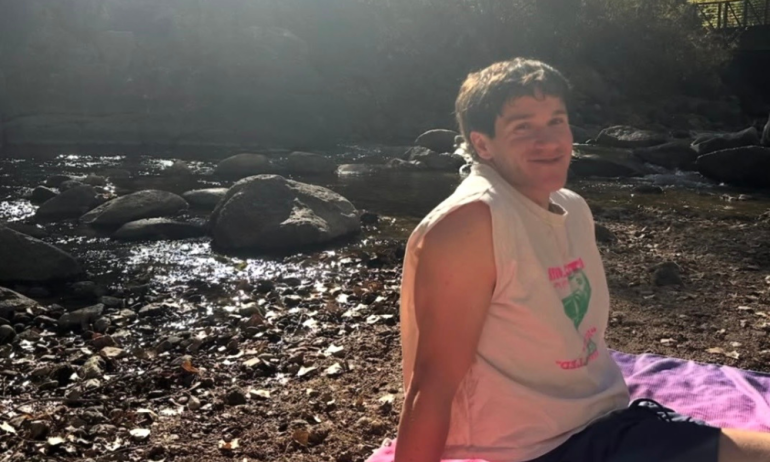

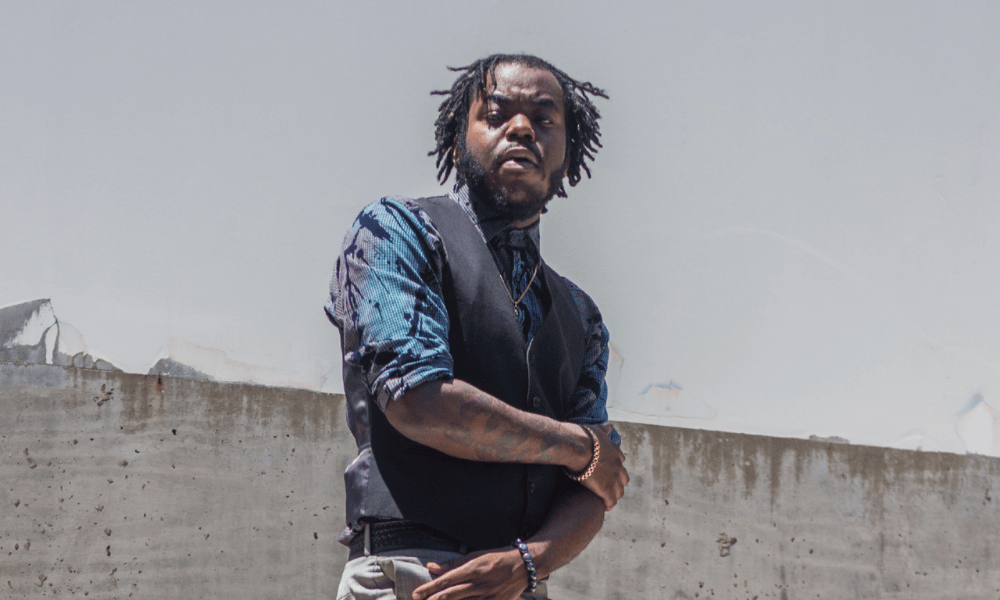
Marco Pavé, a Memphis-born hip hop artist and CU artist-in-residence, joined KGNU for a live studio session. Blending sharp lyricism with the rich musical traditions of the Mississippi Delta, Pavé spoke about carrying forward the hope and resilience of his ancestors while performing tracks that showcase his Southern roots and contemporary vision. (Studio Session: 9/23/25)
D Rider: I want to welcome Marco Pavé. He’s taken time out from his residency at CU to be here in the studio. Welcome to KGNU, Marco.
Marco Pavé: Thank you for having me.
D Rider: How about starting us out with something?
Marco Pavé: Starting us out with a song? Yeah. Alright. One of my songs from my 2018 era is called Dodgers.
(plays music)
D Rider: Marco Pavé, it’s such a pleasure to have you here at KGNU. Since we’re on the radio, let me just say a quick intro. Marco is a Black Muslim millennial from the American South, raised in Memphis. That’s a lot of background behind you—plenty to put into your songs.
Why don’t you tell us a little about being raised in a city like Memphis, and where you are now?
Marco Pavé: Memphis is an amazing city. I’m very proud to be from there. I tell people all the time in my college lecture circuit that Memphis and the Delta region created all forms of popular music we have in America—from blues to rock and roll to soul music, even contemporary trap and hip hop. All of it is derived from the Mississippi River, from the Delta people. That’s in me, that’s within me.
But also within that story there’s a lot of struggle and strife. These are people who created the blues, soul, and rock and roll while being very oppressed—because of the history of chattel slavery, because of systemic oppression. That history still reverberates through the region.
I try to put hope into my music—the hope that we can create a new future, a new reality. It’s the same hope my ancestors put into their music. That’s what I bring to hip hop and everything I do.
D Rider: Alright. Just a quick intro—Marco’s going to be here for a full week on the CU campus as Artist in Residence. [00:05:00] You’ll be teaching classes, right?
Marco Pavé: Yeah, I just taught my first class today, Music Appreciation. We went through my Grammy-nominated project Requiem for the Enslaved, which talks about the history of the GU272. That was the sale at Georgetown University.
D Rider: Well, let’s save that for a little later. We’ll talk about that throughout the week. You’ve got more classes every day, right?
Marco Pavé: Through the School of Music—different classes, different workshops. Also a live performance on campus. And on Wednesday there’ll be a public Q&A that people can attend.
D Rider: Alright. How about another song?
Marco Pavé: This next song is called Hood Obit.
(plays music)
D Rider: Alright. Some listeners, when they think of hip hop and rap, they think of people like Diddy and Drake talking about bling and money. But what you’re doing is actually poetry—real life. You’re telling people what it’s like to be a Black [00:08:00] man in America, what your experience is. And it hasn’t been the easy road.
Marco Pavé: Yeah. It’s important to have authentic representation. A lot of the stuff from mass media is packaged—they want us to act a particular way, be stereotypical in certain ways. Not that some violence isn’t happening in these communities, but it’s important for me not to glorify violence, but to shine a light on reality so we can heal and fix those things.
D Rider: Yeah. And it seems strange that we have leaders talking about violence in the Black community, but the last mass shootings have all been done by white men, and nothing gets said about that. There’s violence in every neighborhood, and you can’t turn a blind eye.
You mentioned Georgetown—let’s get into the GU272 Legacy. Was that already ongoing before you got there?
Marco Pavé: It was ongoing before I got there. They were already doing legacy work and recognition work to try to make sense of their history of selling people.
D Rider: That’s what it was all about.
Marco Pavé: The piece we made, Requiem for the Enslaved, was to honor the lives of the enslaved people who were sold in the GU272 sale. It stands for Georgetown University—272 people sold in 1838 to a plantation in Louisiana to keep Georgetown’s doors open.
D Rider: By Jesuit priests.
Marco Pavé: Yes. That was the sale. And we wanted to make the first requiem ever created for enslaved people. I think we accomplished that.
D Rider: What about the opera you were commissioned to do?
Marco Pavé: I wrote an opera in 2018 called Graceland 2030. It’s a dystopian piece exploring what Memphis—or a city like Memphis—would look like in 2030 if it continued with its current policing and oppressive policies toward vulnerable populations.
There was a yellow fever outbreak in the story that killed a lot of the population. I wrote it before COVID, but it ended up mirroring a pandemic that was on the way.
D Rider: Speaking of that, you also wrote an anti-gun violence anthem. What inspired that?
Marco Pavé: My city. Having friends and community members die from gun violence. I wanted to speak to that—and also to try to understand the mindset of someone who would use a gun to kill. My goal wasn’t to talk down to the community, but to meet them on level ground. The gun should be put away, but let’s understand the pain behind it.
D Rider: You spent five years in residency at Georgetown. How did that come about?
Marco Pavé: It was a blessing on both sides. My wife was recruited to Georgetown’s African American Studies department, so we moved our family from Memphis to DC. I already had a track record as an artist, and I thought—this is the platform I want to build. Georgetown believed in me and supported me for five years. That’s rare.
D Rider: And here at CU now—what’s been going on with you since 2024?
Marco Pavé: I’ve been writing, doing introspective work, screenplays, and developing my audio drama series Blood Bound, set in 1991 Memphis—the year we elected our first Black mayor, the year Beale Street reopened as a tourist destination, the year the Pyramid opened. It was a pivotal year.
I also dropped a new album this February with my friend Tef Poe from St. Louis called Nothing’s Easy.
D Rider: Why don’t you give us a little more music and we’ll come back.
Marco Pavé: Alright. This next song is called Moving Wrong, from my 2020 EP Crossroads.
(plays music)
D Rider: Marco Pavé is a spokesman for his generation. This isn’t gangster rap—it’s real life rap. His project Requiem for the Enslaved is now in the Library of Congress.
Marco Pavé: Right. It premiered with the Library of Congress in 2021. Because of the pandemic, it was a virtual performance, but still a huge honor.
D Rider: You’ve also toured widely—Denver, Boulder, Kansas City, Seattle, Portland, even the Kennedy Center.
Marco Pavé: Yeah, we did the Kennedy Center last year, before its takeover. That was a rare opportunity.
D Rider: Well, let’s hear another one.
Marco Pavé: This song is called Sacrifice, from my 2017 debut album Welcome to Graceland.
(plays music)
D Rider: Alright. Let’s talk about this week. On Wednesday at the Norlin Library, fifth floor, 3:30 p.m., you’ll have a public Q&A.
Marco Pavé: Yes—it’s open, but within the spirit of resilience, courage, and building an artistic life. I’ll share about growing up in Memphis, being an independent artist, the bumps and successes along the way.
D Rider: And Thursday—there’s a performance at the Imig Music Building, Chamber Hall S102, at 7:30 p.m.
Marco Pavé: Yes, a hip hop performance in a recital hall. It’ll be more intimate, with projections and storytelling—a one-man-show kind of energy.
D Rider: If you want info, go to CU Presents. Marco, it’s been a pleasure having you here. Folks can also catch the Q&A Wednesday. Why don’t you take us out with one more song?
Marco Pavé: Thank you so much for having me, Dennis.