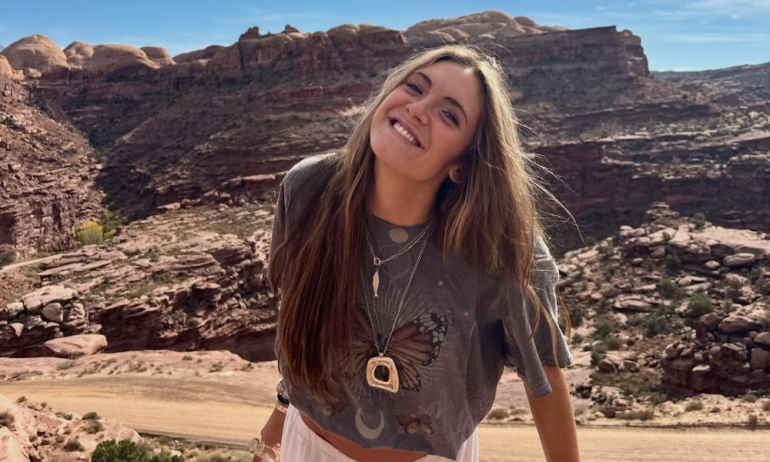

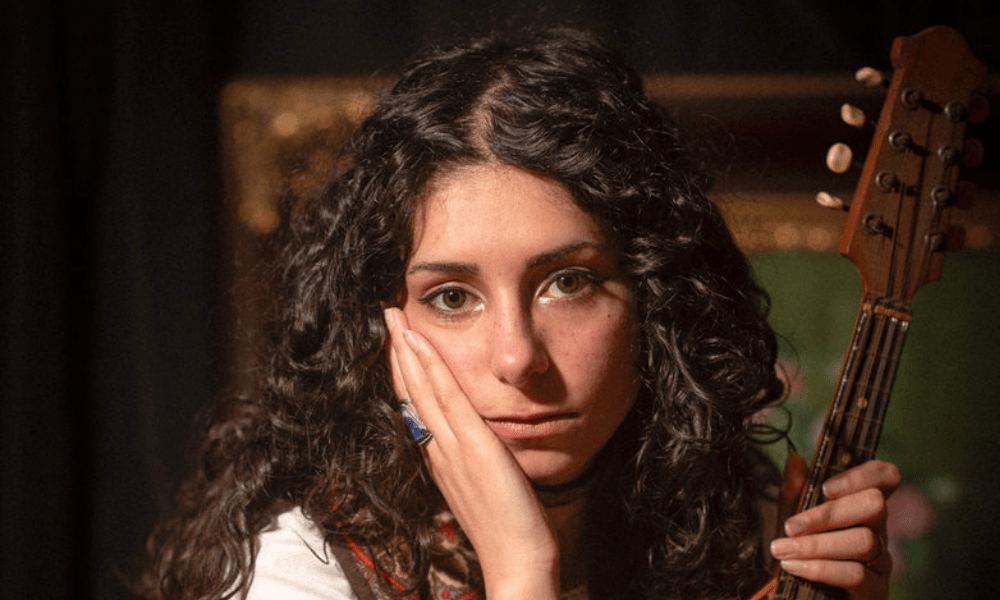
Amanda Pascali and Addison Freeman joined Rodger Hara for KGNU’s Musica Mundi for an intimate studio session and conversation ahead of their Colorado debut performances. The duo discussed their musical journey from Texas to Sicily and beyond, including Amanda’s Fulbright research translating and revitalizing Sicilian folk songs, their residency at the 2025 World Expo in Osaka, and their shared passion for folk traditions from around the world.
Blending Sicilian folk music, Americana, and contemporary storytelling, the pair performed songs from their latest album, Roses and Basil, including “Amuri,” “Hey Amorino,” and “Wake Up Baby.” Throughout the interview, they reflected on cultural exchange, language, history, and how ancient songs continue to resonate with modern audiences. (Air Date 5/6/26)
Listen to the studio session here:
Transcript:
Rodger Hara: And Addison, welcome to KGNU.
Amanda Pascali Duo: Thank you so much for having us.
Rodger Hara: You’re welcome. How are you guys tonight?
Amanda Pascali Duo: We’re good. We’re breathing in some nice mountain air, and it’s such a pleasure to be here tonight in Boulder.
Rodger Hara: Good. Where were you before you came here?
Amanda Pascali Duo: We came here from Austin, but we had the pleasure of driving here. So we got to make the ascent gradually, and we drove through some of our favorite parts of America. We got here a few days ago, and we’re so excited for a weekend full of shows in Colorado.
Rodger Hara: Have you been here before? Have you performed in Colorado before?
Amanda Pascali Duo: This is our Colorado debut, so we have not performed here before. Both of us have been to Colorado under different circumstances and at different periods of our lives, but this is the first time actually performing here.
Rodger Hara: That’s wonderful. What brought you to Colorado before?
Amanda Pascali Duo: Just breathing some good mountain air, climbing.
Rodger Hara: How do you deal with the clean, cool, crisp, thin mountain air?
Amanda Pascali Duo: You mean coming from polluted cities like we do? Drinking a lot of water and staying hydrated is important. But it is definitely a change. I’ve always loved the mountains. I think people probably have the idea that I’m more of a sea person, but I’m actually more of a mountain person. I would choose any day to be in the mountains rather than the sea.
Rodger Hara: Speaking of city person, what city are you from?
Amanda Pascali Duo: I am from Houston, Texas. We live now in Austin, Texas, but I was born in New York City.
Rodger Hara: My. How about you, Addison? Where are you from?
Amanda Pascali Duo: I grew up in San Antonio. I was born in Houston, but Texas through and through.
Rodger Hara: Neither one of you has a Texas accent. How did you manage to avoid that?
Amanda Pascali Duo: You’ll find the cities in Texas are actually very diverse. My grandmother has a very strong Texas accent. She grew up in Fort Worth in a different time. But it’s very surprising when people go to Texas. It’s very metropolitan in the cities, especially Houston. I think almost everyone in Houston is from somewhere else, whether it’s another country or another part of this country.
Rodger Hara: Talk about what led you to performing and interpreting the kind of music that you do.
Amanda Pascali Duo: I’m a huge nerd. I started writing songs when I was 12 years old, and these were songs that I wrote about my everyday life as a kid — my sisters, my family. Then as I got older, I got interested in world music because I was interested in folk music, not just from the American tradition, but from all over, from the places where I have my origins.
When I started digging deeper into the archives of world music, all from my computer screen because I’m Gen Z and very much a child of the internet, I discovered a lot of unique music from around the world at night on the internet, like Mongolian throat singing and things like that.
Then I applied for a Fulbright Fellowship to pioneer the first comprehensive project to translate and revitalize Sicilian folk songs. I was interested in Sicily as this kind of in-between space, not quite Africa, not quite Europe. I embarked on this journey to go there and translate these songs, and the project just grew and grew.
Now it’s somewhat of a digital storytelling project where I’ve been able to reach hundreds of thousands of people around the world online through videos that have gone viral of my interpretations of these songs through a Gen Z and international lens.
Rodger Hara: How did you learn to play guitar?
Amanda Pascali Duo: I’m self-taught in a lot of ways. I’ve had teachers along the way who taught me very valuable lessons, not necessarily musical lessons, but lessons about life, how to play with other people, how to act on a stage.
As I mentioned, I picked up a guitar for the first time when I was 12, and I started writing these songs. I ended up playing in a band with my teacher where we played in rowdy bars where kids were not allowed. Of course, I was a preteen girl playing in these spaces. I’ve learned a lot of things by doing and by having these strange experiences that all culminate in the music that we make now, whatever kind of box you believe it fits in or doesn’t fit in.
Rodger Hara: How old were you when you went to Sicily?
Amanda Pascali Duo: That was 2022 and 2023, so I was 24 and 25. I turned 25 when we were in Sicily. That was really a defining chapter of my life. We went there together. We got married, and we went to Sicily while I did this Fulbright project.
While we were there, we discovered so many things. We were able to play with a lot of local musicians who were interested in American music and culture. I think that further encouraged this fusion of genres and influences that makes up the music that we play now.
Rodger Hara: Did you speak Italian before you went?
Amanda Pascali Duo: Yes. I learned Italian as a teenager. A lot of people think I learned Italian at home, but I actually learned it in school. I grew up speaking only English at home, and then when the choice presented itself in school of whether to learn Spanish, French, or Italian, I chose Italian.
I really excelled in learning Italian because I already had the sounds in my ear, so it was just a matter of learning how to construct sentences. I continuously get better every day, but yes, when we started this project, I could already speak Italian fluently.
Rodger Hara: Did you learn how to speak Italian with a Sicilian accent?
Amanda Pascali Duo: It’s debatable whether I have a Sicilian accent or not. It depends on who you ask. Some people say that I do, some people say that I don’t.
I learned standard Italian — very standard Italian. I learned the textbook kind of Italian, even formal Italian, speaking with lei instead of voi, which some people use in the south and which was more common historically. I learned textbook, very formal Italian to the point where when I was in Sicily, I had to relearn a lot about what was customary to say to people because I think I was arriving at the bar saying things like, “Vorrei un caffè per favore. Buongiorno, signora,” very formally and extra. If you went to the 1800s and found me there, I probably would have sounded the same.
I think it’s safe to say I have more of a Sicilian accent in Italian than a Texas accent in English.
Rodger Hara: Addison, how did you guys meet?
Amanda Pascali Duo: We met in Austin at a folk music conference over 10 years ago. We were the only two people from Houston at this Austin music conference, so we decided to play music together. Houstonians have to stick together.
We were friends for a very long time. We still are, obviously, but we just played music and stayed friends. The adventure has continued, and our friendship has grown and taken us beyond just going to Austin. Now we get to travel the world together.
Rodger Hara: I see you sitting there with a mandolin on your knee and a fiddle in the case. What other instruments do you play?
Amanda Pascali Duo: I also play cello, which is a fairly new addition. It’s difficult to travel with, and I’m glad that we drove because it’s easier to bring a cello in a car than on a plane. I’ll be playing all three of those at our shows in the next few days.
Rodger Hara: Did you learn to speak Italian when you were in Sicily?
Amanda Pascali Duo: Yes. I’m still learning. I’m definitely not fluent, but I’m very confident in certain situations such as ordering a coffee or speaking my mind confidently when somebody is about to run me over.
Rodger Hara: Amanda, talk about what inspired you to find ancient songs and modernize them.
Amanda Pascali Duo: I’ve always been interested in history. But the aspect of taking ancient songs and modernizing them is less of a conscious thing and more of a natural result. If you take a 21st-century girl and ask her to play a song from the 19th century, it’s going to sound different no matter how true to the original she tries to be.
Through this journey of translating and revitalizing these songs, I’m learning a lot more about my ancestors, my grandparents, maybe their parents, and how they used to live. The beautiful aspect of that is that it’s allowed me to humanize them in a way that I wasn’t previously able to do.
A lot of these songs are about unrequited love. They’re about being ignored, having hopes and dreams, working the field, wondering if everything is going to be okay, having anxieties and hopes and dreams. It’s really brought to light for me how similar these people were to us right now.
Although we live in unprecedented times, a lot of the feelings we feel on a deeply human level are things our ancestors felt before us in different contexts.
Rodger Hara: Would you like to sing a couple of songs off your new album and talk about the songs and the stories they tell?
Amanda Pascali Duo: Let’s do it. This is “Roses and Basil,” my English reinterpretation of an ancient Sicilian lullaby called “La Simincina.”
Rodger Hara: That was lovely.
Amanda Pascali Duo: Thank you.
Rodger Hara: Where have you performed around the world? Where have you taken your music, and how has it been received?
Amanda Pascali Duo: We’ve played throughout Europe, the United States, and Canada. Most recently, we had a residency for two months in Japan. We played almost every day for two months in Osaka as part of the 2025 World Expo.
We were representing the United States at the USA Pavilion through the US State Department, and we also got to play at the Italy Pavilion and interact with people from all over the world who were convening in Osaka for this historic event.
Rodger Hara: My wife went to Osaka last year to the pavilion, and I’m sure she saw you. What a small world. How did the Japanese people react and receive you?
Amanda Pascali Duo: They were very receptive. We had a great experience performing for the expo attendees. Japanese people love to clap and interact.
We had a lot of fun bringing our own personalities and identities to the stage. We would play fiddle tunes and old American work songs. A lot of people in the crowd maybe didn’t speak English, but they definitely recognized the historical significance of these American songs, and that was a great privilege to witness while being so far from home and connecting with people who were well educated about our country’s history.
Not only that, but they taught us so much about their music as well. We had the chance to learn Japanese songs and sing them for people. They tell me my pronunciation was good. There’s no way to actually know that. They were probably just flattering me.
We got a chance to learn about so much amazing Japanese music and how much Japanese music has inspired other music in the West, for example the music in spaghetti westerns. It’s beautiful to see this kind of cultural diffusion and communicate with people not necessarily through language, but through art, love, and hospitality.
Rodger Hara: It’s interesting that you had that experience because it is Asian/Pacific Islander month here, and the rest of the setlist tonight is going to be music from Asia, a lot of Japanese music. I’ve included a Mongolian throat song as well.
Amanda Pascali Duo: Beautiful. Stay tuned, y’all, because that sounds like an amazing playlist. We’re always looking for new music to add to our playlists of beautiful music from Asia and throughout the world.
Rodger Hara: We record our shows, and I will send you a link to tonight’s show so you can preserve it, look at the setlist, and pick out the different songs.
Amanda Pascali Duo: Please do.
Rodger Hara: What would you like to sing next?
Amanda Pascali Duo: We’re going to play another song off our latest album. The album is Roses and Basil, and the song is the first track on the album. It’s called “Amuri,” which means love in Sicilian.
Rodger Hara: That was lovely. To get the full effect of enjoyment of the music that Amanda and Addison produce, you really need to come see them because the facial expressions while they play and sing are priceless and add so much to the feeling of the music.
So how did you get the gig in Osaka?
Amanda Pascali Duo: We applied for it, and we were awarded the opportunity. I had done work with the State Department in the past. Fulbright, for example, is a State Department program. It’s another thing that makes me very proud of our country — the fact that we’re able to participate in these exchanges of knowledge and culture around the world.
Rodger Hara: What other awards have you received for your performance and music?
Amanda Pascali Duo: I should have brought my CV. Right now I am the artist-in-residence at the American Folklife Center of the Library of Congress. I am going to embark on a research trip there to look through the archives and create a new body of work based on old songs and tunes contained within the archive in Washington, D.C., including the Alan Lomax Collection and other collections housed there.
I’m also a Harrington Fellow at the University of Texas at Austin, where I take courses and conduct research in ethnomusicology and Italian studies.
Rodger Hara: Wow. I am impressed that you’re able to take three days away from all of that and perform in Colorado.
Tomorrow night, the 7th of May at the Savoy in downtown Denver, then Friday night at the Chautauqua Community House, and after that in Greeley at a performance center there.
I noticed on your schedule that after Greeley you’re performing in Connecticut, and that is listed as a free show.
Amanda Pascali Duo: We have a tour in the Northeast after this. However, I have to mention, we are playing in Boulder on Saturday and Greeley is on Friday.
Rodger Hara: Greeley’s Friday. You’re right.
Amanda Pascali Duo: It’s a lot of shows to keep track of, and that’s a good thing because we’ve got so many shows, and we are so fortunate for that.
Yes, we are going up to Connecticut. We’re playing a free show. I believe it’s in a park, so people can bring their dogs and come hang out. Bring your favorite beverage, but make sure it’s not obvious that you’re drinking in public because we’re in the United States and that’s a thing.
We’re playing in other places in the Northeast as well. You can find all of my tour dates on my website, amandapascali.com.
Rodger Hara: That is wonderful. What would you like to conclude with this evening?
Amanda Pascali Duo: We’ll leave you with one last song, a song that I actually wrote while I was a teenager. It’s a little love song in half English, half Italian called “Hey Amorino.”
Let me tune real quick. I think it’s worth mentioning that all of these songs are available online, so people can listen to them whenever they want, wherever they want. If you’re old-fashioned, you can even order a physical copy off my website.
What a pleasure it is to be here in Boulder and on KGNU. Here’s “Hey Amorino.”
Rodger Hara: Sweet. That has a real Texas twang to it.
Amanda Pascali Duo: I love it. Thank you.
Rodger Hara: How about you guys close out with “Wake Up Baby”? Talk about the background of the song. That will be the last one, and then I’ll go into the studio and tee up the ticket giveaway afterward.
Amanda Pascali Duo: Sure thing.
Rodger Hara: This will give Addison a chance to play the fiddle, and you can get the full pleasure of all of the playing tomorrow night at The Savoy, Friday night in Greeley, and Saturday at the Chautauqua.
It has really been a pleasure having you guys here, meeting you, and hearing you. I will be at The Savoy tomorrow night.
Amanda Pascali Duo: Looking forward to it. Thank you so much.
Rodger Hara: Safe travels. Enjoy your time in Colorado and wherever you go afterward. I look forward to watching you grow and blossom and continue expanding knowledge and feeling with the music that you make.
Amanda Pascali Duo: Thank you so much, Roger. And thank you to KGNU.
Rodger Hara: Amanda Pascali and Addison Freeman, “Wake Up Baby,” lead single from the Roses and Basil album. You can see and hear Amanda and Addison tomorrow night at The Savoy, Friday night at Cottonwood Cottage Concerts in Greeley, and Saturday night at the Chautauqua Community House at 7:30 PM.