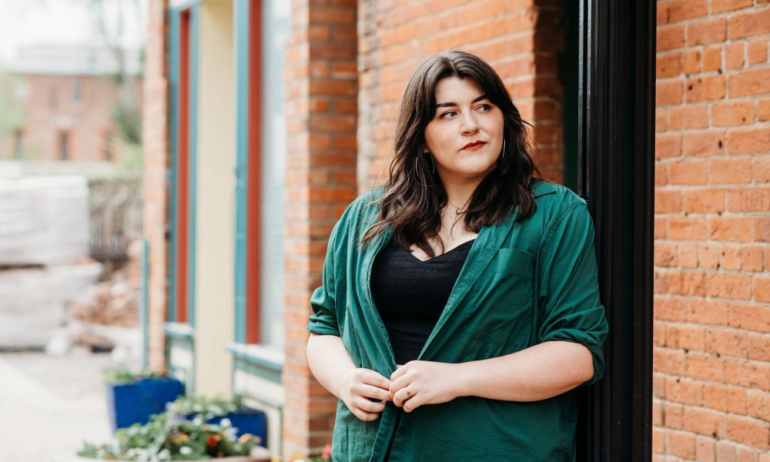

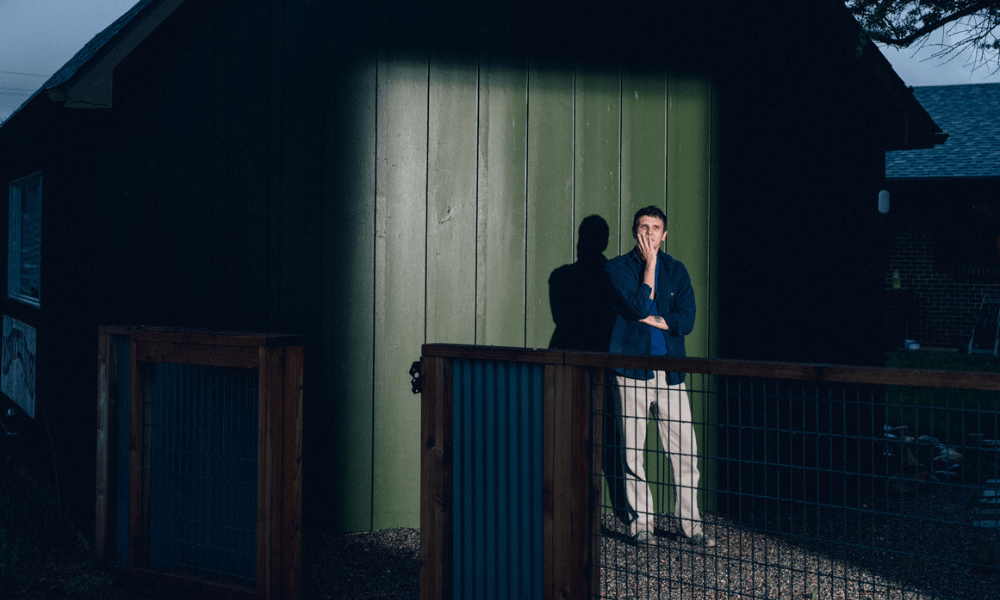
KGNU is a proud sponsor of the Lafayette Electronic Arts Festival (LEAF). Ahead of his performance at LEAF, local musician and interdisciplinary artist M. Sage joined KGNU’s Indra Raj for a live in-studio performance and conversation about his latest album, Tender Waiting, his roots in Colorado’s DIY music scene, and his immersive creative practice blending field recordings, electronics, piano, and clarinet.
M. Sage has a performance on Thursday, May 28 at 7PM at the Center for Musical Arts, 200 E. Baseline Rd. in Lafayette. Tickets and more information are available at https://leafcolorado.org/leaf-2026-m-sage/ (Air Date 5/21/26).
Listen to the local gold here:
Transcript:
Indra Raj: Right now, I’m so excited. We are welcoming local musician M Sage to the studio. So welcome.
M. Sage: Hi, thanks for having me.
Indra Raj: It’s great to have you, and I’m personally very excited because I’ve been following your music for a while. When I saw you were going to be a part of the LEAF Arts Festival and that we were going to be able to have you in, it was so exciting.
M. Sage: Super exciting. Thanks for having me. It’s awesome to be here.
Indra Raj: Yeah, it’s great to have you. Typically I will just have an artist get right into music so that we can get a taste of it, but you’re going to be playing some longer pieces of music today, so we’re just going to do a couple of them. Maybe to start off, you could give our listeners a preview of what you’re going to be playing first for us today.
M. Sage: Absolutely. I’m playing some material off of my latest record, which is called Tender Waiting, and it’s out on a label called Revenge International out of New York. It’s about a post-digital homesteader experience where my partner and I moved to our house in Berthoud, not too far from here, and are trying to help rehabilitate this piece of property while also being terminally online, for better or worse.
It’s pastoral and glitchy, and I think it fits into a Colorado living experience and also an online listening experience.
Indra Raj: Yeah, like a modern life experience in some ways.
M. Sage: Absolutely.
Indra Raj: Great. Okay, well, why don’t we hear that, and then we’ll chat more afterwards?
M. Sage: Sounds good. Thanks.
[Music]
Indra Raj: Listening to a live session with M Sage, local artist who is going to be performing at the Lafayette Electronic Arts Festival next Thursday, May 28th, at the Center for Musical Arts in Lafayette on Baseline Road. Thank you for sharing that piece of music.
M. Sage: Thank you. Thanks for having me.
Indra Raj: Of course. I have so many questions just from hearing that, but I think let’s take it back to basics.
M. Sage: Yeah.
Indra Raj: I would love to hear your story as a musician, how you arrived in the place where you are now. I know it’s multifaceted, so however you want to tell it.
M. Sage: It’s been kind of a long road, but I first started playing music when I was seven or eight. My parents got me a drum set, and I grew up in the church and was playing in worship bands and things like that. That’s how I learned how to be in a band and how to play music.
Then in my teens, I got into punk music, thanks to local record stores in Fort Collins like The Finest and ABCDs, which are both no longer around. Clerks there turned me in the right wrong directions at an early age, and I got into pretty weird experimental stuff in my teens.
From there, I went straight from punk bands to being a guy who was into weird noise, electronic, and experimental stuff. I ended up going to some incredible shows on the Front Range at places like Monkey Mania and Rhinoceropolis, and I was in DIY bands and all that kind of stuff.
Then in 2014, my partner and I moved to Chicago, and that’s where the influence of jazz and improvised music meshed with my table-full-of-electronics noise experience. The Chicago music community was really warm and inviting. I was there from 2014 to 2022 and played a lot of music out there.
I was also a teacher, but music has always been a thing throughout everything. Then we moved back here, and that’s when I started working on the material that became the record I just played from.
That’s a really truncated version, but it’s been an interesting path with a lot of curves and lots of shows in cool places, weird places, and awesome places like this booth here.
Indra Raj: Absolutely. I think it’s also a testament to something that I’ve not been aware of as someone who grew up on the Front Range too. That DIY scene has been alive and well for a long time, but I think it’s even more at the forefront of people’s awareness these days, which is great.
A festival like LEAF has been around for a very long time, and it’s a testament to the wonderful DIY scene here on the Front Range.
M. Sage: Absolutely. This is the 10-year anniversary of LEAF from what I understand, so that’s really exciting. A decade is a long time to be doing any kind of programming, especially programming that’s a little more experimental and adventurous. I think it’s a huge accomplishment.
Indra Raj: Absolutely.
M. Sage: Yeah.
Indra Raj: You went to the Art Institute of Chicago and studied writing and intermedia arts. Can you explain what intermedia arts means?
M. Sage: I’m glad you asked this, because I prepped for this question. So thank you.
Intermedia is a term that was coined by Dick Higgins, who was an artist and educator in the Fluxus movement in the ’60s and ’70s, around the beginning of conceptual art. Higgins was really interested in artworks that didn’t land neatly in one category. It was a painting that was a performance that became a poem that was a sculpture.
This idea seems so commonplace now in contemporary or experimental art, but at the time, from what I understand historically, it was more like you were either a painter or a writer. Artists like Yoko Ono broke the shackles off of that.
Higgins was watching all of this happen, and he made a Venn diagram, which I love. The diagram showed all these overlapping artistic mediums — poetry, mail art, dance — and he was interested in the overlaps between multiple mediums.
When I saw this in grad school, I thought, “Oh my goodness, this is the thing I’ve been looking for my whole life,” because I’ve never just been a musician or just been a writer. Everything’s always been mixed up somehow.
It felt like there was finally a celebrated and canonized term for this weird thing that I do. SAIC was really welcoming because I got to be in the writing department while also taking classes in sound, drawing, painting, digital arts, coding, and more, and then mash it all together into the thing I do now.
Indra Raj: That’s really cool. I had not heard the term Fluxus before today, but that’s wonderful — that you found a space where you could really settle in and say, “This is who I am.”
M. Sage: Yeah, and it gives you ownership over this thing. Often when you’re in an arts community and explaining, “I make sculptures that are poems that are songs,” you have to relay a whole paragraph. Instead, you can say, “I’m part of the history of intermedia,” and people understand that means you work across different forms.
Indra Raj: Absolutely. It feels more and more obvious to me as I get older that all these different art forms inform one another and bounce off one another. That’s what makes creativity so special across artistic mediums.
M. Sage: Absolutely. Thanks.
Indra Raj: Is that going to be part of the experience at your performance next Thursday?
M. Sage: Yeah, absolutely. When I’m making songs, there’s always a visual counterpart in my mind or practice. I’m always collecting images and reading books. I love having an opportunity at a festival like LEAF to lean into that more.
I’ll have projections, and they’ll include footage from research projects around making this album and also literal trash from my house that I found really beautiful.
When we bought this house, it had not been taken care of for over 30 years. We didn’t just buy two and a half acres and a rundown house — we also bought piles of trash. It felt like an interesting moment to excavate some of this inherited Front Range history and try to find something beautiful in it.
I think that’s also a testament to where we’re at ecologically and sociopolitically. There’s definitely a political message in some of the video and performance work, but I also think it’s nature writing at heart. It’s pastoral, and it’s about being not just in a landscape but part of it.
Indra Raj: That’s so beautiful — finding beauty in a situation some people might find very annoying.
M. Sage: It was definitely annoying too. We’ve had to do four roll-offs of trash at our house. It’s been a huge project. But this is the year where we get to focus less on trash and more on our garden, and that’s been the goal.
Indra Raj: That’s a beautiful thing.
M. Sage: Yeah, it is.
Indra Raj: Before we get back into the music, are you going to play the second part of what you started earlier?
M. Sage: Yeah.
Indra Raj: I want to dig into the composition a little bit. You hear recordings of birds, the sound of a car going by, and other environmental sounds. What are some of the sounds included in this piece?
M. Sage: I’ve been collecting field recordings from around our property since we moved in. A lot of it is pastoral bugs, and there are western toads in the ditch at the front of our house, so there are some really nice toad recordings. We also live off a county road, so there’s plenty of traffic going by.
Part of it was trying to capture the place. I also use a device that catches signal interference — a kind of digital listener. I record signal interference from passing cars or my cell phone going off.
I’m interested in putting these recordings together because I think it reflects where we are now culturally. As Coloradans, we’re outdoorsy people. We hike and run and do all these things, but we’re also constantly collecting and sharing data.
Does your run count if you don’t Instagram it? Do my tomatoes taste good if I don’t make a reel about them? I’m really interested in putting the pastoral and the beautiful next to this late-capitalist, glitched-out data-center moment we’re in.
There are no answers in putting those things together, but if you point at it, maybe we can all look at it together at the same time.
As far as the musical components, I write a lot on the piano. I also started learning clarinet when we moved to our house because I wanted an instrument I could carry around the pasture between chores.
I got a clarinet for 80 bucks at a junk store, fixed it up, and immediately plugged it into electronics to see how I could mess it up. It’s been a really fun learning curve incorporating the clarinet into this chapter of my practice.
Indra Raj: You answered my next question, which was whether you always had the sound of a clarinet in mind while conceiving this piece.
M. Sage: Kind of. I knew I wanted a woodwind. I’m in a band called Fuba Pushi with Patrick Shiroishi, who I think is one of the best saxophone players of our generation. He’s incredible.
I couldn’t really step to the saxophone, even though he kept telling me I should. I liked that the clarinet felt elemental and connected to the place I’m in. It also sits in a similar register to my voice.
I’ve sung on music in the past, but this felt like a way for the clarinet to proxy my voice and stand in for me as a singer — as a person breathing life into these compositions.
Once I started playing the clarinet, I realized there was a lot of potential there for me. I still had a steep learning curve, though, and I had to learn how to write on the piano for my novice clarinet playing. That shaped the album in a major way.
Now I’ve played it enough that hopefully you can’t tell, but maybe that was the point.
Indra Raj: I like the connection to voice because there’s a very enticing melodic aspect to this piece of music.
M. Sage: Thank you.
Indra Raj: We should listen to more of it. We’re listening to M Sage live in the KGNU studio today. M Sage will be performing as part of the Lafayette Electronic Arts Festival happening next week at the Center for Musical Arts in Lafayette.
Let’s hear the second part of your composition.
M. Sage: Great. The first part was sort of three songs — a first act — and now we’re going to do another three songs. It’ll be about a 10-minute ride. Thank you.
[Music]
Indra Raj: That was M Sage live in the KGNU studios. Thank you so much for playing your music for us today.
M. Sage: Thank you for having me. It means a lot.
Indra Raj: It’s wonderful to have you. One more plug for next Thursday — you’ll be at the Lafayette Electronic Arts Festival at the Center for Musical Arts. What else is on the horizon for you as an artist?
M. Sage: I just came off a long period on the bench because I had shoulder surgery, so I haven’t been able to play much. Over the last few weeks I’ve finally been getting back into it.
I played Los Angeles a couple weekends ago, and this past weekend Wendy and Carl — ambient guitar legends — played in town, and I got to play with them.
The next little bit is about continuing to recover while also playing more shows and working on new material. I just put out a record with my songwriting partner in Fubar Sushi, Chaz Primick. The record is called Shelter, and we’ve been playing those songs recently.
I’m in that exciting moment where I have a bunch of new stuff to work on, and hopefully this summer I’ll get some studio time to develop it further.
Indra Raj: Lots of great things on the horizon. How can people stay in touch with what you’re up to?
M. Sage: For better or worse, I’m on Instagram too much. My handle is @matthewjsage, and that’s where I do most of my promotion and updates.
I also have a Substack called Tall Grass Dispatch where I write about my practice, gardening, records I like, and things like that. So if you’re a Substack person, that’s another place to keep up with what I’m doing.
Indra Raj: Lovely. It’s been such a pleasure to have you at KGNU. Thank you so much for making the time.
M. Sage: Thank you so much for having me. It means a lot.