
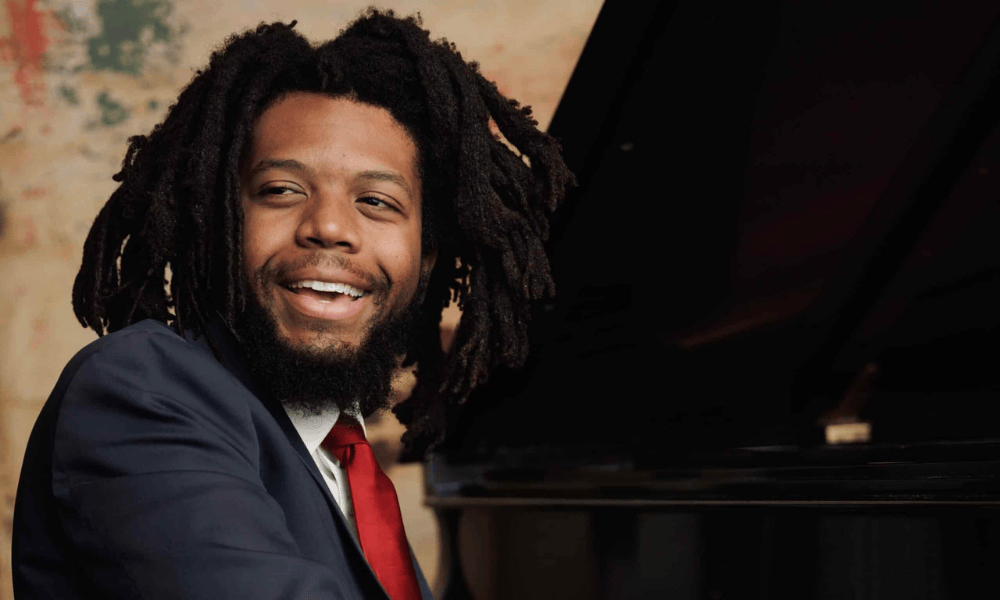
Pianist and composer Sean Mason joined Indra Raj on KGNU to talk about his path from Charlotte to becoming a Grammy-nominated jazz artist. He shared how he blends tradition with innovation, the cultural influences behind his music, and his collaboration with vocalist Catherine Russell. Mason will perform in Denver with MAS Presents at the Savoy on Thursday, October 2nd, and on Friday, October 3rd with Catherine Russell, ahead of the release of his new album A Breath of Fresh Air.
Indra Raj: This is KGNU Community Radio. My name is Indra Raj, and today I am pleased to introduce Sean Mason, a pianist and composer whose music blends southern tradition with jazz innovation, a rising star from Charlotte, North Carolina.
He’s collaborated with Branford and Wynton Maral. Contributed to Broadway productions and leads to dynamic Sean Mason Quartet. His recordings, including the Southern Suite and my ideal showcase, a deep musicality and forward-thinking vision, earning him a 2025 Grammy nomination. Sean joins us today ahead of his shows with Moss presents in Denver at the Savoy on Thursday, October 2nd, and on Friday October 3rd when jazz vocalist Catherine Russell will join him.
Sean Mason, welcome to KGNU.
Sean Mason: Thanks for having me. It’s great to be here.
Indra Raj: Great to have you. And you know, you have such an impressive career as an artist and musician, but I’d like to hear about how it all began. So how [00:01:00] did you get your start in music?
Sean Mason: I started playing when I was 13 is when I started playing the piano, but music has been a part of my life. Since I was a child. I mean, I, I think everybody says that, but I decided to, to take it more seriously and, and I loved music so much. I, I decided to give a shot to, to learn an instrument and to try to play it.
And I really loved music ever since I was a child. And I used to go to church and hear music, and there was music always playing in the house. And we would always be dancing at school. So music was always a part of the culture and I wanted to give my shot at, at actually playing it and, and trying to create it.
Indra Raj: And you know, sometimes in this day and age in jazz pedagogy, it can be very technical and kind of siloed, but you’ve obviously stepped out of that into different spaces. And Broadway, you’re talking about going to church, dancing, all the things that come along with it. And on your latest album, my ideal.
It, uh, I believe you said that it includes the intersection of Renaissance and street culture. So can you tell me a little bit more about what [00:02:00] you meant by that?
Sean Mason: That was for the debut album that I released, the Southern Suite. My ideal was the record I did with Katherine, and that was a completely different creative direction. and both of ’em are great. I think the Southern Suite, what I meant by that statement is, is you kind of hit it, hit it on the nail without even knowing it by prefacing your question, which is that, you know, sometimes this music goes away from the culture and so it’s, it’s stuck in a classroom and there’s no culture in a classroom and there’s no culture in a controlled space.
I think controlled space is a really. Only designed for, and optimally designed for very specific task of learning. But we kind of have to be out here in the world in order to learn. And we have to, as artists be what I like to call culture cultures and, and really absorb culture from all around the world and try to try to do our best to be as open-minded to different cultures and different people and different food and different this and that and that.
And so the Southern Suite specifically took two separate. Cultures that I like that are kind of pitted against each other, which is like this upper echelon of culture. [00:03:00] Um, Which exists all, all throughout the United States and all throughout the world, but really started in the northeast, and then this street culture kind of phenomenon.
And I wanted to, to kind of marry those two things together sonically, so through, through notes and through compositions and through forms and through the way we improvise. So yeah, you, you kind of answered it by, by the way you prefaced the question and I think that was a very important observation that you made.
Indra Raj: Yeah, and there are probably, I imagine as you’re putting it all together, so many, even just technical connections between Renaissance music and what you might consider music from street culture these days. I would, I would think, is that true?
Sean Mason: I try to see the through line between all music. Um. I consider myself lucky to be able to see the through line. Even talking about like the baroque where I see a real big through line. The most obvious through line of course is Bach to jazz. but I, I see a through line musically, but I also see a throughline culture.
I don’t think the human condition has changed that much. And you know, jazz is very unique and. [00:04:00] where it was birthed, like in the world and at the specific time that it was birthed, and then like what was happening from a technological perspective, like the invention of recorded music. Like all of these things like mattered.
And they, they are what produced this music that we love. And so I, I love to pay attention to history and I love to, to let history inform what I’m doing now, but I, I dare not say I shy away from contemporary culture in all forms, not just like. What that means in a very surface level. But I try to pay attention to what’s happening now, and I always just try to go out and hear loud music, all different kinds of music and, you know, street culture is what’s happening on the street.
it’s not just like street wear in fashion, it’s, it’s what’s happening in the street everywhere. I just love to pay attention to what actual, just regular, normal people are doing on the street. It, it really inspires me.
Indra Raj: Yeah, and jazz music is meant to be, it’s meant to always change. It’s meant to be improvisational, so it’s the perfect medium to meet culture as it’s changing all the time.
Sean Mason: Yeah, [00:05:00] it’s, it’s, uh, it’s an, it, it, it has an interesting story. It has an interesting root you know, my, my job as an artist is to study the people that came before me and see their trajectory of their careers and how they dealt with this music. And then for me, I wanna honor that. I think, you know, we have to be careful in the sense that if you’re too in front of the curve, you risk really disrespecting the ancestors.
You know, we see that a lot in the music, but if you’re too behind the curve, you risk not really being present in the moment. So it’s an eternal dance really. You know, you don’t want to, you wanna really respect the people that came before you, so Duke and you know, but, but you also don’t want to be a caricature of the past.
And the time capsule of the past. So it’s, it’s a, it’s a very hard balance to strike actually, because it, it not, not many people can strike it, and I’m still working on it every day. It’s a hard balance to strike of like, not leaning too far this way, not leaning too far that way, and to just be yourself as an artist and to be inspired by both the front end of the curve and the back end of the curve.
Indra Raj: So when you’re trying something new, do you ever catch yourself feeling, I don’t know if this is the right word, but [00:06:00] maybe guilt or I’m not, maybe I, I wasn’t thinking enough about the greats as I’m moving into this new space, or how does that feel for you in the moment when you’re creating something kind of innovative?
Sean Mason: Yeah, I think I’ll answer that in two ways. The first way is that. It is hard for me to use the word try when creating art. I don’t know if I’m trying to do anything innovative, but I think that that feeling of guilt is very real in the jazz community. It doesn’t, it doesn’t, it’s not talked about a lot.
And I think where it really comes from is a lack of, studying and stewardship from the artist. So the guilt comes from this subconscious thing where like. The more I listen to records and the more I study the past, the less guilt I feel because I feel very connected with the ancestors, with the history of the music.
But I think the guilt comes from when you’ve been, Sorry, I was gonna use the curse word when you’ve been, slacking or something, whatever, and like not studying and not shedding, then you can feel a sense of guilt and then you can either do two things with that guilt.
You can either like. Stop what you’re doing and go back and play the [00:07:00] music of the past and play tunes and play standards. Or you can take the arrogant, cocky approach, which is like doubling down on what you’re doing when it’s not rooted in anything, and I found to solve that problem. I just listen to more records, read the line of notes, stay off my devices shed and learn as much music as I can.
But I don’t think I’m trying to be innovative. I think I’m, I’m playing music that I hear and the more music I can absorb, the more stuff that my brain has to like piece through, which is great because then what it spits out when I’m writing a tune, when I’m playing surprises me at all times. And so I just keep trying to study and keep trying to shed and stay on my toes, you know.
Indra Raj: so forgive me for getting it wrong earlier. My ideal, as you said, is your record with Katherine Russell, who you will be performing with. On Friday, October 3rd at Moss Presents. How exciting. She’s such a legend and love her. what was it like working with Catherine?
Like, what is your guys’ journey together?
Sean Mason: Yeah, I think I met Kat like a year before the pandemic, so 2019, and we did this like. Tribute show at Jazz and Lincoln Center in New York City. And we were [00:08:00] paying tribute to Thelonious Monk. And she was on the gig. And I was on the gig, and that’s how we met. So that was the first time we met. And then we, I think she really liked my playing and she called me to, to play some gigs and eventually called me to join her band.
And then, um, so I was in her band for a couple years and it was great. And she brought up an idea to do a duo record and, um. I was like, yeah, let’s, let’s do it. And I love, I love playing duo. It’s really challenging as a pianist to play duo. It’s also really challenging to play with the vocalists in general, whether it’s duo or not.
And so adding that extra challenge, I love, I love being challenged. And so I really took that record seriously and really studied really hard for it. And that’s a perfect example of like how to balance the old versus the new, because the repertoires from the 1920s to the 1960s, and so like how do you.
How do you play that music today without sounding like a caricature? How does it, how does it live in 2025? How do you honor something without, you know, worshiping it? How do you, how do you always make that balance and how can you always put you into the music? And I think that we really did a good job with my ideal to put ourselves into that music.
And, and, and it felt natural. [00:09:00] It didn’t feel forced. There was no guilt. There was no pressure. You know, like, I’m glad you brought that up. ’cause a lot of musicians talk about that, but I don’t. I just try to like be myself in, in every situation and eventually I, I guess I had to just tune out when I was younger.
I mean, I’m still young of course, but when I was like really young, like really starting my career, like straight outta high school, going to college in New York, I really felt it because I didn’t have a sense of identity and I guess I had to just eventually learn how to just ignore people. and the critiques of people, ’cause the jazz criticism is, is serious, you know?
I just ignore everybody ’cause nobody, they can’t play, most of the critics can’t even play instruments and, you know, it’s, it’s, it’s very ironic, but I just had to ignore all of ’em ’cause they, you can’t really please everybody. I think at the beginning I was trying to like, please the jazz enthusiasts, but also like.
Like those thoughts were going through my head. I don’t think I was consciously trying to please anything. Like, I never thought like that, but like they were in my head. But now I’m just like, I, I just don’t even care. I’m just, this is just who I am. Either like it or you don’t, and I don’t care. You know?
So I think we did that on my ideal. We just, we just played the blues [00:10:00] and we played it so seriously, and it was so much fun to make that record. And I hope people enjoy it. I mean, we got good recognition of it, but I, I, I love playing with Kat. That was a, that was a blast to make that record.
Indra Raj: I haven’t talked to a ton of jazz pianists and I, you mentioned it a little bit, you know, like playing in a duo, playing with a vocalist. But what is it like for people who have never been in a band, never played an instrument, don’t know what it’s like, what is it like being a jazz pianist?
In the scene and in a band, like what do you feel as that specific person and instrumentalist in like a typical jazz combo?
Sean Mason: you’re like the friend. If you’re like, let’s say it’s a group of five, like a quintet, you’re like the friend in the dinner that has to like hold. Everybody together while also asserting your position. So it’s different than the bass player. The bass player actually holds things together.
So the bass player is the ground. The pianist has to assert a lot. the pianist has to please two different people, like the bass and the drums [00:11:00] as the rhythm section on the left side. And then like the horn players or the vocalist, or like those frontline people on the right side. And you’re in the middle.
You, you actually don’t belong to either of those camps, so you have to be assertive to both camps. You have to make both camps agree, and you’re kind of the glue between those, those two camps and the art of comping, which is short for accompanying and jazz. The art of comping as a pianist is like to me.
Really the icing on the cake of what really brings the energy to a band. to me it’s not the drums. I think it’s the comping of the piano that brings a certain level of energy to the band where you can switch out the piano player and based on their comping, the energy will go from here to here. And it’s like that with every instrument to a certain extent.
But comping, I think, is the most noticeable. So it’s, it’s a being on the scene. If you mean by that, like in New York, I don’t live in New York anymore. I moved out like two years ago. But being on the scene. I guess when I was on the scene was like, like hell on earth. I mean, you’re, you’re like gigging, you know, from like 11:00 AM like, you’re like, you’re waking up, you have an 11:00 AM to [00:12:00] 5:00 PM like rehearsal.
Or like when I was doing Broadway stuff, it was like a Broadway rehearsal. And then like you play a gig at seven and then once that’s over, you get on the train and you rush to your next gig at 10, and then you’re done at one, and then you go out and get drunk and then you go home at four. I mean, it was just, and then you wake up and do it again.
It was, it was literally held on earth. And so being on the scene, but it is, it’s unchanging. It’s always been like that. Like when you read Herbie’s autobiography, when you read Mouse’s autobiography, it’s always been like that. It’s not like, and actually it was worse back then because they had heroin. I’m not saying heroin is, I mean, of course you can get it if you want, but like, it’s definitely not as pervasive as it was in the forties and fifties.
And so like, the scene is the scene and, um, you know, it, it just will always be the scene. We’re just walking zombies and you know, I, I figured like I had enough of the scene and I was like, all right, I, I’m good. But it was great. It’s great to do it when you’re young. It’s a great experience to be a jazz musician and live that stereotypical jazz life.
It’s incredible.
Indra Raj: Back to what you were saying about being an actual pianist in a band, though, it’s, it’s like you have so much power as a pianist. ’cause you can do so much. You can be the [00:13:00] baseline, you can’t even be the rhythm section. You can be the melody. I’ve always noticed when watching jazz combos that the pianists who show the most restraint.
Really insert themselves where they need to. It’s all so impressive and it’s such a, it’s such a cool place to be in the band. I, I feel like you hold a lot of power.
Sean Mason: We hold, I think, I mean, I’m biased. I think we hold the most power in the band because of we’re in the middle. We don’t get enough credit, especially with vocalists. Oh my God, we, we can either make a vocalist sound very good or we can make them sound very bad. And the pianist usually is the music director and they usually don’t get any credit whatsoever.
And it’s, it’s perfectly fine. But the pianist is the. We are making the magic work. We’re, we’re talking musically to the bass and drums, harmonically and rhythmically. And then we’re also like making sure the frontline people are stars and like we make them sound as best as they can by comping and accompanying behind them.
So I, I do, I’m biased, but I do think we have the most power in the band for sure.
Indra Raj: Everyone should respect their pianists. That’s how, that’s how [00:14:00] I feel.
Sean Mason: And they’ve never respected them if it’s been hundreds of years. The pianist is, they just, it is just, it’s the life. It’s incredible. We joke about it internally, like in the community of pianists, especially with vocalists. Kat is different. Kat actually respects the band. She’s one of one, she, it’s rare to find a vocalist that like actually appreciates it and tells them, thank you, and like.
She’s not, she has, she has no ego. She’s not a diva. She’s just like a pure artist. And so it’s really refreshing to work with Kat as opposed to other different types of people that are like just, oh my God. It’s just crazy. And so we, we talk about it internally as the pianist community, but yes, we hold a lot of power.
Indra Raj: All right, and I won’t take up too much more of your time, but one last question is you are just moving and shaking. You have so much going on, so much energy. What is in the hopper for you? What’s next?
Sean Mason: so I’ve released the first two singles from my upcoming album, and they’ve been doing great. The first one is called Rediscovery. The second one is called Open Your Heart. The album is coming out on October 24th, so that’s what’s next. I’m in [00:15:00] like album release, album rollout mode, and really excited to share that music with the world.
The album is called A Breath of Fresh Air, and so I love new music. I love releasing albums. Albums. I feel like they’re like my children. I don’t have any children yet. But for right now, albums take that place. Like I just put all my love into the album, so I, I can’t wait until this releases out into the world.
So that’s what’s next for and playing in Denver and playing on tour and all the, the regular day-to-day stuff that I’m also doing too.
Indra Raj: Well, Sean Mason will be performing at Moss Presents at the Savoy in Denver Thursday, October 2nd, and Friday, October 3rd with Katherine Russell, Sean Mason, thank you so much for joining me today.
Sean Mason: My pleasure. Thank you. Have a good one.