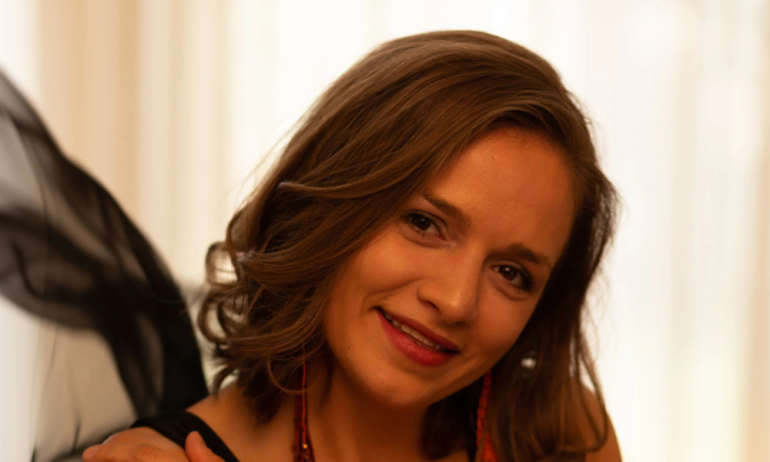

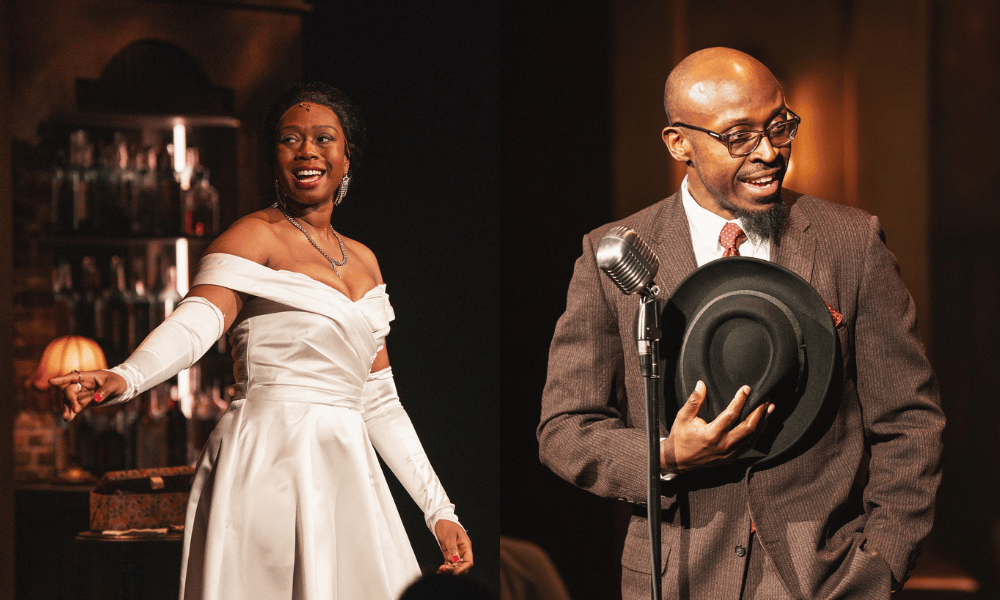
On KGNU Jazz Lives, host Rodger Hara speaks with actress Essence Anisa Tyler and pianist Jodel Charles about their performances in Lady Day at Emerson’s Bar and Grill at the Arvada Center. Tyler portrays Billie Holiday in the singer’s final 1959 performance, while Charles plays piano onstage and takes a small acting role. They discuss their artistic backgrounds, how they connected with director Chris Paige, and the emotional and historical depth of the production. Both reflect on the show’s themes of race, resilience, and legacy, noting how its portrayal of Billie Holiday’s struggles still resonates today. The production runs through November 2 at the Arvada Center. (Interview: 10/23/25)
Rodger Hara: Welcome to KGNU Jazz Lives. I’ve got Essence and Jodel on the line talking about Lady Day at Emerson’s Bar and Grill at the Arvada Center.
Essence Anisa Tyler: Good! How are you?
Jodel Charles: Yeah, very good, Rodger. Thank you for having us. How are you doing?
Rodger Hara: I’m doing well, thank you. Tell me about yourselves—where are you from, and how did you get connected with the show?
Essence Anisa Tyler: I met the director for Lady Day, Chris Paige, in St. Louis when I was about 21. We did a children’s show together, and that’s how I was first introduced to him. That was a few years ago. He later sent me an audition for this show, I auditioned, and now we’re here.
Rodger Hara: What’s your background? How did you get into performing arts?
Essence Anisa Tyler: Both of my parents are actors. My dad no longer acts, but my mom is still heavily involved—she’s a director, an actor, and was a theater professor for 15 to 20 years. I grew up in the theater. I took dance classes when I was younger, and when I got older, I took voice lessons and started doing musical theater. I worked at a theater called The Muni as a kid and grew up doing shows there. I went to school for musical theater for a little while, then I left. So, my background is theater and musical theater—with a little dance and a little singing—based in St. Louis.
Rodger Hara: Excellent. And Jodel, how about you? Where are you from, and what’s your background?
Jodel Charles: Yeah, before I go into my background—Essence went to Carnegie Mellon for a bit. We don’t have to gloss over that; her pedigree is amazing.
But for me—I was born and raised in Haiti. I moved to the States when I was about 17 and went to Boston, where I attended the Boston Conservatory, which is now part of Berklee College of Music. I got a degree in piano performance, as well as some other degrees in engineering—we’re not going to talk about those!
I started out purely classical, but when I moved to the States, I was introduced to gospel and jazz. I do a little bit of everything—I produce, mix, master, and engineer, across genres from classical to jazz, R&B, hip-hop, soul, and neo-soul. I’ve toured and performed with some great artists.
I got introduced to this show because I did Gypsy Jazz in a Nutshell with Cleo Parker Robinson at the Aurora Fox with a full ensemble. Cleo wanted to do a more distilled version of it, and that’s how I met Chris, who was a choreographer and dancer with Cleo Parker. We worked together there and again on Sophisticated Ladies. When he reached out about this show, I said yes immediately—I love working with him. I didn’t know I was going to have lines, though! It started small, but my role kept growing.
Essence Anisa Tyler: Jodel be acting! Jodel be acting up there—so cute!
Jodel Charles: No, no! But yeah, it’s a great band. Matt Campbell on drums, Carl Jackson on upright bass, and Essence—she’s literally living and breathing Billie Holiday almost every night. You get transported back to 1959. I wasn’t there, but it feels like that’s what it must have been like. People who’ve come to the show say she sounds exactly like their Billie Holiday records. It’s truly a pleasure to be part of this show.
Rodger Hara: You all have some incredible credentials. Tell my listeners about the show.
Essence Anisa Tyler: The show is set in 1959, and it’s meant to be one of Billie Holiday’s last performances—about four months before she passed away. It’s like getting a glimpse into what one of her final shows might have been like.
Rodger Hara: As someone who’s considerably younger than she was when she performed—she was about 44—how have you prepared for that role? And how has performing it affected you? What have you learned from it?
Essence Anisa Tyler: Playing someone older than me—I have to go back to my mom. She introduced me to a lot of period pieces, especially Black period pieces—like the works of August Wilson and many others. I was exposed to so much of that growing up, so I learned how people talked, their vernacular, their physicality—I try to bring that into the role.
Knowing the history of Black people in America, and my ancestors’ experiences, also helps me connect to the time period and what it meant to be a Black woman then. The theater and movies my parents showed me helped me understand how to speak, how to carry myself, how to be in that world.
As for what I’ve learned—it’s been a lot. Personally, it’s been a healing experience. Some of the things Billie went through resonate with me, and the role has helped me see them from a different perspective. Professionally, it’s been a huge learning experience.
It’s not easy doing a show that’s essentially a one-person piece. Jodel has lines, and he’s great, and Carl and Matt are up there the whole time—they never leave the stage—but still, it’s a lot. You’re up there carrying the story, singing, performing, talking—it’s hard work, but it’s deeply fulfilling.
Jodel Charles: Rodger, it’s about 80 pages!
Essence Anisa Tyler: It’s not 80 pages!
Jodel Charles: It feels like 80 pages. Having all that memorized—it’s incredible to see.
Rodger Hara: So, 30 pages of dialogue and how many songs?
Jodel Charles: Fourteen—maybe sixteen songs in total. But, you know, at that stage in her life, Billie didn’t always make it through every song, so it ends up being around 14 or 15 full numbers, plus all the dialogue.
Essence Anisa Tyler: People can expect to hear “God Bless the Child,” “Strange Fruit,” “When a Woman Loves a Man”—
Jodel Charles: “He Calls Me,” and some blues pieces too. But we don’t want to give it all away!
Rodger Hara: People need to come and hear it. Jodel, what’s it been like for you to have lines instead of just sitting at the piano?
Jodel Charles: Man, it’s been a huge learning experience. I don’t even have a full page of lines, but it’s really made me appreciate actors. It took me, like, six weeks to learn my five lines!
Essence Anisa Tyler: No, it didn’t! You learned those lines fast—it was nothing!
Jodel Charles: (laughs) For me, it’s rewarding because it’s different. Life is about change—the only constant is growth. I’ve grown a lot from this experience. I love being behind the piano, but having a few moments in the foreground has been great, even if it’s nerve-wracking.
As the production evolved, I realized we’re not up there alone. Essence is doing such heavy lifting and doing it brilliantly—it inspires us to step up, too. And beyond that, we’re standing on the shoulders of our ancestors. This is an actual concert that took place in 1959, and the things Billie was dealing with then—persecution, discrimination, racism—they’re still relevant today. We owe it to those who came before us to go out there and give it everything we’ve got.
Rodger Hara: Has that experience deepened your awareness or changed your understanding of that history and how it still resonates today?
Jodel Charles: Absolutely. What we’re experiencing now in this country—a rewriting of history, denial that certain things ever happened—is dangerous. Books are being banned, museums are losing funding, exhibits are being shut down because they speak truth.
This show is a reminder that 1959 wasn’t that long ago. There are audience members who actually walked with Dr. King, who remember when he was assassinated, and remember how many people—over 60%—approved of it at the time. When you hear people today saying civil rights shouldn’t have happened, or slavery wasn’t real—it’s shocking.
This show is about truth, fact, and memory. As Essence says in the play, “We can only be who we are because of who we’ve been.” Acknowledging that, learning from it, and healing from it—that’s how we move forward together, as a nation, as artists, as people.
Rodger Hara: Lady Day at Emerson’s Bar and Grill at the Arvada Center runs through November 2nd. There are matinee and evening performances. Visit arvadacenter.org to get tickets soon—the show won’t be around forever.
Essence and Jodel, thank you both for your time today. Good luck with the rest of the run. Thank you for sharing your time, your talent, and your God-given gifts with the world. Everyone—go see the show!
Jodel Charles: Thank you, Rodger.
Essence Anisa Tyler: Thank you!