
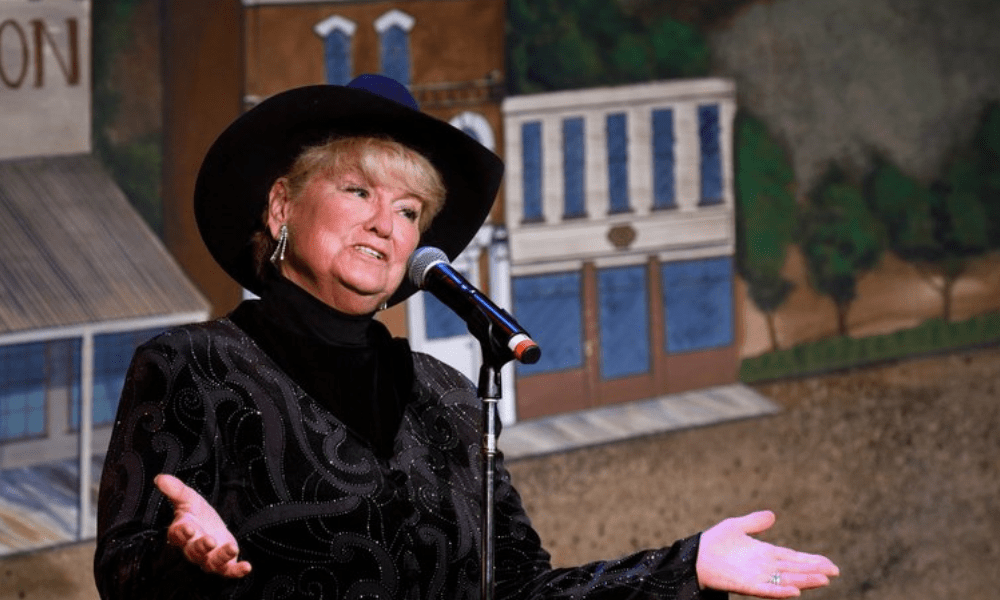
Dan Willging of KGNU interviews cowboy poet Lindy Simmons about her upcoming performances at the Colorado Cowboy Gathering in Golden. Simmons shares how her poetry evolved after marrying into a multi-generational ranching family in southwestern Colorado, drawing inspiration from ranch life, rodeo culture, local coffee shop storytelling, and Western history. She discusses the importance of authenticity in cowboy poetry, her published work and upcoming book, and her involvement in historical preservation. The interview concludes with Simmons reciting a poem about Pearl Hart, the last stagecoach robber of the American West, highlighting her focus on uncovering unique and often overlooked stories—especially those of women in Western history.
(Air Date: 1/17/26)
Listen Here:
Transcript:
Dan Willging: Lindy, are you with me?
Lindy Simmons: Yes, I’m here.
Dan Willging: I love technology when it works. Isn’t it wonderful?
Lindy Simmons: It’s wonderful.
Dan Willging: We have on the line Lindy Simmons, cowboy poet extraordinaire, who will be performing at the Colorado Cowboy Gathering on January 30th and 31st. Welcome to KGNU, Lindy.
Lindy Simmons: Thank you. I appreciate you having me.
Dan Willging: Our pleasure. Is this your first time performing at the gathering here in Golden, Colorado?
Lindy Simmons: No, it’s actually my second time. I was there two years ago.
Dan Willging: So you’re no stranger to the folks out here.
Lindy Simmons: No, and we had great audiences.
Dan Willging: That sounds like a lot of fun.
Lindy Simmons: It is.
Dan Willging: What came first, and how did you get started writing cowboy poetry?
Lindy Simmons: I’ve written poetry since I was young. My style changed when I married a cowboy in southwestern Colorado. That became our life, and cowboys provide plenty of fodder for poetry. In addition to writing about history, I look for stories with humor, and there’s a lot of that in ranch life.
Dan Willging: I imagine there is. When you married this cowboy, did you immediately start living on a ranch?
Lindy Simmons: Yes. My husband owns a ranch that has been in his family for a couple of generations.
Dan Willging: Did you grow up on a ranch?
Lindy Simmons: No, I grew up in a rural area with small animals, but no horses or cows. Ranch life was new to me.
Dan Willging: So those experiences became new inspiration for your poetry.
Lindy Simmons: Exactly. It’s a very different way of life. There are stories connected to nearly every aspect of it. I didn’t know anything about rodeo when I came here, and my husband’s family has been deeply involved in rodeo for years. Working with animals, the demanding schedule, and even the occasional accidents all provide material—sometimes humorous material.
Dan Willging: Does one of those humorous stories come to mind?
Lindy Simmons: I’m working on one now about a cowboy who was given a trailer house to live in during the winter. Since there was no insulation around the bottom, he lined it with hay bales. It worked well. In the spring, instead of mowing the grass around the trailer, he used a flamethrower to burn it. You can imagine what happened next.
Dan Willging: I can. Sounds like someone needed a new place to live.
Lindy Simmons: Exactly.
Dan Willging: You’ve mentioned that a lot of your material comes from listening to conversations.
Lindy Simmons: Yes. We have a little coffee shop downtown called Pete’s where the cowboys gather in the morning. They sit around telling stories. Many of my poems come from those conversations. I’ve even written details down on napkins.
Dan Willging: Do they get suspicious that they might end up in a poem?
Lindy Simmons: Not at all. They love it. There was a fellow named Johnny Green, a cowboy and horse trader who loved to play pranks. I wrote several poems about him. He enjoyed them and wanted copies. Since he recently passed away, people now ask me to recite those poems in remembrance of him.
Dan Willging: Some of your poems appear on your CD Range Rhymes, correct?
Lindy Simmons: Yes.
Dan Willging: And you’ve also published a book.
Lindy Simmons: I published my first book around 1999. Since then, I’ve been busy, but I now have enough material for a second collection and am working on it.
Dan Willging: You’re also involved with the Durango Poetry Gathering and retired from teaching at Fort Lewis College. What else keeps you busy?
Lindy Simmons: I’m involved with the Historical Society for the Mancos Valley and several other organizations. My main focus is history and preserving the Western way of life. There’s an ethic that goes along with it, and the stories are wonderful.
Dan Willging: Listening to Range Rhymes, I realized someone like me couldn’t write this kind of poetry. You have to live it.
Lindy Simmons: That’s true. When gatherings invite performers, they often want authenticity—people who’ve lived on a ranch or been involved in rodeo.
Dan Willging: That’s different from songwriters like Johnny Mercer, who imagined the West from afar.
Lindy Simmons: Sometimes movies and songs imagined the West, but they often drew from authentic sources. That’s why many of those songs have endured and are still performed at gatherings.
Dan Willging: One of your poems mentions electric branding irons. How do those work?
Lindy Simmons: You plug them in with a long extension cord. They function like traditional irons.
Dan Willging: And that’s the subject of your poem “Geriatric Branding.”
Lindy Simmons: Yes. It features older cowboys who might not be familiar with newer tools. That said, we still use traditional irons. Each spring we help brand about 300 cattle in northern New Mexico where there’s no electricity, so we use irons heated in a fire.
Dan Willging: Which method is easier on the animal?
Lindy Simmons: A cow’s hide is quite thick. The iron burns off the hair and leaves a scar. It’s not comparable to branding a human.
Dan Willging: I also had to look up Lowline Angus after hearing your poem.
Lindy Simmons: They do look unusual. That poem grew out of conversations at Pete’s, where the cowboys were teasing about a herd of Lowline Angus in Mancos.
Dan Willging: Those are your husband’s cattle?
Lindy Simmons: Yes. They’re in the field outside our place. They’re smaller and more mild-mannered than some larger breeds.
Dan Willging: Do you know the origin of the breed?
Lindy Simmons: Angus cattle originated in Scotland. I’m not certain where the Lowline variety was developed, but breeding typically focuses on selecting desirable characteristics.
Dan Willging: Before we wrap up, would you share a poem?
Lindy Simmons: I’d like to share one based on history about an unusual woman of the West, Pearl Hart.
(Poem recited)
Dan Willging: That’s fascinating—especially that it was the last stage robbery in the West and involved a woman.
Lindy Simmons: That detail inspired the poem. I enjoy uncovering unusual stories, especially about women of the West.
Dan Willging: How did you discover her story?
Lindy Simmons: I have an extensive library on Western history and spend a great deal of time reading about historical incidents.
Dan Willging: I can’t wait to hear more of your poetry at the Colorado Cowboy Gathering. You’ll be performing throughout the event?
Lindy Simmons: Yes. We begin with a sampler Thursday evening, then performances on Friday and Saturday, including round robin sessions and a Saturday night show.
Dan Willging: Wonderful. Thank you for joining me this morning on KGNU. I appreciate the education.
Lindy Simmons: It’s been a pleasure. I hope many of your listeners come to the gathering.
Dan Willging: Golden is a perfect setting. I believe the sign says, “Where the West still lives.”
Lindy Simmons: That’s right.
Dan Willging: Thank you again, Lindy.
Lindy Simmons: Thank you. Goodbye.
Dan Willging: That was Lindy Simmons, appearing at the Colorado Cowboy Gathering. What a remarkable life she’s packed with history, poetry, and stories of the West.