
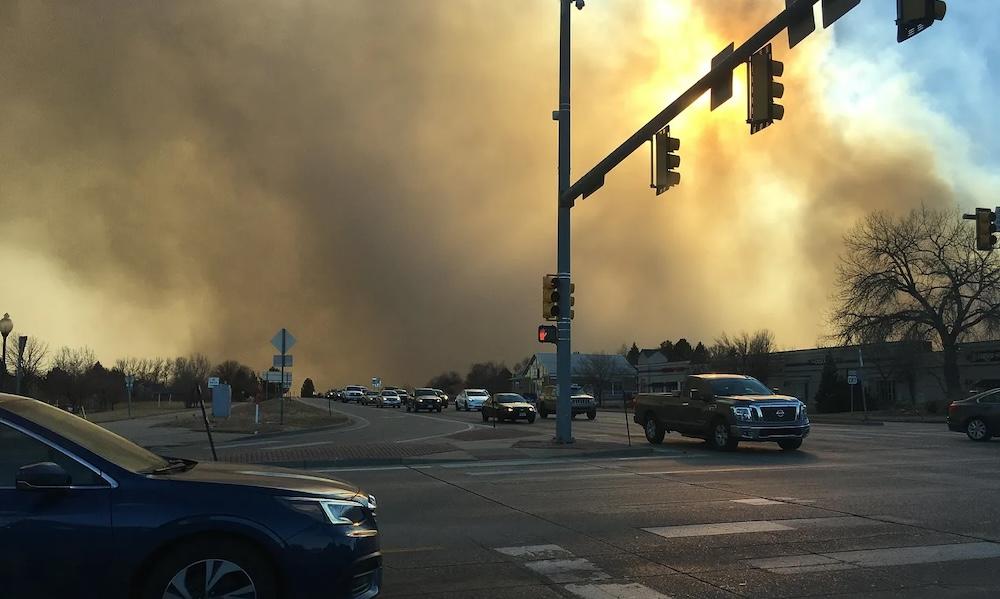
There have been some unusually windy days in Boulder County recently, and they’ve put a lot of people on edge. Tensions were compounded by at least one brush fire, which prompted evacuation orders in parts of Louisville and Lafayette. Fortunately, the fire was quickly contained by Mountain View Fire Rescue, and the evacuation orders were lifted. — John Kelin
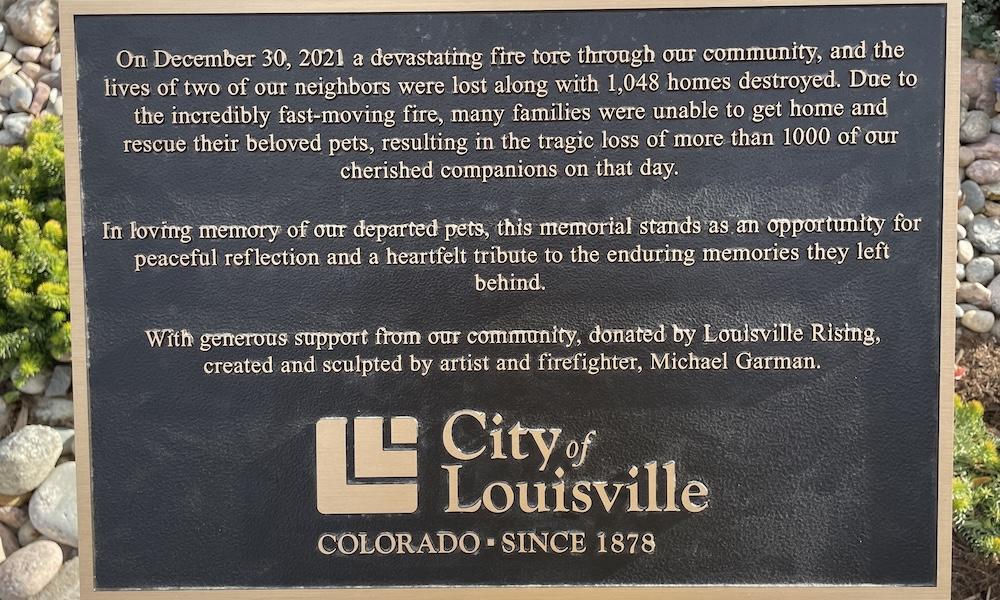
Those winds coincided with the fourth anniversary of the Marshall Mesa Fire, which remains one of the most destructive wildfires in Colorado history. The Marshall Mesa Fire devastated large swaths of Boulder County on December 30th, 2021. The winds that day gusted in excess of 100mph and were a major contributor to the fire’s intensity. When it was all over, two lives were lost, more than a thousand homes and commercial buildings were destroyed, and many others were severely damaged. The similarities between that day, and our more recent windy days, were unmistakable.
-
 play_arrow
Marshall Fire 2026 KGNU News
Three years ago, at the time of the Marshall fire’s first anniversary, some of its survivors shared their experiences with KGNU. Much of what they told us was painful: stories of grieving, and unimaginable loss. But we also heard stories of hope and recovery: reminders of the resilience of our community, and of the human spirit.
We spoke with many of those people again to see how they’re doing.
“It’s hard to believe that it’s been four years,” said Louisville resident Carole Billingham. “But if I step back and look at the landscape of all the things that I personally have gone through in these past four years – boy, it’s been a lot.”
Carole and her husband escaped the Marshall fire four years ago. Their house survived, but sustained a lot of damage; they were unable to return for more than six months.
Like the other survivors we caught up with, she couldn’t help notice those recent high winds, and be reminded of the day of the fire. “The winds that we’ve had, and the irony of having these ridiculous winds and warm weather around the anniversary, I find that like, jeez. Really?”
“There’s an extra tension, an extra stress that still comes up every time we have high winds here,” said Jason Cole. He’s the founder and CEO of Da Primus, an IT consulting firm. Jason and his wife Rachel lived in Louisville at the time of the Marshall Mesa fire.
“It used to be just annoying when the wind would be howling around the house,” he said. “Now it’s got that little added element of, well, I remember one time when it was like this and we almost lost everything.”
Rachel agreed. “Yesterday, with the high winds and the brushfire a few miles away, we kept getting evacuation alerts on our phone. It definitely brought back some unpleasant memories. I was surprised at the acute fear that came back, even this many years later.”
Dr. Jeannine Canty is an ecopsychologist at Naropa University, a field that studies the connection between mental health and the environment. She says high winds will probably always affect people who lived through the Marshall Mesa fire.
“ In ecopsychology, we often look at making sure that people have done real grieving, proper grieving. There’s factors of still sometimes being in denial, disbelief, defense, because the events happened so quickly. And while that stage is probably passed, there can still be probably shocks or dreams: did this really happen? I can’t believe my life has changed so much in the last four years.”
Cindy Mayhew is another Marshall Fire survivor. Those recent windy days and nights really got to her. “I’m in my newly built home as of a year ago,” she said. “The house was actually moving in the wind and, you know, I didn’t get a whole lot of sleep.”
It may be impossible to rank anyone’s experience with the Marshall Fire as better or worse than another’s, but Cindy’s was pretty bad. She lost her home, her massage therapy business, and her pet cat Lucy to the Marshall Mesa fire.
“I did more than 25 counseling sessions. I did EMDR and I took a full six months off of work right after the fire,” she said. EMDR is Eye Movement Desensitization and Reprocessing, an eye-based trauma therapy built on the idea that the mind and body are linked, especially when we process trauma.
“The PTSD is still very much there,” Cindy said. “There’s not a whole lot you could do about it. You still have to go on with your day.”
Rachel Cole also sought counseling, from a therapist she’d already established a relationship with. “I would just sit there and cry and just … everything was so uncertain. She said to me, ‘I have no doubt that you are strong enough to get through this.’ And just hearing someone else say that to me, I have held onto to this day. Because at least for me, it’s hard to say, ‘yeah, I’m a strong person,’ when I’m in those depths.”
Rachel’s husband Jason said that for him, the best therapy was exercise. “When I’m really feeling angry over the situation, or upset, or sad, getting out and moving, going to the gym and just working my body hard helps to pull the emotions out, and helps me get back on an even keel.”
He’s an avid cyclist, and riding his bike also helped. But in the months after the fire, riding amid the fire’s devastation was difficult. “Several of my favorite routes are between Louisville and Boulder,” he explained. “It was like riding through the aftermath of Armageddon for months. And that was very hard. And I actually changed some of my routes to avoid some of the more devastated areas.” But there was a surprising upside: “As people started to rebuild, as those neighborhoods started to pop up, it really became a sign of hope and resilience for me as the neighborhood [began to] come back.”
Writing about personal experiences with the fire can also be therapeutic. “I have always found journaling and writing, expressive writing, to be a really good tool for processing whatever,” Carole Billingham says. “You know, whether it’s grief, loss, shock, [or] confusion.”
Rachel Cole agrees. “Being able to write about it, for me ,was a way to be able to get the feelings out of me. If they stay inside, at least for me, they tend to fester and they might get bigger than they should be. It was very important to have [the fire] not define who I am or not define my, my life.”
Since the fire, Rachel has completed a book of inspirational thoughts called Choose Happiness Day by Day. The book encourages readers to see the goodness around them, no matter what else is going on in their lives. It is dedicated to the victims and survivors of the Marshall Fire.
Dr. Jeannine Canty says that it’s common for fire survivors to still have residual anger, as they cope with their losses and try to come to terms with them. In the end, Canty says, no one is really safe from any sort of disaster.
“Right after the fire, I lost my faith in God,” Cindy Mayhew said. “And I don’t think it’s back to where it was.”
On the day of the fire, in the chaos of evacuating, Cindy had very little time to decide what to do: what she should take, where she should go, and even if she should go. She made the snap decision not to bring her beloved cat Lucy with her.
“If I took her, that would mean that I really [thought] that something’s going to happen… and I really wanted to believe that nothing was going to happen. And then I had to deal with the guilt of, I chose not to take her. [I’ve] done a ton of therapy around it. I had to stop beating myself up for just choosing not to take her. I did my best at what I chose to take that day. I took six water bottles and one pair of underwear, or something, I can’t remember.”
With a lot of professional help, Cindy reconciled herself with the decision to leave Lucy behind.
“EMDR is not usually a ‘journey’ type thing” she said. “It’s more of a clearing, and feeling better.” But in her final EMDR session she confronted the loss of Lucy. “And it was very colorful, and I was flying. I have a blue bedspread on my bed. And at the end, the message that I got was, whenever I need to feel safe and protected, Lucy is going to be laying on the bed. And I can just lay with her, and she’s right there protecting me. She’s keeping me safe… and I thought, oh, that’s it. She was right there.”
Four years after the Marshall Mesa fire, most of the survivors we spoke with are still putting their lives back together, but with hope and optimism. One of those we interviewed on the first anniversary said she’d had enough of Boulder, and now lives up in the mountains. But Carole Billingham and her husband are back in their restored home, and Cindy Mayhew rebuilt on the same ground where her old house was.
Rachel and Jason Cole, on the other hand, still have roots in Louisville, and still own their house in the Harper Lake area. But it is no longer their home. “We’re digital nomads at the moment,” Rachel said, “so we’re not in Colorado that often.”
“We both are able to work remotely,” Jason said. “So we don’t need to be in one place for an office. And for the last year and a half we’ve been traveling around the US and Europe and staying in different cities for usually about three months at a time.”
They were in Louisville during the recent high winds, and got evacuation alerts on their phones. They prepared to flee, but with a new perspective. “I grabbed my computer because my whole business is on it,” Jason said. “[But] we both were very matter-of-fact about it. We looked at each other, we’re like, all right, if we have to go, we have the stuff that can’t be lost. And everything else is replaceable. It’s just stuff.”
“A lot of us have this silly notion that we’re in control, and there’s so little that we’re in control of, especially when it comes to natural disasters,” Carole Billingham said. “We’re reminded that there’s a lot we cannot control. And that’s humbling.”
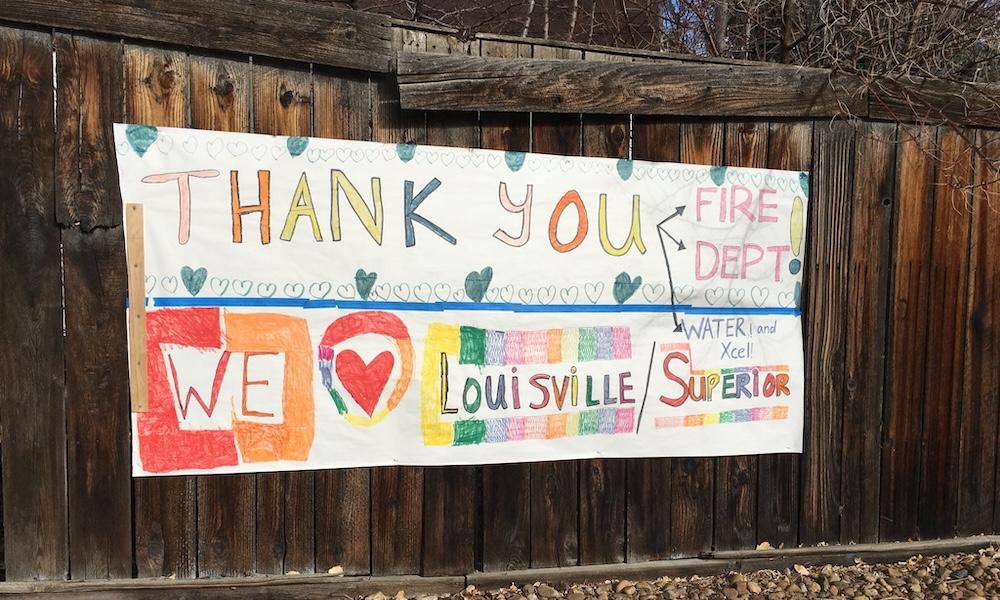
Rachel Cole acknowledged the fire’s first responders. “We remember you,” she said. “I know that a lot of firefighters deal with the grief of what they couldn’t save. And so we just want to say, from the people [whose] homes that you were able to save, we will forever be grateful to you, and to the communities of Louisville and of Boulder. Through all of the grief, I think the biggest emotion that we do feel is gratitude.”
More information about the Boulder County Wildfire Fund recovery support program consolidation can be found here.
This story aired on A Public Affair, KGNU’s weekday morning show featuring in-depth discussions on local news issues. Click here to listen to other episodes of A Public Affair.