
-
 play_arrow
How Can we Imagine a Positive Future for Ourselves and the Climate? Abby O'Brien
Climate anxiety is simply defined as an increase in worry associated with climate change. And some recent studies show that climate anxiety, and other adverse effects of climate change on mental health, are likely on the rise.
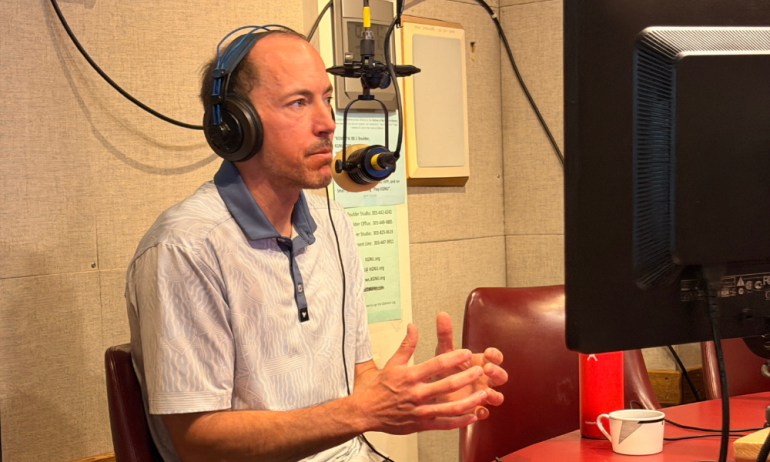
Jeff Wagner, founder of the nonprofit Groundwork, is a basket weaver, an heirloom seed grower, a wilderness first responder, and also the facilitator of a workshop taking place tomorrow in Boulder called “Falling in Love with the Future, A Day of Time Travel Imagination, and Radical Hope.”
“People need stuff like this,” says Wagner. “I meet a lot of young people especially who feel a lot of dread about the future. And the biggest thing that they need to do is to be able to imagine the future that they actually want to live in.”
Wagner’s workshop will be inspired by English activist and writer Rob Hopkins, whose work focuses on sustainability and community-driven change. Hopkins says that imagining the future is a lot like remembering the past, so “ if we’ve never experienced something outside the ordinary, we can’t imagine something outside the ordinary,” according to Wagner.
Dr. Susan Clayton is a professor and researcher at the College of Wooster. She refers to herself as a conservation psychologist, because she studies healthy relationships between humans and nature. Dr. Clayton co-authored a paper earlier this year on climate change and mental health, and she was a co-author of the Climate and Mental Health Section of the Intergovernmental Panel on Climate Change (IPCC) Sixth Assessment Report.
Dr. Clayton recommends that people feeling anxious about climate change arm themselves with information, because uncertainty can make us worry. She also says that conversely, we can recognize our thresholds for overwhelm and learn when to unplug and turn off the news.
Also, says Dr. Clayton, we should “connect to other people who are feeling similarly. For one thing, that reassures you that you’re not wrong to be anxious. You’re not the only one who feels that way, and that’s very comforting.”
Plus, gathering with others to share worries and hopes can help spur us to action, which is a solution in itself. “ Ways to get involved locally can be very useful in helping to build a sort of community level resilience,” says Dr. Clayton.
The “Falling in Love with the Future” workshop will be tomorrow, Saturday, Dec. 27 from 9:30 a.m. to 4 p.m. at the Unitarian Universalist Church of Boulder. Tickets available on Groundwork’s website.
This story aired on the Morning Magazine, KGNU’s weekday morning show featuring in-depth discussions on local news issues. Click here to listen to other episodes of the Morning Magazine.