
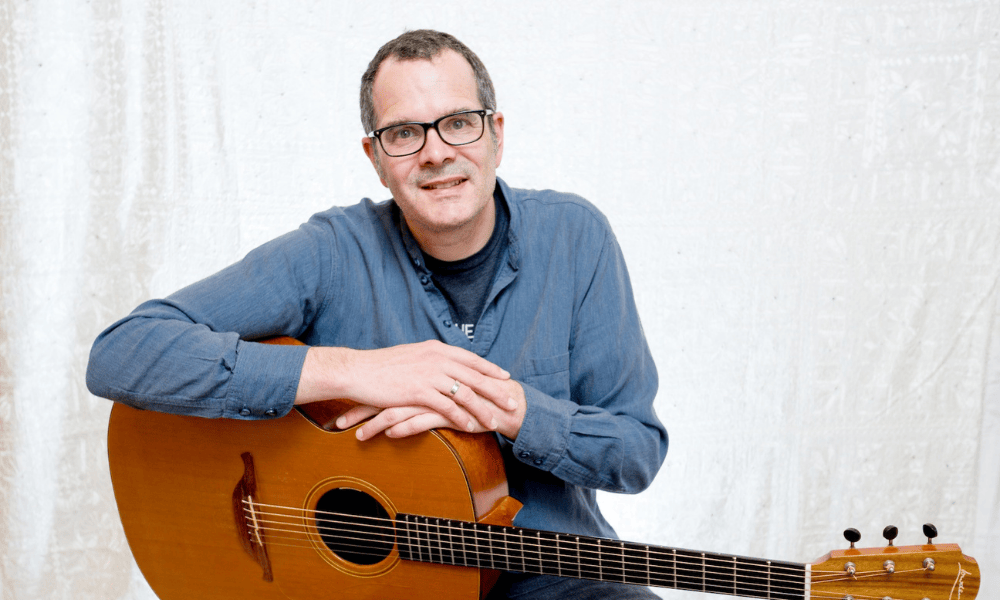
Teja Gerken joins KGNU by phone to discuss his solo fingerstyle guitar approach, which blends folk, jazz, classical, and extended techniques. He discusses his musical influences, his studies in the Bay Area, and the importance of experiencing live music. Gerken reflects on composing for guitar, avoiding obvious patterns, and developing ideas deeply. He also previews upcoming Colorado performances, including shows with guitarist Michael DeLalla and ongoing duo work with collaborator Doug Young, while directing listeners to his website and recordings. (Interview: 10/23/25)
EC: We just heard some music from Teja Gerken, who is joining us now on the phone. Can you hear me?
Teja Gerken: Yes, I can.
EC: Well, good morning. Can you hear me?
Teja Gerken: I can.
EC: Okay, good. It’s just wonderful to get a chance to talk with you. You are somebody who I have known of for years and just haven’t dived into the music as much, but I’m so intrigued with all the kinds of music you play. How do you typically describe your own guitar style?
Teja Gerken: Well, that’s always a challenging thing when it comes to solo instrumental guitar. The general term guitarists tend to use is fingerstyle guitar, but it really doesn’t say much to non-guitarists. I kind of say I play solo guitar that ranges from folk to jazz to a little bit of classical. It sort of depends on who I’m talking to. It’s a perpetual challenge—how to describe what we do.
EC: Right, I’m familiar with that, because you’ve got a show coming up with my husband, Michael DeLalla.
Teja Gerken: Can’t wait.
EC: I am looking forward to hearing you both, and what intrigues me is you just mentioned all these different styles. I know a lot of people play classical music, or Celtic music, or jazz. What are the themes that you find that weave all of this together for you?
Teja Gerken: When I put out my last album, Test of Time, which features all those different styles of music, people were asking about that. Ultimately, it really just comes down to: I like to play music that I like. I have a broad taste. I started out, like so many people, playing rock and blues guitar. I never really played in bands or performed that, and then my entry into solo guitar came through classical and flamenco guitar. A long time ago when I was in college, I got into the steel-string fingerstyle stuff through Michael Hedges. I was fascinated by all the extended techniques he was using. Then I was very fortunate to study with a couple of great folks in the Bay Area—one being Peppino D’Agostino, a wonderful fingerstyle player originally from Italy, and Duck Baker, who lived in the Bay Area for many years. He’s living in England now. Duck especially really showed me that there are no limits to what you can play on solo guitar, and how you don’t have to approach different kinds of music in different ways if you figure out your own style. I think now that I’ve been doing this for 30-plus years, I’ve come up with a way of playing guitar that I think is identifiable as me, whether I’m playing a Celtic piece, a jazz piece, or an original.
EC: Those are some notable teachers you had, and an astute listener might notice you have a touch of an accent. Did you come to the States to study, and you landed in the Bay Area?
Teja Gerken: I didn’t. My whole family moved over from Germany. I grew up in Germany. I was 16 when we came, in the mid-80s. I went to high school for two years here, went to college here, and then settled in the Bay Area after college. I live in Marin County now, just north of San Francisco. The Bay Area is rich with music. I was able to seek out teachers and mentors—Peppino and Duck were high on the list—and I was very fortunate to study with them, but also to be exposed to different music and go to a lot of concerts. I think it’s really important for any musician, especially if you’re developing, to listen to as much live music as you can. I really took advantage of that and still do. My wife and I are recently empty nesters; my daughter’s off to college, so I’m sort of re-investing in seeing more live music, and I find it really refreshing and inspiring as an artist.
EC: Oh, that’s great to hear. I have on occasion met musicians who feel like there’s so much music in their head. Some of my favorite musical moments are musicians meeting, collaborating, playing, and experimenting.
Teja Gerken: Absolutely, and that’s what I’m looking forward to so much with this show. Michael and I have never met in person yet, as you probably know, but we’ve known each other online, we have mutual friends, we’ve talked about doing something. I just can’t wait. It’s going to be super fun to meet in person and meet musically and see what we can do together.
EC: Very nice. You also do some composition, and something Michael and I talk about sometimes is the way the guitar is set up—some composers use things that come readily on the guitar. How do you deal with that? Do you try to look at the guitar as what you’re composing for, or does the music come into your head and then you figure it out?
Teja Gerken: I do think it’s both a blessing and kind of a trap that the guitar offers so much that you can stumble upon and work with. I think it’s important when you’re writing for the guitar to stay away from the obvious. I have a friend who used to run a record label and he was fascinated that so many guitarists from all over sent him demo tapes that basically had the same tune on them, because there are obvious trappings you think you’re the first to discover—and chances are you’re not. So I think part of it is the process of discovering stuff on the guitar, but the hard work is learning how to develop it and turn it into something. Twist it every possible way to see how you can milk that idea before you move on to the next one. That is an important lesson. Usually my ideas for a tune have more to do with the structure of a piece. I might think, “Oh, I want something that moves a certain way,” but then I’ll often grab some things I’ve stumbled across on the guitar to get there. I’m a fairly intuitive composer. I’ve never formally studied composition, but working on original pieces with mentors like Peppino and Duck—and a couple of other people I focused on writing with—gave me fundamentals. I always write on the instrument. I don’t compose away from it or on paper and then see how I can do it. I don’t know how to do that. I’m intuitive, but I always try to question myself and dig deeper than being satisfied with what happens immediately.
EC: And you have performed in Colorado before, haven’t you?
Teja Gerken: Once. I played with Sean McGowan at the University of Colorado, where he teaches. I did a master class and a concert there. It’s been quite a while though. I think that’s the only time I’ve been in Colorado.
EC: Oh, we’re excited to have you back. So this is coming up—let’s transpose this to November 6 at Niwot Hall, formerly known as the Niwot Grange Hall. You might have heard of a band called Hot Rize; they used to play there all the time.
Teja Gerken: Oh yeah.
EC: That’s awesome. Michael DeLalla and Teja Gerken at Niwot Hall. You can look on Michael’s website, fallingmountainmusic.com, for information on that. On October 7, you’re in Greeley. That’s a house concert, I understand.
Teja Gerken: That’s correct—that’s in Greeley. And then on the 8th I’ll be at the Hendrickson Family Stage in Arvada. Nice little three-show run, and people can go to my website, which is tejagerken.com—T-E-J-A-G-E-R-K-E-N.com. Google my name and you’ll come up with that, and there’s contact and concert information there.
EC: That is wonderful. I’m so looking forward to meeting you in person and hearing your performances.
Teja Gerken: Me too. It’s going to be a lot of fun.
EC: I also pulled up a piece that you did with Doug Young, a frequent collaborator in the Bay Area.
Teja Gerken: Doug and I have played as a guitar duo for a decade plus now, and we have two albums out. Doug is probably the person I’ve played with the most over the last 30 years or so, because we started out sharing gigs and both hosted some guitar shows in different parts of the Bay Area. Eventually we decided it was time to put a repertoire together. Our first album came out just as COVID hit in March of 2020—we had to put everything on hold. Even though we both have home studios, we continued working and collaborating remotely. We put the results of those efforts out earlier this year with the second album, called The Water Is Wide.
EC: All right, we’re going to take a listen to that and to “Tacoma.” Thank you so much, Teja. Looking forward to the shows.
Teja Gerken: Yeah—so you’re going to play “Tacoma”? That’s the duet version of that.
EC: Yeah.
Teja Gerken: It’s inspired by Leo Kottke. There’s also a solo guitar version of it on my Test of Time album. All my albums are available online—people can stream them or go to Bandcamp and find them if they want to check them out ahead of the concert. It’s all easily available.
EC: Thank you again for calling in. We’ll see you soon.
Teja Gerken: Thank you so much.
EC: All right.
Teja Gerken: Bye-bye.