
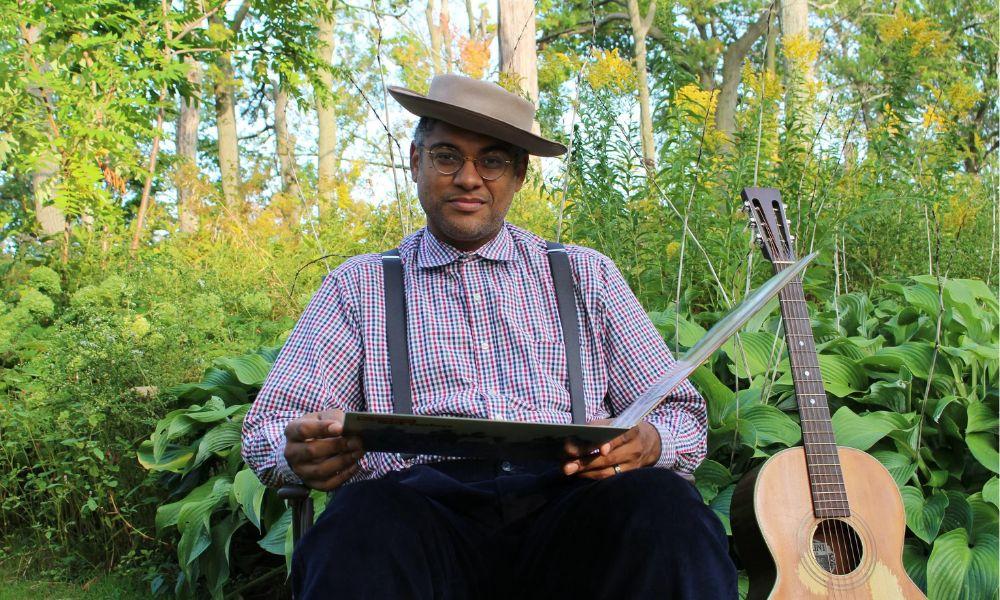
Dom Flemons, the “American Songster,” is a musician and historian who preserves and reinterprets over a century of American roots music. In this interview on KGNU with Duck La Rock, he discusses his research into overlooked artists and archives, his Black Cowboys project highlighting the hidden history of Black cowboys, and his mission to bring underrepresented stories to life through music and performance.
(Air Date: 4/22/26)
Listen Here:
Transcript:
Duck La Rock:
Alright, I am excited and honored to welcome Dom Flemons to the show. Dom, thanks very much for coming in.
Dom Flemons:
Absolutely.
Duck La Rock:
If you’re not familiar—though I think many of you are—Dom Flemons is known as the American Songster. His repertoire covers over a hundred years of American roots music. He’s a folk musician, Black country artist, songwriter, multi-instrumentalist, music scholar, historian, actor, slam poet, record collector, curator, podcaster, cultural commentator, influencer, and the creator, host, and producer of the American Songster Radio Show on WSM in Nashville, Tennessee. He’s also the co-founder and original member of the Carolina Chocolate Drops, the first Black string band to win a Grammy. Over the past 25 years, he’s received major awards, worldwide recognition, and become one of the most influential voices in American roots music. Dom, welcome.
Dom Flemons:
Thank you, Duck. It’s a pleasure to be here and great to be back at KGNU. Always an honor to be in Colorado.
Duck La Rock:
You’ve got shows coming up—April 23rd in Denver at the Savoy and April 24th in Boulder at the Chautauqua Community House. How many times have you played there?
Dom Flemons:
A couple of times. I played last year and also opened for Old Crow Medicine Show there a few years back. I’ll also be at the Surf Hotel in Buena Vista tonight. Later this summer, I’ll be at the Rhythms of the Rio Festival in Del Norte and the Telluride Bluegrass Festival with my new band, the Traveling Wildfires.
Duck La Rock:
How long has that band been together?
Dom Flemons:
Since last fall. It’s a great group—we go through my catalog from all my records.
Duck La Rock:
You’ve also got more touring coming up?
Dom Flemons:
Yes, heading to MerleFest, then South Carolina for Bird Fest. For everything else, people should check my website, americansongster.com.
Duck La Rock:
You’re also on Instagram. Alright—would you play a song for us?
Dom Flemons:
Duck La Rock:
That was wonderful. What was that called?
Dom Flemons:
“Brown Skin Girl.” It’s from my 2009 album American Songster.
Duck La Rock:
You describe your work as covering a hundred years of American roots music. What time period does that span?
Dom Flemons:
From about the 1880s forward, sometimes earlier into the mid-19th century, but mainly from when recorded music became retrievable.
Duck La Rock:
You’re also a record collector. Are you reinterpreting old recordings?
Dom Flemons:
Yes. Early recordings can be hard to access due to fidelity. I reinterpret them—clean them up, rearrange them, and bring them to new audiences. I was drawn to artists outside the standard blues canon, and many of their works hadn’t been revisited in nearly a century.
Duck La Rock:
A listener asked about your experience with archives and research.
Dom Flemons:
I studied English literature in college, which led me into folklore and music. After college, I attended the Black Banjo Gathering and moved to North Carolina. I met musicians and historians, and I began visiting archives—local libraries, universities—before digitization. I built my knowledge gradually, collecting localized histories and rare materials.
Duck La Rock:
That’s fascinating—local archives rather than just national ones.
Dom Flemons:
Exactly. I gathered unique materials, like detailed research on figures such as Leslie Riddle, that weren’t widely available. People also shared resources with me over time.
Duck La Rock:
It reminds me of oral storytelling traditions—history not always captured in mainstream narratives.
Dom Flemons:
Exactly.
Duck La Rock:
Would you play another song?
Dom Flemons:
Duck La Rock:
What was that one?
Dom Flemons:
“Steel Pony Blues” from my 2018 album Black Cowboys.
Duck La Rock:
You’ve also presented a 1939 film starring Herb Jeffries. Can you tell us about that?
Dom Flemons:
It’s one of the first all-Black cowboy films. Jeffries saw a need for representation and created films to reflect the real history of Black cowboys. I perform a live score alongside the film using music from my albums.
Duck La Rock:
Why is it important to highlight that history?
Dom Flemons:
It connects post-slavery Reconstruction to early 20th-century America. Black cowboys were part of westward expansion and nation-building. It’s a major part of history that’s often overlooked.
Duck La Rock:
You’ve spoken about a spiritual dimension to bringing these stories forward.
Dom Flemons:
My goal is to create cultural memory and help people see themselves as part of the story. Representation matters—it expands what people believe is possible. With Black Cowboys, I wanted to create both an educational and musical entry point into that history.
Duck La Rock:
You’ve also worked with the National Museum of African American History and Culture.
Dom Flemons:
Yes, I performed at the opening and contributed to the broader narrative of Black history through music. It was a major honor.
Duck La Rock:
Before we wrap up, could you play one more song?
Dom Flemons:
Duck La Rock:
Dom Flemons, thank you so much for joining us.
Dom Flemons:
Thank you. It’s been a pleasure.