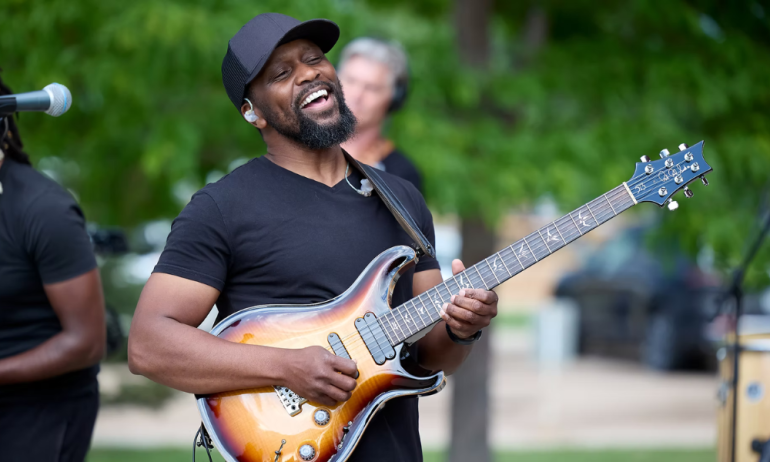

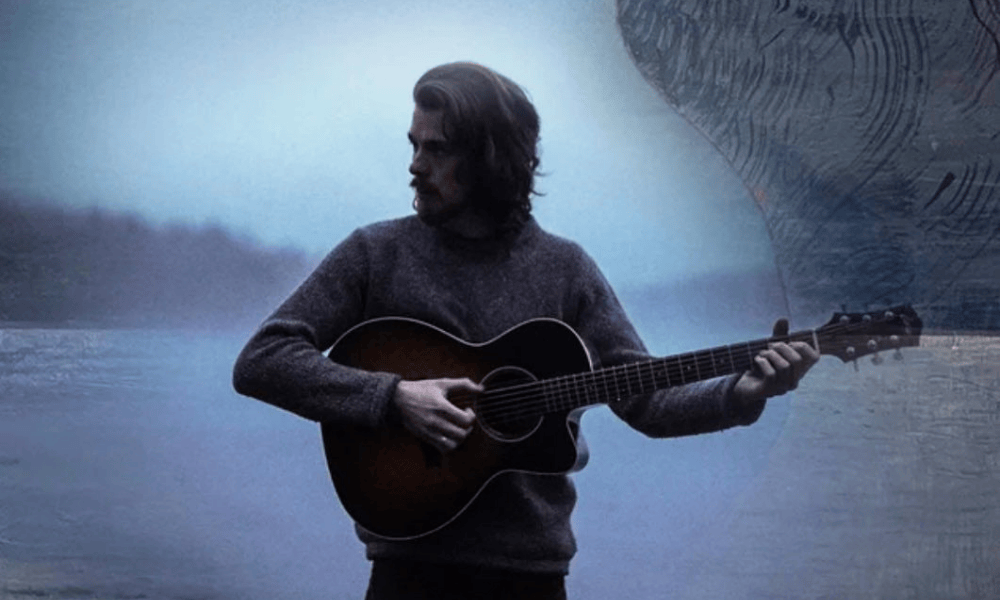
Singer-songwriter and guitarist David Howley, known for his work with We Banjo 3, joined Wendy Mills live in the KGNU studio to talk about his journey from Galway, Ireland, to Boulder, Colorado. He reflected on his upbringing surrounded by eclectic music, his philosophy of creating community through song, and the emotional power of honest, human connection in music. Howley also discussed his songwriting process, fostering dogs, and finding inspiration in Boulder’s artistic spirit before performing his song “Dig Your Heels.” (Studio Session: 10/17/25)
Wendy Mills: [00:00:00]
We have David Howley in the studio with us, and he brought his guitar. We’re gonna find out just what you’ve been doing. A lot of things have been happening, David. Galway-based We Banjo 3—
You’ve been with We Banjo 3 for quite some time, and you’ve certainly been at the forefront of Irish guitar, banjo, and mandolin. You’re an amazing musician, but the guitar is really your heart instrument, isn’t it?
David Howley:
It’s so good to be here. Thank you so much, I really appreciate it. I was just walking by, I heard my music on the radio, and I thought, “I better go in and talk to these people.”
Wendy Mills:
See? Anything can happen in Boulder. It’s magic.
David Howley:
It’s really nice to be here. Thank you for having me. I moved to Boulder about two years ago. I used to live in Nashville, Tennessee. As you can tell by my accent, I’m not from here. Some people used to tell me I have the strangest Southern accent they’ve ever heard, and I said, “Yeah, it’s Southern—but it’s a different Southern.”
Wendy Mills:
On the other side of the world.
David Howley:
Exactly. I grew up in Galway, Ireland, and I think I’ve been in the U.S. for nearly 10 years now.
Boulder—well, I’ve been a touring musician all my life. I was supposed to be a mechanical engineer, and for the sake and safety of everybody in the world, it’s really good that I didn’t continue that. I’ve been traveling all over, and I really do feel like Boulder has this magical community.
I love Irish music, I love folk music, I do a lot of songwriting, and I love bluegrass music—I play a bit of bluegrass myself. What I love about Boulder is that all those worlds seem to gel together. Everybody knows everybody, and everyone’s really friendly here as well.
It’s something I grew up with in Ireland—we’d sit around in pubs and just play music together for the love of it. Now I’m part of a few Irish trad sessions here, which I hadn’t done since I was a kid.
I moved to Boulder, in the middle of the mountains, and I found a group of people who want to play great tunes on a Wednesday evening in the basement of a hotel. Now, it’s a nice basement of a hotel. I go to the session at the Boulder Auto, but I like to explain it as going to a session in the basement of a hotel—it sounds more mysterious.
Wendy Mills:
Mysterious, yeah.
David Howley:
Exactly—more mysterious than saying I’m going to a fancy cocktail bar.
Wendy Mills:
You’ve developed almost a new style of playing the guitar.
David Howley:
Yeah, I was lucky. I grew up in the traditional Irish music idiom, but my dad is a big music fan in general. I had a tape player outside my bedroom door when I was young, and I’d fall asleep to music.
My dad would put on tapes he’d recorded off the radio in Ireland because it was hard to get music there. Ireland was almost a third-world country in the ’50s and ’60s, so by the time I came around in the ’90s, my dad had built up all these tapes—but they weren’t in any order. You could listen to The Chieftains, then Paul Brady, Garth Brooks, Doc Watson, and then Sting.
Wendy Mills:
Sounds like KGNU programming!
David Howley:
Exactly! And that’s actually wonderful. I think one of the things we’ve lost in the world is randomness—everything’s so perfectly algorithmized for us now. It makes things homogenized. The gift I was given as a kid was that I didn’t know musical genres. They didn’t exist for me or my brother. We just had music.
I started a band when I was 19 with my brother Martin and my friend Easkey. Later, our friend Fergal joined—that was 15 years of my life traveling around the world. When the band ended, I had a moment of asking, “What is it that I want to do with my life?”
That’s a classic post-twenties existential question. I’m in my thirties now and had that “Who am I? Why am I doing this?” moment. I tried to quit. I turned to my partner in a grocery store parking lot in Wisconsin and said, “I think I’m done.” And she said, “Great. Let’s put a meeting in our calendar for next year and we’ll discuss it then.”
We never had that meeting. Smart woman!
The music I’m making now is about creating community—a space for people to come together. I don’t want that community to be homogenized. You might come because you love Irish music, or because you’re having a hard time and one of my songs made you feel seen.
At my gigs, I have the most smorgasbord group of people in front of me. That’s my offering, my calling. That’s what gets me out of bed. I don’t want the gig to be about me—I want it to be facilitated by me.
I grew up in Irish Catholicism, and one thing I did like was the idea of facilitating people coming together. Especially in the world we live in now, we need people to say, “Hey, come together.” You might find that the person you thought you disagreed with online is actually super nice and not different at all.
That’s kind of my story—and Boulder’s a great place for that. What a group of like-minded people here.
Wendy Mills:
Yes, it’s a fabulous place. Many people in the arts are drawn here because of that—whether musical, visual, or performance arts. This area embraces it all.
David Howley:
Exactly. I’ve been up to Gold Hill a good bit. My good friend Cort McCumber, who introduced me to KGNU, and I do little pop-up shows there. People around here really love supporting the arts.
That’s a huge part of being human—we’re not programmable. You can’t just plug us in and reboot us, even though that’s my dream!
Wendy Mills:
You defrag a computer. I think we defrag by going to the mountains, the beach, being quiet, listening to music—going to the forest. We need that.
David Howley:
We definitely need that. And that’s something I tell people at my shows—if you want to come but don’t know anyone, come anyway. Life can be lonely, and music facilitates connection. In Ireland, people just sit in a corner playing together—no microphones, no amplification.
You can go by yourself and meet people. Music opens people up—it gives that little point of connection.
I’ve met so many people through music and through dogs. My partner and I foster dogs through Fire Fools in town—we usually take the wild ones!
Wendy Mills:
The real super ones! They just need love.
David Howley:
Exactly. We all just need to find ways to connect.
If you come to my gig alone, I promise you—you’ll leave having met someone. I played my first professional gig at 11; I’m 34 now. My job is to create that space. When people ask what I do, I sometimes say, “I do low-grade therapy for large groups.” Because that’s what it feels like!
We can talk about serious things and unserious things, and somewhere in between is that connection. That’s what I love about Boulder—there are enough oddballs here willing to go out on a limb, put on a weird gig, or just talk to strangers.
Wendy Mills:
As the old saying goes, “Blessed are those who are cracked, because that’s where the light gets in.” But also, that’s where the light comes out. Why don’t we hear some of your music?
David Howley:
I was thinking about what to play. I’ll do something from my first album. I wrote this song in 2020—it’s called Dig Your Heels. Coming from Ireland, we have a rebellious streak in us. The song represents digging your heels in and being the resistance. I think we need a bit of resistance at the moment.
(Performs “Dig Your Heels”)
Wendy Mills:
Thank you. We’re talking with and listening to the great music of David Howley. You may know David from We Banjo 3. How long have you been writing songs?
David Howley:
I started writing seriously around 20. I lived in Nashville for years, writing alongside amazing artists. One of the biggest lessons I learned was that there’s no wrong answer in songwriting.
My brother Martin, who was also in We Banjo 3, is joining me Friday at Swallow Hill as a special guest. Martin’s a great writer—he can swallow a book in an afternoon! I recently got an ADHD diagnosis, and my family basically said, “Did you need a doctor to tell you that?”
Writing is sometimes just how I release pressure. Songs are funny—history books preserve facts, but songs preserve emotions. I’ve been digging through old records lately, and sometimes I’ll put on a Guy Clark song like Dublin Blues—the facts may be unclear, but the emotion is timeless.
Wendy Mills:
Good history should tell a story—not just facts and dates.
David Howley:
Exactly. I heard an interview with Ken Burns where he said he starts with the music—and that blew my mind. Music is the emotional element you can’t distill away.
Some of my favorite musicians play simply, but they move you. Others are technically brilliant but don’t. The most compelling music is real music.
I also produce music here in Boulder. When artists come in, I tell them: our job is to capture the soul and essence of your music. We’re taking a photograph—maybe we comb your hair and clean your shirt—but we’re not lying. The best music is honest.
Wendy Mills:
That’s really powerful. Especially now, with social media, people think they need to be at a certain level to even play music.
David Howley:
Totally. That’s my biggest stress—how to live in a world I feel unprepared for.
I grew up near Kinvara in Ireland. My dad used to bring us to music sessions at a pub called Connolly’s. One night, there was an American man singing in the corner. On the way home I asked, “Dad, who was that?” He said, “That’s John Prine.”
Even as a kid, I could feel how powerful his music was. John made music for everybody. It wasn’t about “tasty licks”—it was about humanness.
Wendy Mills:
We’re speaking with David Howley. David will be performing at Swallow Hill in the Tuft Theatre on Friday, October 17th at 8 p.m. We have tickets to give away here on KGNU 88.5 FM Boulder, 1390 AM Denver.
David, thank you.
David Howley:
Thank you—it was a great chat.
Wendy Mills:
It’s been fabulous. You must see this man at Swallow Hill! Seriously—Friday, October 17th at 8 p.m. You can hear this glorious man, who’s now part of us here in Boulder. He also gives guitar lessons.
David Howley:
Thank you for having me.
Wendy Mills:
It’s been such a pleasure and a privilege, sir.