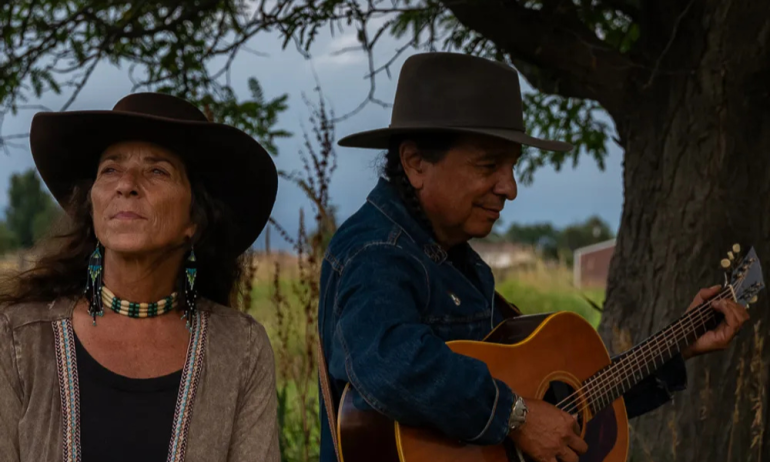

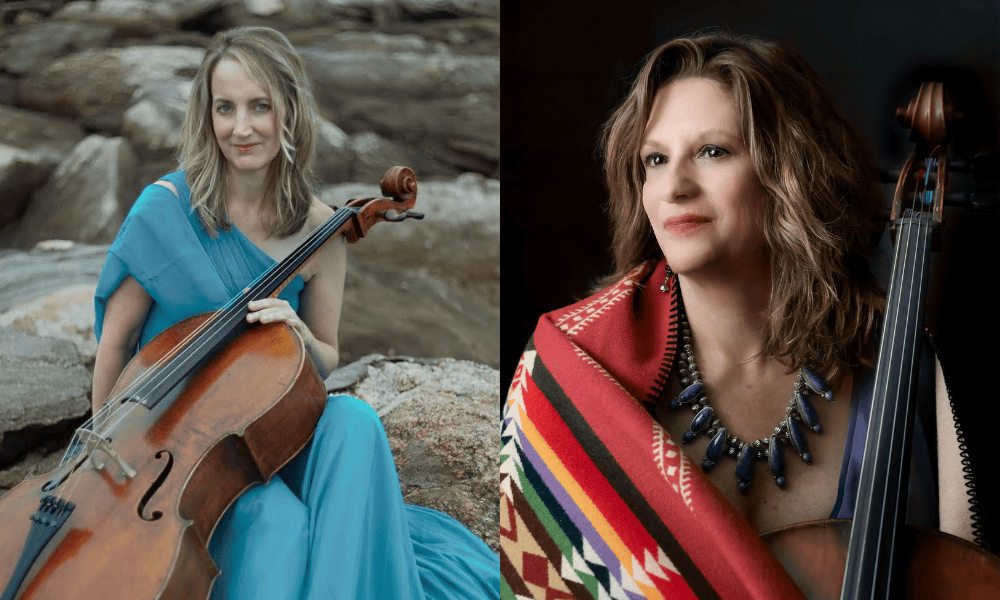
Cellist Wilhelmina Smith and composer-vocalist Dawn Avery (Mohawk) joined Sanford Baran to discuss their new album, Sweetgrass. The collaboration began during the pandemic, when Smith sought out indigenous composers and was drawn to Avery’s music, which connects deeply with nature and Mohawk traditions. Their work together, including pieces like Gratitude and Decolonization, blends cello and voice to convey indigenous sounds, spirituality, and storytelling. The title track, Sweetgrass, honors one of the most sacred plants in Mohawk culture, symbolizing strength, tenderness, and reverence for women. Both artists emphasize healing, peace, and cultural connection—values that shaped their music during a time of global crisis. Sweetgrass offers ten tracks weaving indigenous themes with contemporary classical artistry.
Sanford: I am joined by two extraordinary artists discussing their new collaboration, cellist Wilhelmina Smith, acclaimed for her solo debut at the Philadelphia Orchestra and praised by the Strad as a consummate communicator, and Grammy-nominated composer Dawn Avery, whose Mohawk name means she goes to her roots to learn. Dawn has worked with Pavarotti, Sting, and Philip Glass and holds a Ph.D. in ethnomusicology, focusing on indigenous theory. Their newly released album entitled Sweetgrass features ten tracks combining cello and voice around indigenous themes, a collaboration born during the pandemic. Welcome, Wilhelmina and Dawn.
Wilhelmina and Dawn: Thank you.
Sanford: Wilhelmina, this collaboration started when you were specifically seeking out indigenous composers during the pandemic. What drew you to that search? And Dawn, what was it like receiving that call?
Wilhelmina: Well, I was looking for a project to produce during the pandemic for my chamber music festival that I run in Maine, in the mid-coast of Maine. Nobody was able to perform live, of course, and so many of my friends were making videos in their living rooms, and as I’ve said to some other people, that wasn’t really possible for me. I had two teenagers at home, and a barky dog, too. More to the point, I wanted something that would be visually inspiring and something that could really connect certain music with a very definite, beautiful place of the coast of Maine. And so there were four different iterations of that that I created, and I had previously for my festival, which is called Salt Bay Chamber Fest on the coast of Maine, for probably a decade, have been working with some of the Passamaquoddy and Penobscot tribal musicians in Maine. And, for example, the singing group, the Burner Wurbskik singers from the Penobscot Nation, had always come and done some drumming, and they’re such incredible musicians and spirits, but also educators. And so often they spoke about the connection between their drumming and their singing, their songs, and the nature around them, the rivers, the Damariscotty River, which we were on, and the trees, and how that really connected with their ancestry and their culture. And so, with that very felt connection, I had wondered to myself, could there be, since I was recording solo cello music, is there an indigenous composer who was writing for solo cello that would, of course, naturally have maybe some similar connections between their music and nature? And so I discovered Dawn, and the moment that I heard her, and she was playing her own piece of Gratitude, it was just a light went off, and that was it. And I said, I’ve got to get in touch with her and ask her permission for me to use her music in this project.
Dawn: And when I got the call from Wilhelmina, I was delighted, and she just sounded like a heartfelt, sincere person who could get things done. And I loved that she was connecting nature and the visual to my music, and that she understood the piece. So that was Gratitude was our first piece together. And in that work, it’s inspired by the Thanksgiving dress that the Haudenosaunee say every morning, and that is to bless every part of nature. So she totally got it before she even totally knew she got it. She had the right idea and connection. I really appreciate that. And that’s the beauty of Dawn’s music, actually, is that it communicates without your needing to try. I mean, it just flows from her, and it flows to you.
Sanford: Dawn, how do you navigate sharing your Mohawk heritage through music while respecting cultural protocols?
Dawn: Beautiful question. So there are certain protocols that we have, and I never quote directly or arrange sacred music. So that’s a totally separate entity for us. But I am certainly inspired by my culture. And there are certain indigenous sounds that I think a lot of indigenous people have in common. Sounds of the rattle, sound like how we listen to the wind so closely, or sounds of the stomp dance, sounds of the drum. And in certain ways that we sing in our traditional music can really be nicely done on the cello. So I’d say in terms of sound that comes in. And then with the type of music that I write, it is my own, but it surely is inspired by the spirituality and the concepts of the Kani Kehalga.
Sanford: Can you walk us through how these pieces came together? Dawn, are you composing with Wilhelmina’s specific cello style and technique in mind? And Wilhelmina, how do you approach interpreting music so deeply rooted in cultural traditions that aren’t necessarily your own?
Wilhelmina: For the first part of your question, sort of how the selections came together, once we, Dawn and I had established this connection through the video project, then we began to communicate about other works of hers. And she had sent me this really amazing piece, Decolonization, which I started to play in my solo programs. And I discovered that not only was I inspired and blown away by this piece, but audiences really were connecting with it very viscerally.
Dawn: So I am so delighted and really honored to have such a great cellist play my music. And she adds her own style, but she also really understands what I was going for, but in a much higher level than, frankly, I could have ever played it. So it’s just a wonderful experience. Decolonization, I wrote after hearing an elder of mine speak, Tom Porter, at the Kani Kehalga Mohawk community. And the way that he speaks is very much like storytelling. So he would tell one story linked to another story, then come back to a story. And sometimes it was funny, sometimes it was tragic, sometimes it was in Mohawk, but we felt like we understood it all. So it’s like history and positive solutions to how do we decolonize the colonized. So when I wrote that piece, I decided to write it the same way, to have many different songs that represent music that came from the land of America, where the Mohawk have been for, we believe, 90,000 years now, and link them together. And the first time I heard her play it for me over Zoom at the time, I was blown away by how beautifully she played it, and the phrasing, and how she could switch styles, and how much she understood, like the depth of the meaning underneath the notes. And also she brings her heart to everything. So it was just, that really inspired me. And she said, you know, if you’d like me to send, if you’d like to send me some other pieces. So I picked a bunch of other pieces with that in mind, partly heart, partly technique, and a lot of spirit. That’s sort of what made me choose the specific pieces. And then ultimately she chose what she liked to play.
Sanford: Wilhelmina, you’re known for your extreme clarity and interpretive precision. What technical challenges did Dawn’s compositions present, and how did they push your artistic boundaries? And actually, it’s great when a performer can work directly with the composer. What was the nature of the collaboration?
Wilhelmina: Well, exactly. And you’ve really hit on an important topic. You know, you had asked previously how I was going about understanding some of these traditions and cultural references that were not my own. And, you know, I just feel incredibly grateful. Well, first of all, to have any living composer to work with, because we have the opportunity to ask them a million questions, and have those questions answered. And specifically to work with Dawn. I mean, her, she is a gifted cellist herself. So she has the inherent knowledge of the instrument, a performer’s knowledge, but a composer’s imagination. And so I was able to ask her about so many things. Like, for example, in decolonization, certainly there are a lot of different kinds of techniques. And, you know, not unfamiliar to me as somebody who for their whole life has worked with composers and tried to stand an expanded technical language. But what I would say about Dawn’s music in that respect is that the technique always serves the musical intent with her. And so those technical things actually come very naturally when that is the case in a piece of music. And so, you know, for example, in decolonization, it starts off with the song of Geronimo, and it’s played very high on the cello, but alternating with these collineo batuto rhythmic gestures in between. And so, you know, probably when I first played it for her, it might have been more in the style of, I don’t know, an Elgar or a Dvorak. But I asked her to explain, well, what does that mean, Geronimo’s song? I mean, I know who Geronimo was historically referenced, but what was that singing like? What does that actually mean for that? And Dawn answered, go for it, Dawn.
Dawn: It was the high falsetto of the male warrior voice. And then that was interjected with the sounds of the drum, with the lower sounds of the drum. So it is going back very, you know, she goes from very high up, these sort of almost screeching, but not, but she makes it sound really nice, like screeching from your heart as a warrior. And then she goes down below with the batuto, you know, hitting on the strings to make it sound like a drum. Right. So playing it and then really understanding it in the way that Dawn had envisioned it really sort of expanded my vocabulary, I guess, and understanding of what I was trying to put forth as a performer.
Sanford: Can we talk about the significance of the name of the album, Sweetgrass, and which is the title track? What does sweetgrass represent in Mohawk culture? And how does this translate musically?
Dawn: So sweetgrass is one of our most sacred plants. And when we pick it to use, to dry for, for its scent or for its essence or to braid it for baskets or adornment, we do this early in the morning and we say a prayer to Mother Earth and get close to the earth. And then we gently tug at her roots. And as we tug at her roots, we can smell her fragrance and some of the dew that is from her. And the idea of really respecting and revering sweetgrass is the same concept that we have for our women. So when I was thinking of what piece to write for Wilhelmina, I just thought of sweetgrass would be so perfect because it is such a fierce, strong, womanly plant. And at the same time, it has this tender beauty that perseveres and that just keeps giving. You know, sonically, I’ll let, I’ll let Mina talk about it more, but I know for myself, I really wanted to write, I wanted to show the tenderness and the harmonics, like the different sounds of the harmonics, because the, the way that they ring has, in our belief, we believe that there are spirits inside the harmonics so that every time you’re playing one, there’s a spiritual component. And I love how, I love how Wilhelmina notices some of that, some of that movement of the piece. So I’ll let her talk to that.
Wilhelmina: Well, there’s a lot of imagery in the piece. And just by having a piece that’s predominantly false harmonics in so many different realms is so different and interesting and such a different sonic world to enter into. And it’s very evocative of, you know, for me, this, the, the rising smoke that comes from burning sweetgrass, this, like, as Dawn said, the spiritual element, kind of this meta area that’s half, half in between, and it’s, and it’s a different world, and sort of the oscillating harmonics going back and forth and seagull effects, bird effects, it just really creates a different world that you enter into. And I, I would also mention, that’s kind of a little interesting side story, that the photograph on the cover of the album is of authentic sweetgrass. And it was taken by a mutual friend of ours, Hawk Henry’s, was a beautiful flutist, woodlands flutist. And he also happens to be a gifted photographer. And at the time that we were looking for an image for the cover of the album, our designers kept giving us pictures of wheat. I was like, gosh, I don’t think that sweetgrass, you know, looks like wheat to me. And we were having trouble finding images of sweetgrass. And so I wrote to Hawk, I said, Hawk, by any chance, because he’s a nature photographer, do you have a photo of sweetgrass? And he sent this. And it was just for me, so beautiful. It really kind of captured the vulnerability and the innocence of what this plant can be. And he explained to us also, or explained to me, because I didn’t understand this, that part of the reason you don’t often find those photos of sweetgrass is that it’s in and among other plants and grasses, and you have to know what you’re looking for. And so some of these do stand alone by themselves.
Sanford: The project, as we said before, began during the COVID lockdowns. How did that isolation and global uncertainty shape the creative process?
Wilhelmina: For me, I was looking to express something that would be of a healing nature, and something that could help us all breathe in a time when breathing was compromised, whether that was from COVID, whether that was from the wildfires, George Floyd murder, you know, everything that was going on in 2020, that kind of compromised our ability to simply do the one thing that we need to do as humans, that’s to breathe. So that’s what I find in nature to be the strongest thing that connects me. And what I found in Dawn’s music that really brought it full circle. That’s beautiful.
Sanford: I understand both of you are also educators. What do you hope students, both musical and cultural, will take from this work?
Dawn: I guess for me, I really hope that the message of peace, and that we are all connected as human beings through spirit, regardless of how hard, difficult things may be, I hope that that message will come across to people. I feel like it’s definitely played that way. So I hope other people can feel that. And I am very proud of my culture. So some of our concepts, I think, are really great for us to live by. The whole idea of when we say, how are you? We say skanagoaga. And that means, do you carry a lot of peace with you? We don’t actually ask how you are. So that idea of peace being at the center of our needs, and that that comes through spirit and breath and connection to people.
Wilhelmina: Beautiful.
Sanford: Excellent. What a profound conversation about music, culture, and collaboration. The album Sweetgrass by Wilhelmina Smith, featuring the compositions and vocals of Dawn Avery, is available now, featuring 10 tracks that beautifully weave together indigenous themes with contemporary classical artistry. Thank you both for joining us today and sharing not just your music, but your thoughtful and deep spiritual approach to cross-cultural collaboration. And cultural preservation. It’s been a real delight to speak with you.
Wilhelmina and Dawn: Thank you so much.
Sanford: This is Sanford Baran for KGNU.