
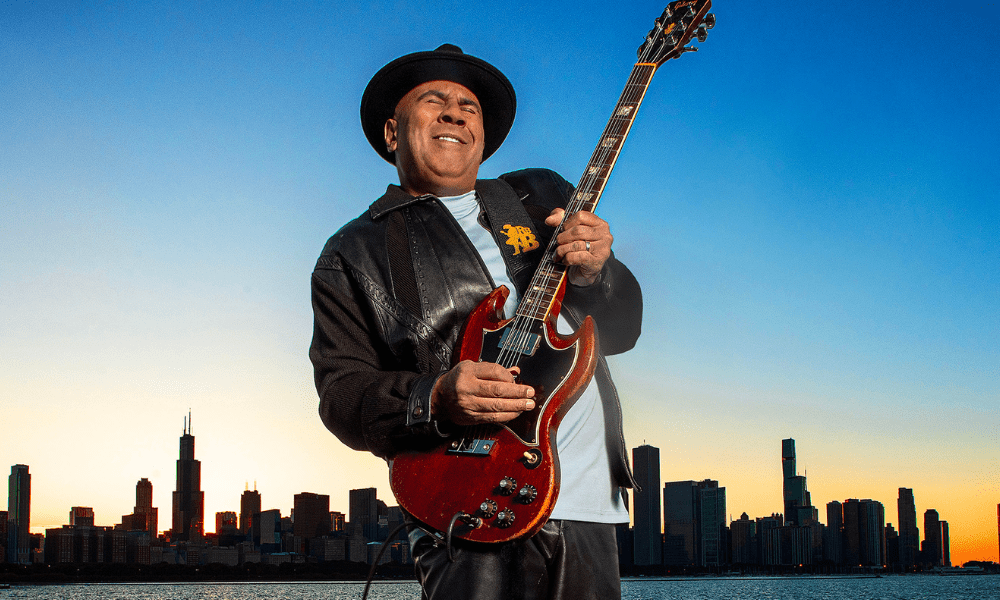
Blues guitarist and singer Ronnie Baker Brooks joins DJ Dan Willging on KGNU’s Blues Legacy ahead of his upcoming Colorado shows this February. In the interview, he talks about growing up as the son of Lonnie Brooks and being surrounded by blues legends like Koko Taylor and Buddy Guy.
Brooks shares details about his current band, his approach to touring and songwriting, and how he continues to build on the blues tradition. He also reflects on changes in the live music scene and what keeps him motivated on the road. (Air Date 1/2/2026)
Listen to the interview here:
Transcript:
Dan Willging: All right, I think I have Ronnie Baker Brooks on the line.
Ronnie Baker Brooks: Yes. Happy New Year.
Dan Willging: Happy New Year. Thank you so much for calling in. This is a real treat for us to be able to have you on this show right after the holidays.
Ronnie Baker Brooks: Thank you for having me, man. Thank you.
Dan Willging: We’re excited about you coming out here in February. You’ve got a big show at the Oriental, a place you’ve been a few times. I remember seeing you one time and you had Todd from Big Head Todd with you as a guest.
Ronnie Baker Brooks: Yeah. Great times. Looking forward to coming back.
Dan Willging: Who’s going to be in your band this time?
Ronnie Baker Brooks: I’ve got Darrell Kutz on keyboards. He’s been with me since 1999. Phil Castleberry on bass, with me since 2017. Chris Singleton on drums, with me since around the pandemic, 2020 or 2021. It’s a four-piece band. We’re doing our best to contribute to what was laid down by the pioneers of the blues and to keep it thriving.
Dan Willging: That’s going to be a great run. You’ll be at the Moxie Theater on February 14, and then there on Sunday, February 15.
Ronnie Baker Brooks: Looking forward to coming back to Colorado. It’s been a big state for the blues, even when I was playing with my father, Lonnie Brooks. It was one of the places where fans really showed him support.
Dan Willging: Really?
Ronnie Baker Brooks: Yeah. It was one of his favorite states. People showed us a lot of love for many years. It’s always great to come back, see familiar faces, and connect with friends like Big Head Todd and the Monsters, who are doing their part to keep this music alive.
Dan Willging: The first time I saw you play was in 1997 at the Blues and Bones Barbecue Fest. You were with Lonnie Brooks, and your brother Wayne Baker Brooks was there too.
Ronnie Baker Brooks: That’s right.
Dan Willging: I’ve got a question about the Baker part of your name. Is that a family name?
Ronnie Baker Brooks: Yes, it is. Baker is my legal last name. Brooks is a stage name. I didn’t even realize my full name until I got into school because everyone called me Ronnie, and my dad was Lonnie. When I decided to make music my career, I added Baker between Ronnie and Brooks. It separates me while still connecting me to my dad.
Dan Willging: So his legal last name was Baker too?
Ronnie Baker Brooks: That’s correct.
Dan Willging: What was it like growing up in a musical family?
Ronnie Baker Brooks: The older I get, the more I realize how special it was. Now that I’m an adult and a father, it means even more. My dad spent time with us, always had music in the house, and made it fun. It kept us out of trouble growing up on the South Side of Chicago. There was music and love all around, and I got to meet a lot of his friends.
Dan Willging: Can you name a few?
Ronnie Baker Brooks: Wayne Bennett, who played with Bobby Blue Bland, used to come by and jam with my dad. He had a pink Cadillac with a drop top. He taught me how to play “Hideaway” by Freddie King. Hubert Sumlin, Eddie Clearwater, Koko Taylor, and many others came through. I can’t even name them all.
Dan Willging: Did you ever meet Muddy Waters?
Ronnie Baker Brooks: I met Muddy when I was a little kid at the Chicago Fest, before it became the Chicago Blues Fest. I didn’t know who he was at the time. Same with Buddy Guy. I used to go to his house because my mom and his first wife were best friends. I didn’t realize who he was then. I just knew I was around something that pulled me in. I gravitated to the blues.
Dan Willging: It sounds like you always had access to learning.
Ronnie Baker Brooks: At that age, I wasn’t asking questions. I just observed. I got to jam with people like Wayne Bennett and Eddie Clearwater. As I got older, I started asking questions and learning from people like Albert Collins, B.B. King, John Lee Hooker, Albert King, and Koko Taylor. I cherish those moments.
Dan Willging: I love a quote from your website: “Dad started the fire, Albert poured gas on it, and Koko put the grill on.”
Ronnie Baker Brooks: I should say Koko started the grill, but I wasn’t ready yet. When I was about 12, I was working as a roadie for my dad. We played a show with Koko Taylor, and she told me to learn everything I could from my father because one day it would be up to me and Bernard Allison to keep the blues alive. That stuck with me, and it means even more now.
Dan Willging: As a kid, you probably thought everyone grew up like that.
Ronnie Baker Brooks: At one point, I did. Later I realized how unique it was. I’m grateful my dad exposed me to that world.
Dan Willging: You’re doing a big tour when you come out here. What keeps you going back on the road?
Ronnie Baker Brooks: The love of the music and the connection with the audience. I love seeing people happy. If I can do that through music, that’s everything. It makes the long drives and early mornings worth it.
Dan Willging: I never thought about how much the audience drives that.
Ronnie Baker Brooks: It’s mutual. We share a love for the music. Being able to pass on what I learned from the greats and have people receive it with positive energy is a powerful feeling.
Dan Willging: What did you learn about touring from your father?
Ronnie Baker Brooks: Get your rest. Take care of your band and yourself. Handle your business. As you get older, it gets harder, so you have to stay prepared. When you’re off the road, keep creating.
Dan Willging: So you stay fresh.
Ronnie Baker Brooks: Exactly. It can get monotonous, so you have to find inspiration. I think about Michael Jordan—he found ways to stay motivated. I try to do the same. Even if there are only five people at a show, I give them everything. They chose to be there.
Dan Willging: That’s a great perspective.
Ronnie Baker Brooks: We both showed up. We both love this music. Let’s do it.
Dan Willging: I really like your 2024 album. “Losing My DNA” is my favorite track.
Ronnie Baker Brooks: Thank you. Each album is a chance to grow. I try to be better every year, whether it’s songwriting, performance, or playing. I learned from Robert Cray that you have to open your heart to tell a story, and also learn when to close it offstage.
Dan Willging: That’s powerful. One last question—do you still play places like the Odyssey Lounge on the South Side?
Ronnie Baker Brooks: When I’m in Chicago, I go out and jam or support other musicians. There aren’t as many clubs as there used to be. Odyssey still does Sundays. Lee’s Unleaded reopened. There used to be a lot more spots. Back when I played with my dad, we did about 250 nights a year. There were more venues supporting blues. It’s slowed down some.
Dan Willging: We’ve lost places here too over the years.
Ronnie Baker Brooks: I played a lot of those spots. It’s happening everywhere.
Dan Willging: We can’t wait to see you in February. Thanks for joining us on KGNU’s Blues Legacy.
Ronnie Baker Brooks: Thank you for having me, and thanks to your listeners for keeping this music alive. I’m looking forward to coming back to Colorado. Happy New Year.
Dan Willging: Happy New Year to you too. Take care.